Malaysian motor insurance landscape 2026: a comprehensive analysis of myths, market dynamics, and digital transformation
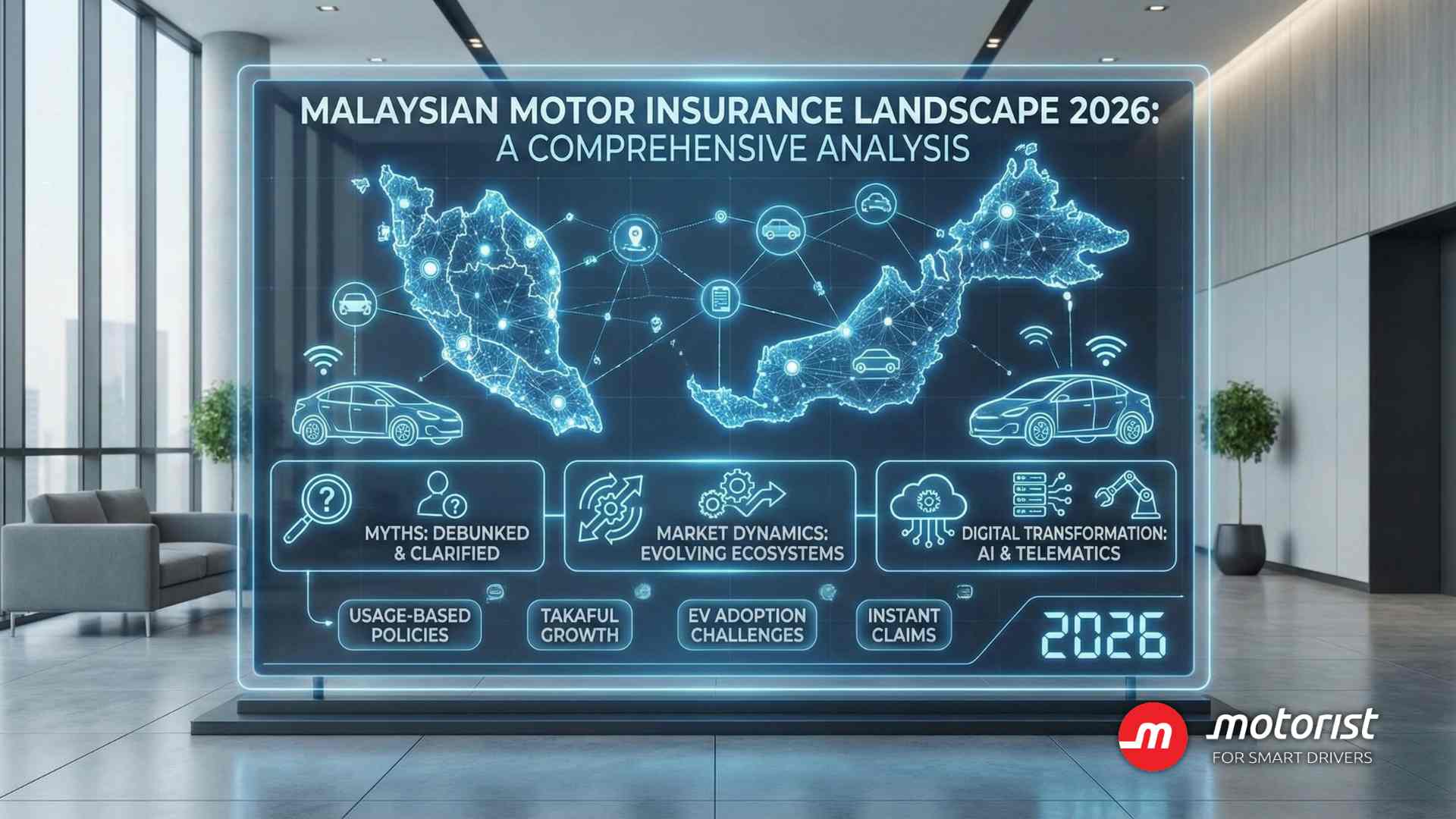
The Malaysian automotive insurance sector in 2026 represents a complex convergence of regulatory liberalization, technological disruption, and shifting macroeconomic factors.
As the nation moves deeper into the 13th Malaysia Plan (13MP) period, the traditional frameworks governing "insurance kereta" (car insurance) have been dismantled in favor of sophisticated risk-based pricing models.
This report provides an exhaustive examination of the state of car insurance Malaysia in 2026, driven by a dual purpose: to debunk persistent consumer myths that continue to result in financial inefficiency and to elucidate the critical role of integrated digital platforms, specifically Motorist Malaysia, in navigating this new reality.
The transition from a tariff-based regime—which dominated the industry for decades prior to 2016—to a fully liberalized market has fundamentally altered the cost structure for vehicle owners. By 2026, premiums are no longer static figures determined solely by engine capacity and sum insured; rather, they are dynamic values influenced by granular risk profiles, vehicle safety technology, and driver behavior.
Simultaneously, the expiration of the electric vehicle (EV) road tax holiday on December 31, 2025, has introduced a new fiscal paradigm for the growing population of EV owners, necessitating a recalibration of Total Cost of Ownership (TCO) calculations.
Furthermore, the operational aspect of vehicle management has migrated from physical counters to digital ecosystems. The rise of the "Super App," epitomized by Motorist Malaysia, has streamlined the renewal of road tax and insurance, offering value-added services such as real-time traffic safety alerts ("Co-Driver") and automated valuations that traditional agents cannot match.
This report synthesizes data from 115 distinct research sources to provide a definitive guide for consumers, industry stakeholders, and policymakers, ensuring a nuanced understanding of insurance kereta Malaysia in the current era.
The Macro-Economic and Regulatory Environment of 2026
To truly understand the "insurance kereta" market of 2026, one must first dissect the regulatory and economic substrate upon which it sits. The year 2026 is not merely another calendar year; it is the culmination of a decade-long liberalization strategy initiated by Bank Negara Malaysia (BNM) and the Ministry of Finance (MoF).
1.1 The Maturation of Detariffication (Phase 3)
The journey toward the 2026 market structure began in July 2016 with Phase 1 of the Liberalization of Motor and Fire Tariffs. Prior to this, Malaysia operated under a rigid tariff system where premiums were fixed by law. If two drivers owned the same model of car, they paid the same premium, regardless of the fact that one might be a reckless driver in a high-accident zone and the other a defensive driver in a rural area.
By 2026, the industry has settled into a mature "Phase 3" environment. The implications of this are profound:
Risk-Based Pricing Sovereignty: Insurers now have full autonomy to determine premiums based on their internal risk models. This has led to a significant divergence in pricing. A high-risk driver (e.g., young age, high-theft vehicle model, urban location) may see premiums 20-30% higher than in the tariff era, while low-risk drivers benefit from reduced rates.
-
Differentiation Factors: Insurers now utilize a broader spectrum of rating factors. Beyond the traditional cubic capacity (cc) and sum insured, algorithms now weigh:
Geographical Location: Granular risk assessment down to the postcode level, accounting for flood frequency and theft rates.
Driver Demographics: Age, gender, and occupation are heavily weighted.
Vehicle Safety Tech: The presence of Autonomous Emergency Braking (AEB), blind-spot monitoring, and dashcams can yield discounts.
Market Competition: The liberalization has spurred intense competition. Insurers like Allianz, Etiqa, and AIG are no longer competing on a fixed price but on product differentiation—offering free towing, faster claims processing, or unique add-ons to justify premium variances.
1.2 Fiscal Pressures: The Service Tax (SST) Impact
A critical economic factor influencing car insurance Malaysia in 2026 is the Service Tax (SST). The government increased the SST rate from 6% to 8% effective March 1, 2024. By 2026, the cumulative effect of this hike is deeply felt in the Total Cost of Ownership.
Direct Premium Inflation: The 8% tax is applied directly to the base premium. For a comprehensive policy costing RM2,000, the SST burden has risen from RM120 (at 6%) to RM160 (at 8%). While seemingly small per transaction, across the millions of vehicles in Malaysia, this represents a significant increase in the cost of mobility.
Claims Cost Inflation: The SST hike also affects the repair ecosystem. Workshops pay 8% SST on parts, labor, and overheads. These costs are passed on to insurers through higher repair bills, which are subsequently cycled back to consumers in the form of higher base premiums.This creates a cycle of "claims inflation" that keeps premiums buoyant despite competitive pressures.
1.3 The 2026 Economic Outlook
The Ministry of Finance's Economic Outlook 2026 projects a resilient economy with GDP growth between 4.0% and 4.8%. However, this growth is accompanied by the rationalization of subsidies, particularly for fuel. As the Budi95 program and other targeted subsidy mechanisms take hold, the disposable income of the average Malaysian driver is under pressure.
This economic tightening makes the choice of insurance kereta more critical than ever. Drivers can no longer afford to passively renew their policies with the first agent who calls. They require tools to compare coverage effectively, balancing the need for comprehensive protection (especially against floods) with the necessity of budget management. This economic backdrop sets the stage for the rise of aggregator platforms like Motorist Malaysia, which empower consumers to find the "sweet spot" between cost and coverage.
Debunking Persistent Car Insurance Myths in 2026
Despite the modernization of the industry, myths regarding car insurance Malaysia persist. These misconceptions often lead vehicle owners to make suboptimal financial decisions. In 2026, it is imperative to separate folklore from financial fact.
Myth #1: "Red Cars Cost More to Insure"
The Myth: There is a widespread belief that vehicles painted red attract higher insurance premiums. The logic suggests that red cars are associated with speed and aggression, or that they are more visible to police, leading to higher accident rates and thus higher risk.
The Reality: In 2026, this remains a complete fabrication. The color of a vehicle is not a rating factor in the actuarial algorithms of Malaysian insurers.
The Mechanism: When generating a quote, insurers request the Make, Model, Year, Engine Capacity, and Chassis Number. They do not ask for the color code.
The Nuance: The only scenario where color impacts cost is in repairs for custom paint jobs. If a car has a specialized, non-factory "Matte Red" or "Pearlescent Red" finish that costs thousands to replicate, the repair bill will be higher. Unless this modification is declared, the insurer will only pay for a standard respray. However, the premium itself is color-blind.
Myth #2: "My NCD Can Be Shared with My Family"
The Myth: A father with a 55% No-Claim Discount (NCD) believes he can "lend" or apply this discount to his daughter's new car or his wife's vehicle to reduce their premiums.
The Reality: NCD is strictly personal and non-transferable to other individuals. It is tied to the unique NRIC of the policyholder and the specific vehicle class.
Implication: If a household buys a second car, it must start at 0% NCD, regardless of the primary earner's driving record.
Strategic Transfer: An individual can transfer their own NCD from an old car to a new car registered in their own name. In 2026, a common strategy is to transfer the 55% NCD to a newly purchased expensive vehicle (maximizing the Ringgit value of the discount) and letting the older, cheaper car revert to 0% NCD.
Myth #3: "Old Cars Are Dirt Cheap to Insure"
The Myth: Since a 15-year-old Proton Wira has a low market value, the insurance premium should be negligible.
The Reality: While the Sum Insured is low, older cars often attract loading charges (surcharges) that keep premiums high.
Risk Loading: Insurers view older vehicles as higher risks due to mechanical degradation (brake failure risk) and the lack of modern safety features (ABS, ESC, ADAS).
Minimum Premiums: There is a floor price for insurance to cover administrative costs and Third-Party Liability, which does not decrease with the car's value. A crash caused by an old car can still cause millions in damage to a third party.
Spare Parts Volatility: For imported older cars, parts may be scarce, driving up repair costs and thus premiums.
Myth #4: "Comprehensive Insurance Covers Everything" (The Special Perils Trap)
The Myth: Purchasing a "Comprehensive" policy provides a "shield of invincibility" against all forms of damage, including floods and falling trees.
The Reality: A standard Comprehensive policy covers: (1) Third-Party Liability, (2) Fire, (3) Theft, and (4) Accident damage to the own vehicle. It excludes "Acts of God" or Special Perils unless specifically added.
The 2026 Context: With climate change exacerbating monsoon intensity in Malaysia, flood damage has become a primary financial risk. A car submerged in floodwater often suffers total engine and electrical failure (ECU damage), costing tens of thousands to repair. Without the Special Perils add-on, the insurer pays nothing.
Myth #5: "Online Renewal is Always Cheaper"
The Myth: Cutting out the agent always results in the absolute lowest price.
The Reality: While buying direct often yields a 10% rebate, it is not guaranteed to be the best value.
Comparison is Vital: Insurer A (Direct) might charge RM1,500. Insurer B (via an app like Motorist) might charge RM1,300 for the same coverage due to a different risk appetite for that car model. Even with the rebate, Insurer A is more expensive.
Service Gap: A "cheap" direct policy puts the administrative burden of claims entirely on the user. Platforms like Motorist offer concierge support which, in the event of a confusing claim, offers value far exceeding a small premium difference.
Myth #6: "Small Claims Don't Affect Me"
The Myth: "I pay for insurance, so I should claim for this minor scratch."
The Reality: Any Own Damage claim (unless specified as non-NCD affecting) resets the NCD to 0%.
The Math: Losing a 55% discount on a RM2,000 premium means paying an extra RM1,100 per year for several years as the NCD slowly climbs back up. A claim for RM400 worth of damage is financially disastrous in the long run.
The Electric Vehicle (EV) Paradigm 2026
The year 2026 marks a watershed moment for Electric Vehicles in Malaysia. The landscape has shifted from early adoption incentives to a structured, matured market environment. The expiration of the road tax exemption on December 31, 2025, has introduced new cost dynamics.
2.1 The Post-2025 Road Tax Structure
For years, EV owners enjoyed a tax holiday. From January 1, 2026, road tax for EVs is reinstated, but with a new structure based on motor power output (kilowatts - kW) rather than engine displacement (cc).
The Myth: "EV Road Tax will be exorbitantly expensive in 2026."
-
The Reality: The Ministry of Transport (MoT) and JPJ have implemented a block-based tiered system.
Low to Mid-Range EVs: Vehicles with lower kW output (e.g., BYD Dolphin, Ora Good Cat) fall into lower tiers, often comparable to or cheaper than their ICE counterparts (e.g., 1.5L Myvi or City).
High-Performance EVs: High-output vehicles (e.g., Tesla Model 3 Performance, Porsche Taycan) attract higher taxes, similar to how large-capacity ICE engines (3.0L+) are taxed. The system is designed to be progressive.
Comparison: A 228kW EV might pay around RM300-RM400 annually, which is competitive against a 2.0L ICE vehicle.
2.2 Insuring the Electric Fleet
Insurance kereta for EVs in 2026 presents unique challenges.
Premium Loading: EV premiums are generally higher than comparable ICE vehicles. A Tesla Model 3 (value ~RM180k) may have a premium of RM5,000–RM6,000, whereas a BMW 3 Series of similar value might be RM4,000.
-
Why the Disparity?
Battery Risk: The high-voltage battery represents 40-50% of the vehicle's cost. Even minor accidents that dent the battery casing can lead to a "Total Loss" declaration due to safety protocols, forcing the insurer to pay out the full sum insured.
Repair Ecosystem: There is still a shortage of specialized EV workshops and certified technicians. Authorized centers charge premium labor rates.
Parts Supply: Supply chains for EV body panels and sensors can be slower, leading to extended "Loss of Use" claims.
2.3 Total Cost of Ownership (TCO) Analysis 2026
| Cost Component |
ICE Vehicle (e.g., Honda Civic) |
EV (e.g., BYD Atto 3) |
| Fuel / Energy |
High (Targeted subsidies reduce RON95 availability) |
Low (Stable electricity tariffs) |
| Maintenance |
Moderate (Oil, filters, transmission fluid) |
Low (Tires, wipers, cabin air filter) |
| Road Tax (2026) |
Standard (cc based) |
New kW Tiers (Competitive) |
| Insurance |
Standard Market Rate |
Higher (20-30% Loading) |
| Depreciation |
Stable / Predictable |
Variable (Battery health dependent) |
Insight: In 2026, the savings on fuel and maintenance often offset the higher insurance costs, provided the owner avoids major battery damage.
2.4 EV-Specific Insurance Add-Ons
Insurers have responded to the EV boom with specialized coverage options. In 2026, EV owners should look for policies that cover:
Home Wallbox Chargers: Protection against fire or theft of the home charging unit.
Charging Cable Theft: Coverage for cables stolen while charging in public.
Mobile Charging Assistance: Roadside rescue that provides a power boost if the battery runs flat, rather than just towing.
Strategic Insurer Analysis
With dozens of insurers operating in Malaysia, choosing the right partner for insurance kereta is daunting. The Motorist Malaysia app simplifies this by aggregating quotes, but understanding the profiles of key players is essential.
3.1 Etiqa (Takaful & Insurance)
Profile: A market leader known for its digital-first approach.
-
Strengths:
Fast Claims: "E-Cleva" video-assisted claims allow for rapid approval (sometimes within minutes) for minor damage.
Cashback: Does not typically offer cashback, but offers instant 10% rebates for direct online renewal.
Product: Strong Takaful options for Shariah-compliant coverage.
Best For: Tech-savvy drivers who value speed and Takaful compliance.
3.2 Allianz Malaysia
Profile: The giant of general insurance, known for robustness.
-
Strengths:
Roadside Assistance: Their "Allianz Road Rangers" fleet is widely regarded as the industry benchmark, offering nationwide coverage and reliable towing.
Flood Cover: Offers flexible Special Perils options.
Best For: Drivers who travel long distances interstate and prioritize reliable emergency assistance over the absolute lowest premium.
3.3 AIG Malaysia
Profile: A global insurer with a focus on premium protection.
-
Strengths:
High-End Valuation: Known for expertise in valuing and repairing luxury and imported vehicles.
Complex Claims: Handles complex liability claims well.
Best For: Owners of Continental cars (BMW, Mercedes) or high-value imports who need assurance that repairs will meet OEM standards.
3.4 Takaful Malaysia
Profile: A strong challenger in the Islamic insurance space.
-
Strengths:
Cashback: Famous for its 15% No Claim Cashback (if no claims are made during the period), which effectively lowers the net cost of insurance.
Best For: Safe drivers who want to be financially rewarded for not making claims.
3.5 Liberty General Insurance (AmGeneral)
Profile: Following the merger with AmGeneral, Liberty is a massive entity in the motor space.
-
Strengths:
Network: An enormous network of panel workshops nationwide.
Campaigns: Frequent renewal campaigns offering prizes like motorcycles or e-wallet credits.
Best For: Mass-market vehicle owners looking for accessibility and promotional value.
Coverage Mechanics and Critical Add-Ons
6.1 The Hierarchy of Coverage
-
Third-Party Only:
Coverage: Pays for damage you cause to others (cars, property, bodily injury).
Own Car: Zero coverage. If your car is stolen or crashes, you pay 100%.
Use Case: Very old cars (15+ years) or motorcycles where the premium for comprehensive would exceed the vehicle's value.
-
Third-Party, Fire, and Theft (TPFT):
Coverage: Adds protection if your car is stolen or burns down.
Use Case: Cars that are old but still have theft risk (e.g., older Toyota Hilux or Honda Civic).
-
Comprehensive (First Party):
Coverage: Covers your own car's repair costs after an accident.
Use Case: All cars under financing (mandatory) and any vehicle where the owner cannot afford to replace it out-of-pocket.
6.2 The "Must-Have" Add-Ons for 2026
In the 2026 climate, a base Comprehensive policy is often insufficient.
-
Special Perils (Flood Coverage):
Context: Malaysia's "100-year floods" now happen annually.
Cost: Typically 0.2% to 0.5% of the Sum Insured (e.g., RM100 for RM50,000 coverage).
Verdict: Mandatory. The financial risk of a total loss due to flood is too high to ignore. 20% of the sum insured is a budget option, but 100% is recommended.
-
Windscreen Coverage:
Context: A cracked windscreen usually costs RM1,000–RM3,000 to replace (especially with ADAS sensors).
Mechanism: Allows replacement without resetting your NCD.
Cost: 15% of the windscreen value.
Verdict: Highly Recommended for modern cars with sensors.
-
Betterment Waiver:
Context: When an old car (5-15 years) is repaired with new parts, insurers charge the owner a percentage of the part cost ("betterment") because the car is "better" than before.
Mechanism: This add-on waives that fee, ensuring 100% coverage.
Verdict: Essential for cars aged 5 to 10 years.
-
e-Hailing Endorsement:
Context: Standard private policies exclude commercial use.
Verdict: Mandatory for anyone driving for Grab, AirAsia Ride, or Lalamove. Driving without this voids the entire policy.
Claims, Fraud, and Incident Management
The true test of insurance kereta is the claims experience. 2026 sees a mix of high-tech processing and persistent low-tech fraud.
7.1 Combating the "Staged Accident"
Insurance fraud, particularly staged accidents (e.g., "brake checking" to force a rear-end collision), remains a threat.
The Scam: A fraudster slams brakes unexpectedly. You hit them. They demand cash or force you to a specific (shady) workshop.
-
The Defense:
Dashcam: Irrefutable evidence.
Motorist Co-Driver: Alerts you to high-risk zones.
Protocol: Never settle cash on the spot. Report to the police within 24 hours. Contact your insurer or the Motorist Concierge immediately.
7.2 The Claims Workflow
Notification: Use the insurer's app or Motorist Concierge to notify of the accident.
Towing: Only use the insurer's authorized tow truck (Panels). Using a random "long kai" tow truck can lead to your car being held hostage.
Assessment: For minor damage, AI photo assessment via smartphone can approve repairs in hours.
Repair: Must be done at a Panel Workshop to guarantee the quality and warranty of the repair.
Frequently Asked Questions (FAQ)
1. Can I drive my car in Singapore or Thailand with my Malaysian insurance?
Singapore: Yes, your Malaysian policy covers Third-Party Bodily Injury in Singapore. However, you must ensure your policy meets Singapore's minimum liability requirements. You often need to print your insurance certificate or Log Card.
Thailand: No. Your Malaysian comprehensive policy usually only covers you up to the border (or a very short distance inside, if specified). You must buy Thai Voluntary Motor Insurance and the compulsory Por Ror Bor insurance at the border. Driving without it is illegal and financially dangerous.
2. What is the "market value" vs. "agreed value" dilemma?
Market Value: The insurer decides what your car is worth at the time of the crash (often lower than you think).
Agreed Value: You and the insurer agree on a fixed value (e.g., RM40,000) at the start of the year. If the car is totaled, you get exactly RM40,000.
Advice: Always choose Agreed Value to avoid disputes
3. I am a student/young driver (under 21). Why is my insurance so expensive?
- Insurers statistically view drivers under 21 or with provisional licenses (P-plate) as high risk due to lack of experience. You will face "loading" (higher premiums) and potentially a higher Compulsory Excess (the amount you pay first before the insurer pays).
4. Does my credit score (CTOS/CCRIS) affect my car insurance premium?
Myth: "Bad credit means high premiums."
Reality: Unlike in the USA, Malaysian insurers generally do not use credit scores to determine motor insurance premiums. Premiums are based on driving risk, not financial credit risk.
5. Can I claim for a tree falling on my car?
Only if you have the Special Perils (Convulsions of Nature) add-on. A standard Comprehensive policy considers this an "Act of God" and may exclude it unless specifically covered.
6.How does the Motorist App help me save money?
(1) By comparing quotes to find the best rate. (2) By using Co-Driver to avoid traffic fines. (3) By earning mPoints for rewards. (4) By preventing NCD loss through safety alerts.
Conclusions
The landscape of car insurance Malaysia in 2026 is one of choice and complexity. The days of standard tariffs are gone, replaced by a dynamic market where premiums reflect individual choices, vehicle technology, and risk profiles. The reinstatement of EV road tax and the specific challenges of insuring electric vehicles add further layers to the decision-making process.
In this environment, information is the most valuable asset. Debunking myths—such as the red car fallacy or the transferability of NCD—saves consumers real money. Understanding the necessity of Special Perils coverage protects against catastrophic loss.
Ultimately, the shift towards digital platforms like Motorist Malaysia represents the future of vehicle ownership. By consolidating insurance comparison, road tax renewal, safety alerts, and vehicle management into a single "Super App," Motorist empowers Malaysian drivers to navigate the roads of 2026 with confidence, compliance, and cost-efficiency. The smart driver in 2026 is not just insured; they are digitally integrated, proactively protected, and strategically covered.
Read More: Yes, you can sell your car even If It has an existing loan! here’s how to do It
I want to find the highest selling price for my car within 24 hours!
Download the Motorist App now. Designed by drivers for drivers, this all-in-one app lets you receive the latest traffic updates, gives you access to live traffic cameras, and helps you manage vehicle related matters.