EV road tax 2026: how much will you pay now that the exemption has ended?
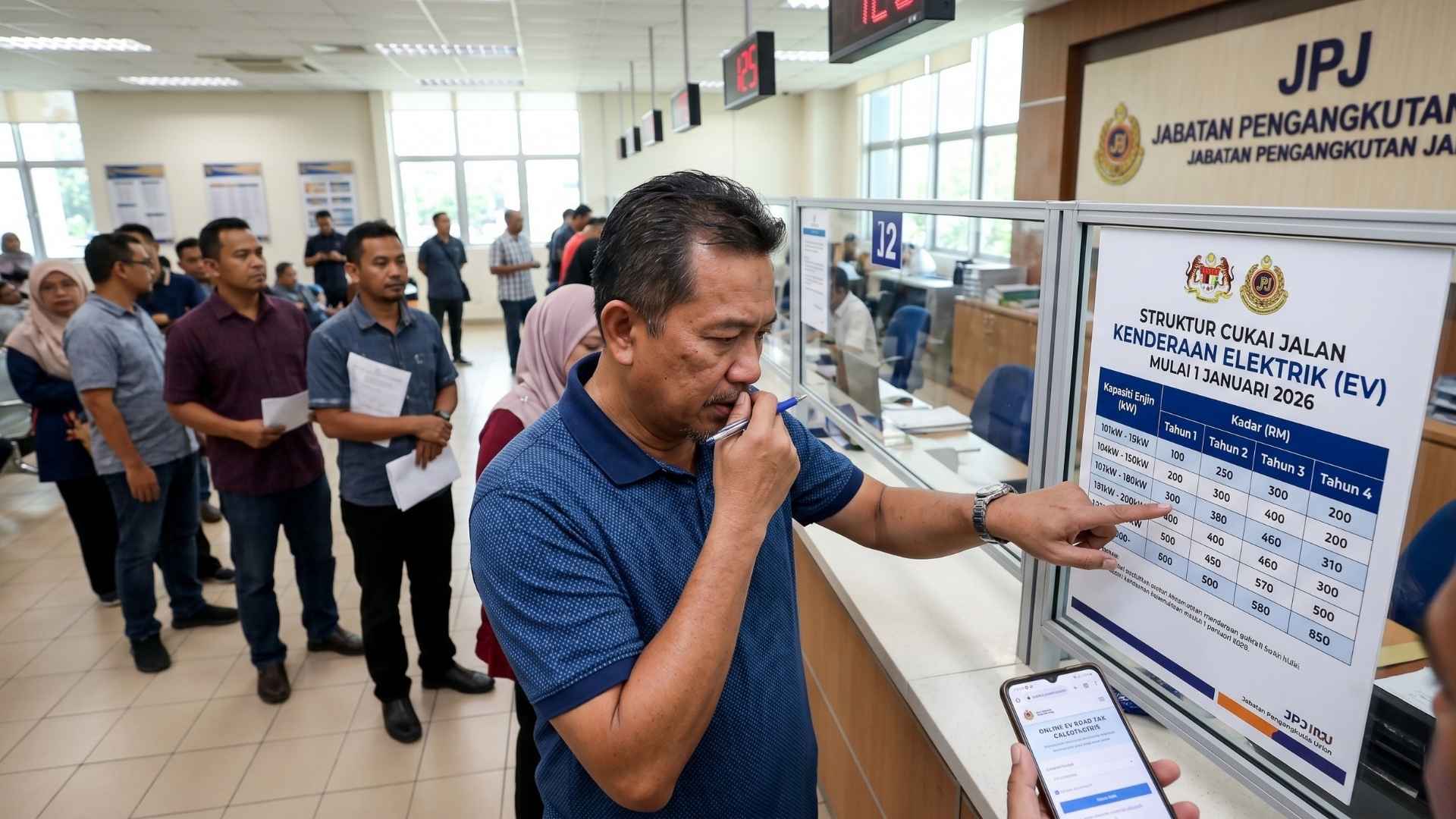
If you bought an EV in Malaysia in the last few years, you have been enjoying something most car owners never get: zero road tax. That benefit officially ended on 31 December 2025. From 1 January 2026, every battery electric vehicle (BEV) and fuel cell electric vehicle (FCEV) in Malaysia now pays road tax under a brand new system introduced by JPJ.
The good news? It is still very affordable. Most mainstream EVs pay between RM40 and RM280 per year, which is up to 85% cheaper than what an equivalent petrol car would cost in road tax. This guide explains exactly how the new system works, how much your specific car will cost, and how to renew your EV road tax digitally without visiting a counter.
Why Did the Exemption End?
The free road tax period was introduced in 2022 as a government incentive to push EV adoption during the early years of the market. It worked. EV registrations tripled between 2022 and 2025, with over 50,000 EVs on Malaysian roads by the end of last year.
With the market now maturing, Transport Minister Anthony Loke confirmed in 2024 that the exemption would end on schedule and be replaced with a permanent, affordable kW-based structure. The goal was to make EV road tax fairer and more logical, without creating a shock that would discourage buyers from going electric.
The result is a tiered system that keeps everyday EVs very cheap while ensuring high-performance luxury models contribute more proportionately.
How the New System Works: kW, Not CC
The most important thing to understand about the 2026 EV road tax is this: it is calculated based on your motor's power output in kilowatts (kW), not engine capacity in CC like a petrol car.
This matters because two cars with similar prices can have very different road tax if one has a more powerful motor. A BYD Dolphin with 70 kW pays far less than a Tesla Model Y Performance with 393 kW, even though both are electric.
JPJ uses a Base + Incremental formula. Your EV is placed into one of 11 power bands. You pay a base rate for that band, then a small additional fee for every 10 kW block above the band's minimum. This way, the tax rises smoothly rather than jumping dramatically the moment your car crosses into a higher band.
One important thing: do not confuse kW (motor power output) with kWh (battery capacity). The kWh figure is what you see in most marketing brochures and tells you how much energy the battery stores. The kW figure is what JPJ uses for road tax, and it tells you how powerful the motor is. Always check your Vehicle Ownership Certificate (VOC or Geran) for the official "Keupayaan Enjin" figure in kW to get the right number.
The 2026 EV Road Tax Bands (Peninsular Malaysia)
| Band 1 | Up to 50 kW | RM 20 |
| Band 2 | 50.001 kW to 100 kW | RM 20 to RM 70 |
| Band 3 (Group B) | 100.001 kW to 210 kW | RM 80 to RM 280 |
| Band 4 (Group C) | 210.001 kW to 310 kW | RM 305 to RM 575 |
| Band 5 (Group D) | 310.001 kW to 410 kW | RM 615 to RM 1,065 |
| Band 6 and above | Above 410 kW | RM 1,240 and above |
For Sabah and Sarawak, rates are generally lower than Peninsular Malaysia. Check your exact figure via the MyJPJ app when renewing.
How Much Will Your EV Actually Pay?
Here are the 2026 road tax estimates for the most popular EV models on Malaysian roads today.
| Proton e.MAS 5 Prime | 58 kW | Around RM 40/year | 1.0L Myvi: RM 20/year |
| Proton e.MAS 5 Premium | 85 kW | Around RM 70/year | 1.5L Myvi: RM 90/year |
| BYD Dolphin Dynamic | 70 kW | RM 40/year | 1.0L Axia: RM 20/year |
| BYD Atto 3 (150 kW) | 150 kW | RM 160/year | 2.0L CR-V: RM 380/year |
| BYD Seal 6 Premium | 160 kW | RM 180/year | 2.0L Camry: RM 800/year |
| Proton e.MAS 7 | 200 kW | RM 260/year | 2.5L Accord: RM 900/year |
| Tesla Model 3 (SR RWD) | 208 kW | RM 280/year | 2.0L Camry: RM 800/year |
| Tesla Model Y (RWD) | 220 kW | RM 305/year | 2.5L Accord: RM 900/year |
| Tesla Model Y (AWD) | 258 kW | RM 425/year | 3.0L SUV: RM 1,200/year |
| BMW iX xDrive40 | 240 kW | RM 365/year | 3.0L BMW 5 Series: RM 1,500/year |
| Tesla Model Y Performance | 393 kW | RM 1,015/year | 4.0L equivalent: RM 3,000/year |
| Rolls-Royce Spectre | 430 kW | RM 1,240/year | 6.75L Petrol RR: RM 19,005/year |
Looking at these numbers, the new structure is actually very fair to EV owners. A BYD Atto 3 driver saves over RM 220 per year on road tax alone compared to driving a petrol CR-V. Even the Tesla Model 3 pays RM 280 versus the RM 800 a Toyota Camry owner pays. And the Rolls-Royce Spectre saves its owner nearly RM 18,000 per year in road tax compared to the petrol equivalent.
Is EV Road Tax Cheaper Than Petrol in 2026?
For almost every mainstream model, yes. The government's target of making EV road tax 85% cheaper than the pre-2022 ICE equivalent structure has largely been met.
The only exception is at the very bottom of the market. An EV with under 50 kW pays RM 20 per year, the same as a 1.0L petrol car. At this specific point the advantage disappears, but that matters less in practice because most EVs sold in Malaysia today sit in the 70 kW to 220 kW range where the savings are significant.
For anyone comparing total annual running costs, EV road tax savings add up meaningfully over a 5-year ownership period.
AWD Models Pay More: Here Is Why
One thing that surprises some EV owners is how much more AWD models cost in road tax compared to their RWD equivalents. The reason is straightforward: AWD EVs have two electric motors, and JPJ calculates road tax based on the combined maximum power output of all motors.
A Tesla Model Y RWD has a single motor producing 220 kW and pays RM 305 per year. The Tesla Model Y AWD Long Range has two motors with a combined output of 258 kW and pays RM 425 per year. The Tesla Model Y Performance pushes this further with 393 kW combined and pays RM 1,015 per year.
This is worth factoring into your buying decision if you are torn between RWD and AWD variants of the same model.
What About PHEVs?
Plug-in hybrid vehicles (PHEVs) like the Volvo XC60 Recharge, BMW 330e, or Honda CR-V e:HEV are not covered by the new EV road tax structure. PHEVs are still taxed based on their internal combustion engine's CC, exactly like a regular petrol car. Only pure battery electric vehicles (BEVs) and fuel cell electric vehicles (FCEVs) use the new kW-based system.
When Do You Start Paying?
If your EV road tax was issued before 31 December 2025 and is still valid, you do not pay anything extra until that road tax expires. You only start paying the new 2026 rates when you come up for your first renewal in 2026. So if your road tax runs until March 2026, you pay the new rate in March when you renew.
There is no retroactive charge. You pay the new rates from your renewal date onwards.
OKU Exemption Still Applies
If you are a registered OKU (Orang Kurang Upaya) cardholder, you still enjoy a 100% road tax exemption on one EV registered in your name. This follows the same criteria as the existing OKU exemption for petrol vehicles and remains in place from 2026 onwards.
How to Find Your Exact kW Rating
Before you renew, check your exact motor output figure so you know which band you fall into.
The most accurate source is your Vehicle Ownership Certificate (VOC), also called the Geran. Look for the field labelled "Keupayaan Enjin" which will show your motor's power in kilowatts. Do not use the kWh battery capacity figure found in most marketing materials as these are two completely different measurements.
You can also check via the MyJPJ app under your vehicle's registered details, or ask your authorised dealer if you are unsure.
How to Renew Your EV Road Tax in 2026
Physical road tax stickers were abolished from February 2026. There is no sticker to display on your windscreen anymore. Road tax is fully digital via the MyJPJ app, which means renewal takes minutes from your phone.
The renewal process works in this order:
First, renew or confirm that your car insurance is active. JPJ requires a valid insurance cover note before road tax can be processed. This is where Motorist Malaysia makes the process easy. You can compare EV insurance quotes from multiple insurers in one place, choose the right plan, and purchase instantly. EV-specific policies in 2026 now cover battery damage from accidents, specialist workshop repairs, 24-hour roadside assistance, and cross-border coverage on select plans.
Once your insurance is confirmed, open the MyJPJ app, go to Motor Vehicle Licence, select your vehicle, confirm the road tax amount, and pay via FPX, credit card, or debit card. Your e-LKM digital road tax is issued instantly and stored in the app. No counter visit, no sticker, no queue.
With over 1.53 million motorists on the platform and a 4.9 out of 5 star rating, Motorist Malaysia handles your insurance renewal and links directly to the road tax process so you can do both in one sitting.
Compare EV insurance and renew your road tax on Motorist Malaysia
EV Road Tax vs Total Ownership Cost in 2026
To put the road tax in proper perspective, here is how it sits within the full annual running cost of a typical EV versus a petrol car.
| Road tax | Around RM 70 | Around RM 90 |
| Insurance (est.) | Around RM 1,100 | Around RM 900 |
| Fuel or charging (15,000 km) | Around RM 700 | Around RM 3,800 |
| Servicing | Around RM 500 | Around RM 1,200 |
| Total annual estimate | Around RM 2,370 | Around RM 5,990 |
Even with road tax now in the picture, the EV still saves roughly RM 3,600 per year in running costs compared to an equivalent petrol car. Over 5 years that is around RM 18,000 in your pocket, before accounting for any further changes in RON95 petrol prices.
Frequently Asked Questions
1. Is EV road tax still free in Malaysia in 2026?
No. The EV road tax exemption officially ended on 31 December 2025. From 1 January 2026, all BEVs and FCEVs pay road tax under the new kW-based structure.
2. How do I calculate my EV road tax for 2026?
Find your motor's power output in kW from your Vehicle Ownership Certificate (look for "Keupayaan Enjin"). Match it to the power band table above to find your annual rate. You can also use the MyJPJ app to see the exact amount when you start the renewal process.
3. Is EV road tax the same for private and company-registered vehicles?
Yes. Unlike petrol cars where company-registered vehicles sometimes pay different rates, EV road tax in 2026 is identical whether the car is registered to a private individual or a company.
4. Is there a difference between SUV and sedan EV road tax?
No. Another advantage of the new system is that EV road tax does not differentiate between saloon (sedan or hatchback) and non-saloon (SUV or MPV) categories. You pay based purely on kW output regardless of body style.
5. My EV has two motors. Which kW figure does JPJ use?
JPJ uses the combined total maximum power output of all motors. So if you have an AWD EV with a front motor of 150 kW and a rear motor of 150 kW, JPJ calculates road tax based on the combined 300 kW figure.
6. How do I renew EV road tax now that physical stickers are gone?
Renew via the MyJPJ app or through Motorist Malaysia. You need an active car insurance policy first. Once insurance is confirmed, your e-LKM digital road tax is processed and stored on the MyJPJ app instantly.
Road tax figures are based on the official 2026 JPJ LKM ZEV schedule and publicly available data current as of June 2026. Final payable amounts are determined by JPJ upon renewal. Verify your exact rate via the MyJPJ app or with your nearest JPJ office.
Read More: Why Toyota and Honda continue to rule Malaysia’s used car market
I want to find the highest selling price for my car within 24 hours!
Download the Motorist App now. Designed by drivers for drivers, this all-in-one app lets you receive the latest traffic updates, gives you access to live traffic cameras, and helps you manage vehicle related matters.