Hybrid vs electric vs petrol cars in Malaysia: Which one actually fits your life
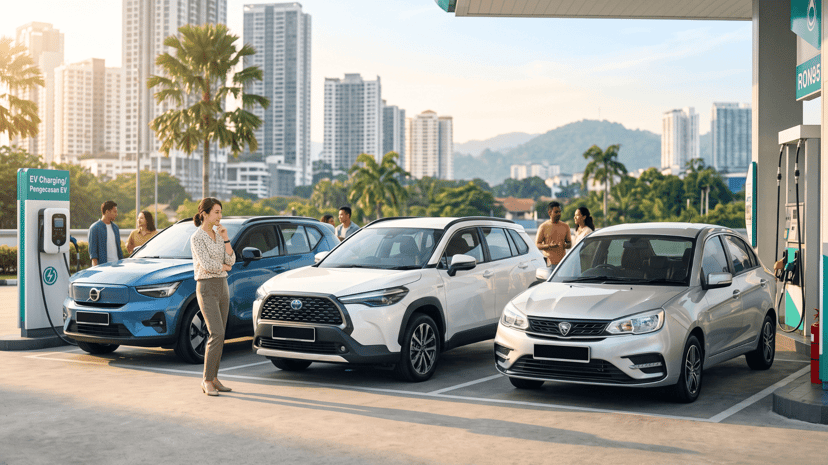
If you're shopping for a new car this year, you've probably noticed the decision isn't as simple as it used to be. It's no longer just about picking a sedan or an SUV in the colour you like. Now you're also weighing whether to go fully electric, dip a toe in with a hybrid, or just stick with the petrol engine you already understand. Each option comes with a different price tag, a different monthly commitment, and a different set of habits you'll need to build. Let's walk through this the way we would with a friend at the kopitiam, without the sales pitch.
Key Takeaways
Petrol cars remain the most straightforward choice for buyers prioritising lower upfront costs, familiar financing, and easy refuelling.
Hybrids offer a practical middle ground, reducing fuel consumption without requiring drivers to change their routine or rely on charging infrastructure.
EVs can deliver lower running and routine maintenance costs, especially for drivers who have convenient access to home charging.
Insurance and road tax can differ significantly by powertrain, so buyers should compare EV-specific coverage and confirm the latest road tax rules before purchasing.
The best choice ultimately depends on your lifestyle: EVs suit predictable commutes with charging access, hybrids work well for mixed or long-distance driving, while petrol cars remain practical for buyers seeking simplicity.
Upfront cost and financing: What you're really signing up for
Petrol cars remain the cheapest entry point in almost every segment. Hybrids sit a notch above their petrol equivalents because you're paying for both an engine and a battery-motor system, though the gap has narrowed as more brands bring hybrid variants of popular models to Malaysia. Fully electric vehicles range wildly, from surprisingly accessible compact EVs to premium models that cost as much as a small property down payment. Since these prices shift often as incentives and new models arrive, check the manufacturer's current on-the-road price and confirm with JPJ and the dealer whether any EV or hybrid incentive still applies to the specific model you want.
Financing is where things get interesting. Loan tenures and margins for EVs have generally become more competitive as banks compete for this growing segment, sometimes offering longer tenures or better rates to soften the higher purchase price. Hybrids usually get financed like any other passenger car, since banks see less residual value uncertainty with a familiar engine on board. Whatever you're considering, run the actual numbers rather than going by gut feel. A car loan calculator lets you see how the down payment, tenure, and interest rate combination changes your monthly instalment before you commit to a specific trim.
Running costs: Fuel, electricity, and the maintenance gap
This is usually where the EV and hybrid arguments start to look attractive. A petrol car's biggest recurring cost is fuel, and that bill fluctuates with pump prices and how heavy your foot is. A hybrid uses its electric motor to take the edge off fuel consumption, especially in stop-start city traffic, so monthly fuel spend usually drops meaningfully compared to an equivalent petrol model, even though you're never plugging it in.
A fully electric car swaps petrol for electricity, and depending on your charging habits and rates, cost per kilometre is typically lower still, particularly if you can charge overnight at home. Maintenance is the other quiet win for EVs. With no engine oil, spark plugs, or exhaust system to service, scheduled maintenance tends to be simpler and less frequent, though tyres and brakes still wear as normal and battery health becomes the long-term variable to watch. Hybrids sit in between, still carrying a combustion engine that needs regular servicing, plus a battery system that generally needs less attention than you'd expect but isn't entirely maintenance-free.
Insurance considerations: Not all powertrains are covered the same way
Here's something a lot of first-time EV or hybrid buyers overlook until renewal time: your insurance needs shift with your powertrain. A comprehensive policy is still the sensible baseline whichever car you choose, but the details underneath it differ. For electric vehicles, insurers increasingly offer or require specific add-ons covering the high-voltage battery pack, by far the most expensive component to replace and vulnerable in ways a petrol engine block isn't, such as flood damage. Charging cable and home wallbox cover is another EV-specific consideration some policies now include, worth asking about explicitly rather than assuming it's bundled in.
Hybrids generally sit closer to petrol cars in how insurers price and structure cover, since the battery involved is smaller and the combustion engine is still doing meaningful work, though it's still worth flagging the hybrid components to your insurer. Premiums can vary quite a bit between insurers for the same car, which is exactly why it pays to compare rather than auto-renew with whoever covered your last car. A quick way to see this side by side is to run your car details through Motorist's insurance comparison tool and see how quotes differ once you factor in the add-ons relevant to your powertrain.
Road Tax: A real point of difference, but check current rules
Road tax structure genuinely differs across the three categories, and this is an area where rules have been actively evolving in Malaysia, so treat anything you read, including this article, as a starting point rather than the final word. Petrol cars are taxed on engine displacement under the long-standing structure most Malaysian drivers already know. Hybrids typically get calculated on a similar engine-capacity basis, sometimes with a partial reduction reflecting the electric assistance, though the exact treatment depends on the specific hybrid technology and capacity band.
Electric vehicles have had a different, generally more favourable road tax structure to encourage adoption, but the exemptions and calculation methods for EVs have been under review and subject to change as the government recalibrates incentives. Don't finalise your budget around a road tax figure you saw in an old forum post. Confirm the current calculation directly with JPJ or through your dealer before you sign anything, especially if road tax savings are part of why you're leaning toward an EV.
Charging and fuelling convenience: The lifestyle question
This is genuinely the most personal part of the decision, because it has less to do with money and more to do with your daily routine. Petrol is frictionless in Malaysia. There's a station every few kilometres, refuelling takes minutes, and you never have to plan your day around it. That convenience is easy to take for granted until you're the one waiting for a charger.
EV charging convenience depends heavily on whether you can install a home wallbox charger, which works beautifully if you live in a landed property or a condo that allows installation, letting you wake up to a full battery every day without ever visiting a public charging station. If you live somewhere that makes home charging difficult, or you regularly drive long distances between towns, you'll need to be more deliberate about route planning and public charging network coverage, which has improved but still isn't as dense or as fast as a petrol pump. Hybrids neatly sidestep this entire conversation, since you never plug them in at all and simply refuel as you always have, just less often.
Matching the right powertrain to your life
There's no single correct answer here, only the one that fits how you actually live. If you're a city commuter with a predictable short daily route and access to home charging, an EV can genuinely transform your monthly running costs and daily convenience. If you frequently drive long distances between states or aren't confident about charger availability along your usual routes, a hybrid gives you meaningful fuel savings without any of the range anxiety, making it a comfortable middle ground. If you're a first-time buyer prioritising the lowest upfront cost, simplest financing, and the fewest unknowns to research before you buy, a well-chosen petrol car remains a perfectly sensible choice, especially while you're still figuring out your actual driving patterns.
FAQ
1. Is a hybrid car actually worth it in Malaysia compared to a petrol car?
For most drivers doing a reasonable amount of city or mixed driving, yes, a hybrid is usually worth the extra upfront cost through fuel savings over ownership, without requiring any change in daily habits like charging. The exact payback period depends on how much you drive and the current price gap between the hybrid and its petrol equivalent, so it's worth comparing specific models rather than assuming the answer applies universally.
2. Do electric cars really cost less to maintain than petrol cars in Malaysia?
Generally yes, since EVs have no engine oil, spark plugs, or exhaust components to service, which removes a large chunk of routine maintenance cost. Tyres, brakes, and eventually battery health still need attention, and specialised EV servicing can sometimes be pricier per visit, so factor in the frequency versus the cost per visit rather than assuming everything is automatically cheaper.
3. Is car insurance more expensive for an EV than for a petrol car in Malaysia?
It can be, mainly because EV-specific add-ons covering the high-voltage battery and home charging equipment add to the premium, and the vehicle's overall value often factors into the calculation too. It varies significantly between insurers, so comparing quotes for your specific EV model is the only reliable way to know rather than assuming a flat markup.
4. How is road tax calculated differently for EVs versus petrol and hybrid cars?
Petrol and hybrid road tax is generally based on engine capacity under the familiar displacement-based structure, while EVs have historically had a distinct, often more favourable calculation method to support adoption. These EV-specific rules have been subject to periodic government review, so always confirm the current structure with JPJ before finalising your budget.
5. Can I get a car loan for an EV as easily as for a petrol car in Malaysia?
Yes, EV financing is now widely available and banks have become increasingly competitive on EV loan terms as demand has grown. Rates, margins, and tenures still vary by bank and by your personal financial profile, so it's worth using a car loan calculator to compare a few scenarios before settling on a specific package.
Whichever way you lean, get the cover right before you drive off
At the end of the day, this decision comes down to your budget, your commute, and how much research you're willing to do before committing to a new way of running a car. There's genuinely no wrong answer among a well-chosen petrol car, a sensible hybrid, or a fully electric vehicle that suits your charging situation. What matters most once you've decided is making sure the rest of the paperwork actually matches your choice.
That's really the practical next step regardless of which powertrain wins you over: once you've settled on a car, or even while you're still comparing a shortlist, run it through Motorist Malaysia's insurance comparison tool to see how policies and their add-ons stack up for that specific vehicle, EV battery cover and all. And if financing is still an open question, the car loan calculator on our site can help you sanity-check the monthly numbers before you walk into the showroom, so the excitement of a new car doesn't come with any unpleasant surprises a few months down the road.
Read More: KL road closures & drone ban for National Day 2026
I want to find the highest selling price for my car within 24 hours!
Download the Motorist App now. Designed by drivers for drivers, this all-in-one app lets you receive the latest traffic updates, gives you access to live traffic cameras, and helps you manage vehicle related matters.