Worn tyres in Malaysia: Why rain makes them riskier
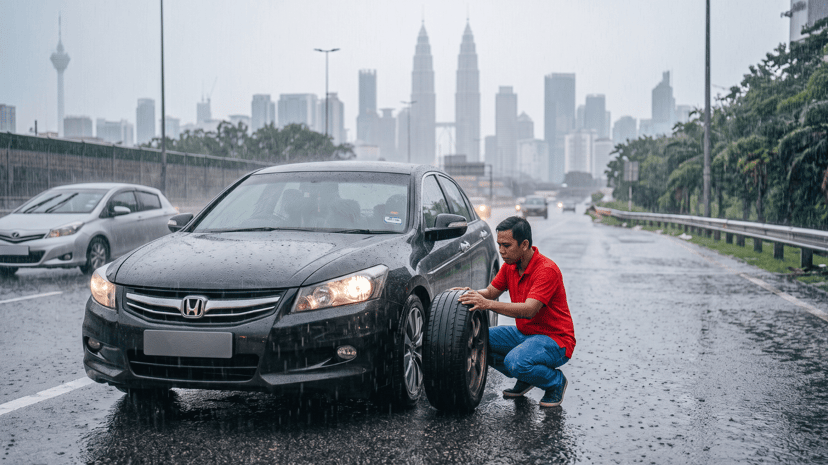
Worn tyres become more dangerous in Malaysia’s rainy conditions because shallower tread has less capacity to move water away from the tyre-road contact patch, which reduces wet-weather grip and raises the risk of aquaplaning; Malaysia’s passenger-car tyre standard uses 1.6 mm tread-wear indicators as a key replacement benchmark.
A tyre that feels normal on a dry road can behave very differently during a tropical downpour. Tread grooves help channel water away from beneath the tyre, allowing more of the tyre to remain in contact with the road.
As tread wears down, its ability to deal with water is reduced. Wet-road braking performance also progressively declines as tread becomes shallower, while aquaplaning risk increases.
Malaysia’s weather makes this especially relevant. The Northeast Monsoon generally occurs from November to March, while thunderstorms can occur throughout the year and are particularly frequent during the inter-monsoon periods.
Key Takeaways
Shallower tyre tread increases wet-weather risk because less tread depth is available to disperse water.
Malaysia’s passenger-car tyre standard uses tread-wear indicators at 1.6 mm as a minimum safety reference.
Do not treat 1.6 mm as a target for wet-weather performance. Grip and braking performance can deteriorate before the tyre reaches that point.
Malaysia’s main rainy season generally runs from November to March, but thunderstorms occur throughout the year.
Measure tyre tread instead of relying only on appearance, because tyres can wear unevenly.
Why does tyre tread matter more on wet roads?
Tread grooves help move water away
The tread is the part of the tyre that interacts directly with the road. Its grooves, blocks and channels are designed to support grip, handling and water evacuation.
When rainwater collects on the road, those grooves help create paths through which water can escape from underneath the tyre.
As the grooves become shallower through normal wear, their ability to manage water becomes less effective. That can make steering, braking and maintaining traction more difficult in wet conditions.
What is aquaplaning?
Aquaplaning happens when a layer or wedge of water forms between a tyre and the road surface, causing the tyre to lose sufficient contact with the road.
When this happens, steering response and traction can be significantly reduced. Standing water, vehicle speed, tyre condition and tread depth all influence the risk.
Aquaplaning does not occur only with completely bald tyres. Even tyres that still have visible tread can become less effective at water displacement as that tread becomes shallower.
What does the 1.6 mm tyre tread figure mean in Malaysia?
The most accurate way to describe 1.6 mm for Malaysian passenger cars is as an established minimum tyre-safety benchmark, rather than making a blanket claim that it is the statutory road-use limit for every private vehicle.
Malaysia’s current passenger-car tyre standard, MS 149:2018 AMD.1:2021, specifies tread-wear indicators with a height of at least 1.6 mm. These indicators allow a person inspecting the tyre to identify visually when the tread has worn down to approximately that depth.
For tyres with a rim diameter greater than 12 inches, the standard specifies at least six tread-wear indicators positioned approximately evenly around the tyre. Tyres for rims measuring 12 inches or less require at least three indicators.
Is 1.6 mm still good for driving in heavy rain?
Not necessarily. The 1.6 mm figure should not be interpreted as meaning wet-weather performance remains optimal until that exact point.
As tread depth decreases, wet braking performance progressively declines and aquaplaning risk rises. Drivers who frequently travel in heavy rain should therefore monitor tyre condition before reaching the minimum benchmark.
What changed on 1 June 2025?
A separate commercial-vehicle inspection change took effect from 1 June 2025.
Before the change, at least 75% of the inspected tyre surface had to comply with the minimum 1.6 mm tread-depth requirement. From 1 June 2025, applicable commercial vehicles undergoing periodic inspection must have at least 1.6 mm across the entire tyre surface that contacts the road.
This did not introduce 1.6 mm as a new figure. The 2025 change tightened the amount of the tyre surface that must satisfy the existing minimum during the applicable commercial-vehicle inspection.
For private-car owners, the practical takeaway remains simple: use the tyre’s tread-wear indicators and actual tread measurements to monitor wear rather than waiting until the tyre looks bald.
Why Malaysia’s weather makes worn tyres a bigger concern
Northeast monsoon: November to March
Malaysia’s Northeast Monsoon generally runs from November to March and is the country’s main rainy season.
It typically brings particularly heavy rainfall to the east coast of Peninsular Malaysia, western Sarawak and eastern Sabah.
Frequent heavy rain can leave roads wet for longer and increase the likelihood of standing water, making sufficient tyre tread increasingly important.
Thunderstorms occur throughout the year
Malaysia’s tyre-safety risks are not confined to the Northeast Monsoon. Thunderstorms are common throughout the year, with higher frequency during the inter-monsoon periods from approximately April to May and October to November. That means tyre condition should be checked throughout the year rather than only before November.
How to check whether your tyres are worn
1. Use a tread-depth gauge
Do not rely only on looking at the tyre. A tread-depth gauge provides a clearer measurement of how much usable tread remains. Insert the gauge into the tyre’s main grooves and take measurements at several points. Tyres can wear unevenly, so the lowest tread-depth measurement is more important than the deepest section you can find.
2. Check several parts of every tyre
Measure the tread across different sections rather than inspecting only the easiest outer edge to see. Check the inner, centre and outer areas where practical, and inspect all four road tyres. Uneven wear may indicate other issues requiring attention, such as incorrect wheel alignment.
3. Find the tread-wear indicators
Modern passenger-car tyres have raised tread-wear indicators inside the main grooves. When the surrounding tread becomes level with the indicator, the tyre has reached the depth represented by that indicator. Malaysia’s passenger-car tyre standard specifies these indicators at 1.6 mm.
Do not wait for the tyre to become completely smooth or visibly bald.
Old tyre-checking habits vs a better approach
| Check |
Old habit |
Better wet-weather approach |
|---|---|---|
| Tread depth | Look at the tyre and guess | Use a tread-depth gauge |
| Replacement reference | Wait until the tyre looks bald | Monitor the 1.6 mm tread-wear indicators |
| Measurement points | Check one convenient groove | Measure several locations |
| Tyres inspected | Check only the front or easiest tyre | Inspect all 4 road tyres |
| Uneven wear | Use the deepest reading | Pay attention to the lowest reading |
| Rain preparation | Check only before year-end monsoon | Inspect tyres throughout the year |
| Main rainy season | Assume rainfall is the same year-round | Northeast Monsoon: November–March |
| Inter-monsoon period | Ignore wet-weather risk | More frequent thunderstorms: April–May and October–November |
Other warning signs you should not ignore
Cracks, bulges and tyre damage
Tread depth is not the only sign that determines whether a tyre remains suitable for use.
While checking the tread, look for bulges, cuts, cracking or other visible damage to the tread and sidewall.
A tyre with reasonable tread depth may still require professional inspection or replacement if its structure is damaged.
Uneven tyre wear
One part of a tyre may wear significantly faster than another.
For example, incorrect alignment can cause uneven tread wear. This is why taking only one tread-depth measurement can give a misleading impression of the tyre’s overall condition.
Incorrect tyre pressure
Correct tyre inflation also plays an important role in tyre safety and wear.
There is no single PSI figure suitable for every car. Drivers should use the pressure specified for their particular vehicle rather than copying another vehicle’s tyre pressure. Tyre pressure should also be checked regularly rather than relying solely on a warning system.
Expert tip: When measuring tread, do not stop after finding one acceptable reading. Check several areas around each tyre and base your decision on the lowest tread depth you measure, because uneven wear may leave another section significantly more worn.
Common mistake: Do not deliberately drive a tyre down to exactly 1.6 mm because you assume everything above that number provides equally good wet-weather grip. The figure is a minimum safety benchmark; wet braking and aquaplaning resistance progressively worsen as tread wears.
How should you drive during heavy rain?
Reduce your speed
Slowing down is one of the most important precautions when roads are heavily wet. Lower speeds give the tyre more opportunity to deal with water beneath it and reduce the risk of losing road contact. Even tyres with good tread can aquaplane when conditions are severe enough, so tyre condition does not replace careful wet-weather driving.
Leave more space ahead
Heavy rain can make stopping more difficult and reduce visibility. Allow additional space between your car and the vehicle in front so you have more time to react without aggressive braking or steering.
What should you do during aquaplaning?
If the vehicle begins to aquaplane, ease off the accelerator and avoid sudden steering or braking movements while the tyres regain contact with the road. If immediate braking is required to avoid a collision, however, emergency action takes priority.
When should worn tyres be replaced?
At the latest, drivers should act when the tread reaches the tyre’s 1.6 mm tread-wear indicators. Replacement may be appropriate earlier if the tread is becoming low, wet-weather performance is a concern, or the tyre has bulges, damage or severe uneven wear.
The important point is not to wait until a tyre looks completely bald. Regular measurement gives you time to identify deteriorating tread before Malaysia’s next period of heavy rain.
Conclusion
Worn tyres become increasingly risky on Malaysia’s wet roads because shallower tread reduces water displacement and raises the chance of aquaplaning. Check tread regularly, use 1.6 mm as a minimum safety benchmark rather than a wet-weather performance target, and replace damaged or heavily worn tyres before they become a bigger safety problem.
FAQ
1. Why are worn tyres more dangerous in the rain?
Worn tyres have shallower tread grooves available to move water away from the tyre-road contact area, which can reduce wet-weather grip and increase aquaplaning risk.
2. What tyre tread depth should Malaysian drivers know?
Malaysia’s passenger-car tyre standard specifies tread-wear indicators at 1.6 mm, making this an important minimum tyre-safety benchmark for drivers.
3. Is 1.6 mm the legal tyre limit for every private car in Malaysia?
It is more accurate to describe 1.6 mm as an established minimum safety benchmark unless citing the specific road-use regulation applicable to the vehicle category. Malaysia’s passenger-car tyre standard requires tread-wear indicators at 1.6 mm.
4. What changed for tyre inspections on 1 June 2025
For applicable commercial vehicles, the inspection requirement changed from at least 75% of the tread area meeting the 1.6 mm minimum to the entire tyre surface contacting the road meeting at least 1.6 mm.
5. Did Malaysia introduce the 1.6 mm tyre figure in June 2025?
No. The 1 June 2025 change tightened how the existing 1.6 mm requirement was applied during applicable commercial-vehicle inspections; it did not introduce 1.6 mm for the first time.
6. Should I wait until my tyres reach 1.6 mm before replacing them?
Not necessarily. Wet braking performance and resistance to aquaplaning progressively deteriorate as tread becomes shallower, so replacement may be sensible before reaching the minimum benchmark.
7. What is aquaplaning?
Aquaplaning occurs when water builds up between a tyre and the road surface and the tyre loses sufficient road contact, reducing steering and traction.
8. Does driving faster increase aquaplaning risk?
Yes. Higher vehicle speed makes it harder for tyres to deal with water beneath them, especially when there is significant standing water on the road.
9. How should I check tyre tread?
Use a tread-depth gauge in the main grooves and take readings in several areas. Pay attention to the lowest measurement, because tyres can wear unevenly.
10. When is Malaysia’s main rainy season?
Malaysia’s Northeast Monsoon is generally from November to March and is considered the country’s main rainy season.
11. Can Malaysia have heavy rain outside the Northeast Monsoon?
Yes. Thunderstorms occur throughout the year and are especially frequent during the inter-monsoon periods around April–May and October–November.
12. What should I do if my car starts aquaplaning?
Ease off the accelerator and avoid abrupt steering or braking while waiting for the tyres to regain road contact. Emergency braking should still be used if necessary to prevent a collision.
Make everyday car ownership easier to manage with the Motorist App. Get useful vehicle reminders, real-time traffic updates and motoring tools in one convenient place download the Motorist Malaysia App today.
Read More: Road tax transfer when selling a car in Malaysia
I want to find the highest selling price for my car within 24 hours!
Download the Motorist App now. Designed by drivers for drivers, this all-in-one app lets you receive the latest traffic updates, gives you access to live traffic cameras, and helps you manage vehicle related matters.