Three-second rule: Safe following distance in Malaysia
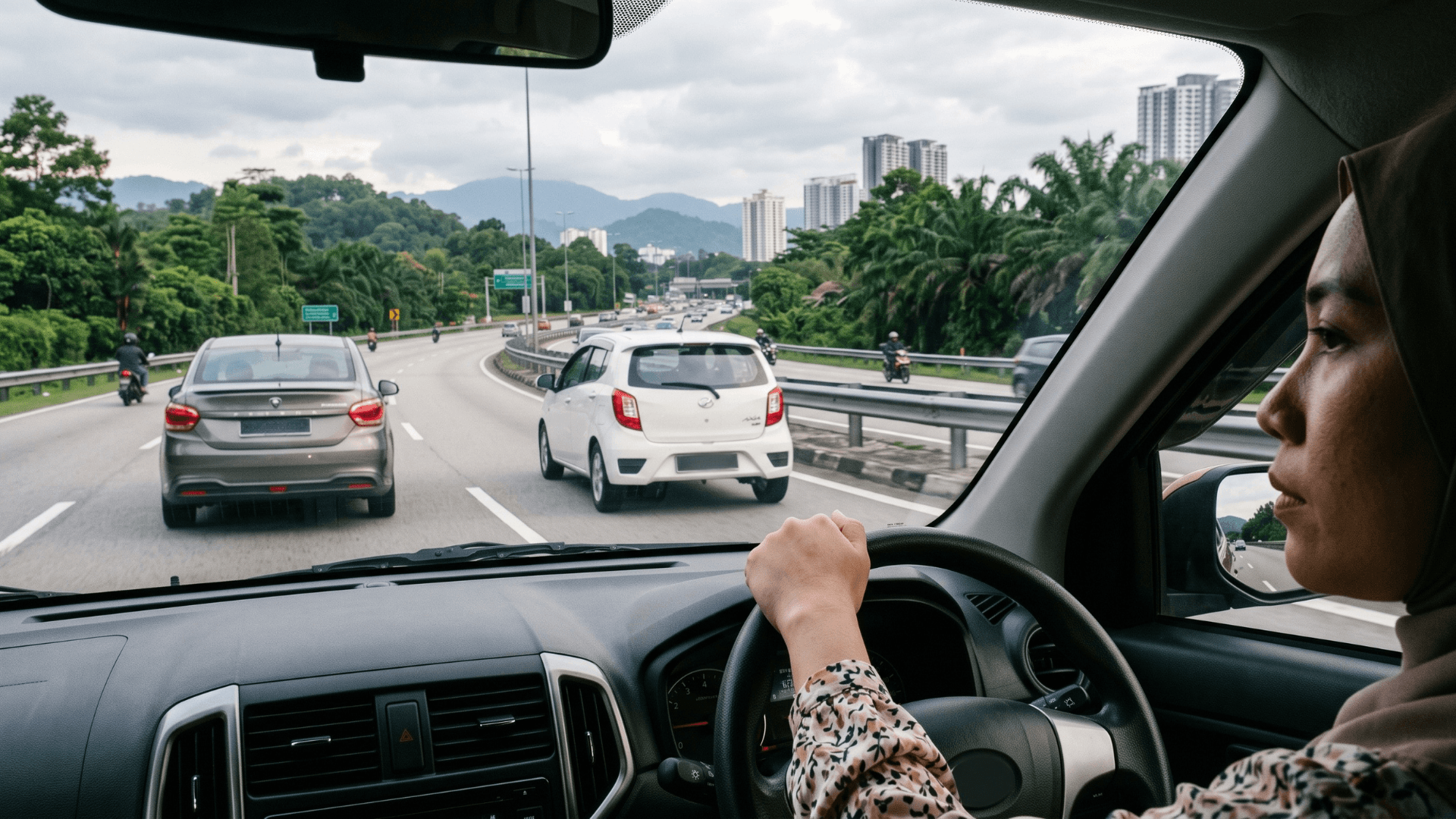
A car travelling at 110 km/h covers about 92 metres in three seconds nearly the length of a football field which is why the three-second rule is best treated as a starting point, not a fixed target, on Malaysian roads. Most drivers learn it once during driving lessons and never revisit it, but the safe gap changes with speed, weather, and what's ahead of you.
This guide shows the actual distance covered at common Malaysian speed limits, when to extend beyond the basic gap, and the one habit that quietly erodes most drivers' following distance without them noticing.
Key Takeaways
- Three seconds at 110 km/h equals roughly 92 metres tight once reaction time is factored in, so treat it as a floor rather than a comfortable margin.
- Reaction time alone can eat up a large share of that gap. A commonly used general estimate puts driver reaction time around 1.5 seconds at 110 km/h that's roughly 46 metres gone before braking even starts.
- Wet roads generally require a longer gap. As a widely used rule of thumb, doubling your normal following distance in rain is a reasonable precaution, though the exact increase depends on tyres, road surface, and speed.
- Seconds beat car lengths because a seconds-based gap automatically scales with your actual speed, while "two car lengths" doesn't.
- Closing the gap to block a lane-changer is a common habit that removes your own safety buffer the driver doing it has less time to react if the vehicle ahead brakes.
How the three-second rule actually works
The method is simple: pick a fixed point ahead a road sign, a bridge, a lamppost and start counting the moment the car in front passes it. If you reach that same point before finishing "one-thousand-and-one, one-thousand-and-two, one-thousand-and-three," you're following too closely. Because the count is timed, it automatically adjusts to whatever speed you're driving.
Why seconds beat car lengths. "Two car lengths" feels intuitive but breaks down as speed changes the same gap might be generous in a car park at 30 km/h and dangerously short at 90 km/h. A seconds-based gap accounts for speed by design, which is why it's the standard taught in most driving curricula.
How far is three seconds, really?
| Speed |
Distance covered in 3 seconds |
|---|---|
| 60 km/h | ~50 metres |
| 90 km/h | ~75 metres |
| 110 km/h | ~92 metres |
These are straightforward speed-times-time calculations worth sitting with, because a gap that feels fine at town speeds can be far too tight once you're on the expressway.
Why three seconds isn't always enough
Reaction time eats into your buffer before braking even starts. Using a commonly cited general estimate of around 1.5 seconds for driver reaction time, a car at 110 km/h covers roughly 46 metres just perceiving the hazard and moving to the brake pedal before the vehicle has slowed down at all. This is a general approximation used broadly in road-safety education, not a Malaysia-specific measured figure, but the underlying logic that reaction time consumes a meaningful chunk of your following gap at highway speed holds regardless of the exact number.
Wet weather generally increases stopping distance. Reduced tyre grip means more distance is needed to stop compared to dry conditions. As a widely used rule of thumb, doubling your normal gap in the rain is sensible, though the precise increase varies with tyre condition, road surface, and how hard you brake.
Heavy vehicles need more room, and block your view. Lorries and buses take longer to stop due to their mass, and following one closely also limits how far ahead you can see, delaying your own reaction to hazards you can't yet spot.
When to extend beyond the baseline gap
- Rain or wet roads: extend the gap doubling it is a reasonable rule of thumb
- Night driving or poor visibility: extend the gap for the same reason
- Following a lorry, bus, or towing vehicle: leave extra room for stopping distance and sightlines
- Heavy traffic: keep enough space to see at least one vehicle ahead of the car directly in front of you
Comparison: What drivers shouldn't do vs. what they should do
| Situation |
❌ What drivers shouldn't do |
✅ What drivers should do |
|---|---|---|
| Judging distance | Estimate using "two car lengths" regardless of speed | Count seconds using a fixed landmark, adjusted for speed |
| Rainy weather | Keep the same gap as dry conditions | Extend the gap doubling it is a sensible rule of thumb |
| Behind a lorry/bus | Tuck in close to save space in traffic | Drop back for stopping room and a clearer view ahead |
| Highway speed (110 km/h) | Treat 3 seconds (~92m) as generous | Treat 3 seconds as a floor, not a comfortable margin |
| Heavy congestion | Close the gap to block others from merging | Leave enough space to see one car ahead of the vehicle in front |
| Checking your own habit | Never re-test following distance after learning to drive | Re-check it periodically, especially after switching vehicles |
Expert tip
Re-run the landmark test every time you change vehicles. A heavier car, different tyre condition, or worn brake pads all change your real stopping distance even if your "felt" sense of following distance stays the same. Pick a quiet stretch of road and consciously count your gap for the first few drives in a new-to-you car; most drivers are surprised at how much closer they've drifted without realising it.
Common mistake to avoid
A common mistake is closing the gap to stop another driver from merging in front of you. This works against the driver doing it: it removes their own reaction buffer if the vehicle ahead brakes suddenly, and it narrows their view of the road, delaying reaction to hazards further up. Leaving a slightly larger gap rarely costs real time in traffic, but it reliably buys back the seconds needed to react safely.
Conclusion
The three-second rule is a useful starting point, but treat it as a floor rather than a comfortable margin at highway speed, in rain, or behind heavy vehicles, extending the gap further gives you the reaction time you actually need. The landmark-counting method takes seconds to apply and works at any speed, making it one of the simplest habits that meaningfully improves your safety margin.
FAQs
1. How do I count the three-second rule without a stopwatch?
Pick a fixed point ahead, like a sign or lamppost, and count "one-thousand-and-one, one-thousand-and-two, one-thousand-and-three" from the moment the car ahead passes it; if you reach that point before finishing the count, you're too close.
2. Is three seconds enough on the expressway?
At 110 km/h, three seconds is only about 92 metres once you factor in reaction time, it's a minimum rather than a comfortable buffer, so many drivers choose to extend it further at highway speed.
3. How much extra distance do I need in the rain?
There's no single fixed figure, but a widely used rule of thumb is to roughly double your normal dry-weather gap when the road is wet.
4. Why do car lengths not work as well as seconds?
Car lengths don't scale with speed a gap that looks fine at 30 km/h can be far too short at 90 km/h, whereas a seconds-based gap automatically adjusts because it accounts for how fast you're actually travelling.
5. Does following distance matter in stop-start traffic?
The exact timing matters less at low, variable speeds, but the principle still applies: keep enough space to see at least one vehicle ahead of the car directly in front of you.
6. What's the biggest sign I'm following too close?
If you can't see the tyres of the vehicle in front touching the road, or you're regularly braking hard because the car ahead has slowed, you're likely too close for your current speed.
7. Does following distance matter on motorcycles too?
As general road-safety guidance, motorcyclists are often advised to keep at least as much following distance as car drivers, since they can be harder for others to see and have less forward visibility of their own around larger vehicles.
8. Should I follow the same gap behind a lorry as behind a car?
No, lorries and buses take longer to stop and block more of your forward view, so a larger gap gives you both extra stopping room and a clearer line of sight to hazards ahead.
Just like the three-second rule gives you a buffer before you need to brake, having your paperwork sorted gives you a buffer before you need it during a roadside check, a claim, or a renewal deadline you nearly missed. The Motorist App helps you stay on top of road tax, insurance renewals, and traffic fines, all in one place. Download it today to keep your paperwork organised before you ever need it.
Read More: QR code summons scam Malaysia: Never scan this
I want to find the highest selling price for my car within 24 hours!
Download the Motorist App now. Designed by drivers for drivers, this all-in-one app lets you receive the latest traffic updates, gives you access to live traffic cameras, and helps you manage vehicle related matters.