How to jump-start a car safely: Step-by-step guide for Malaysian drivers
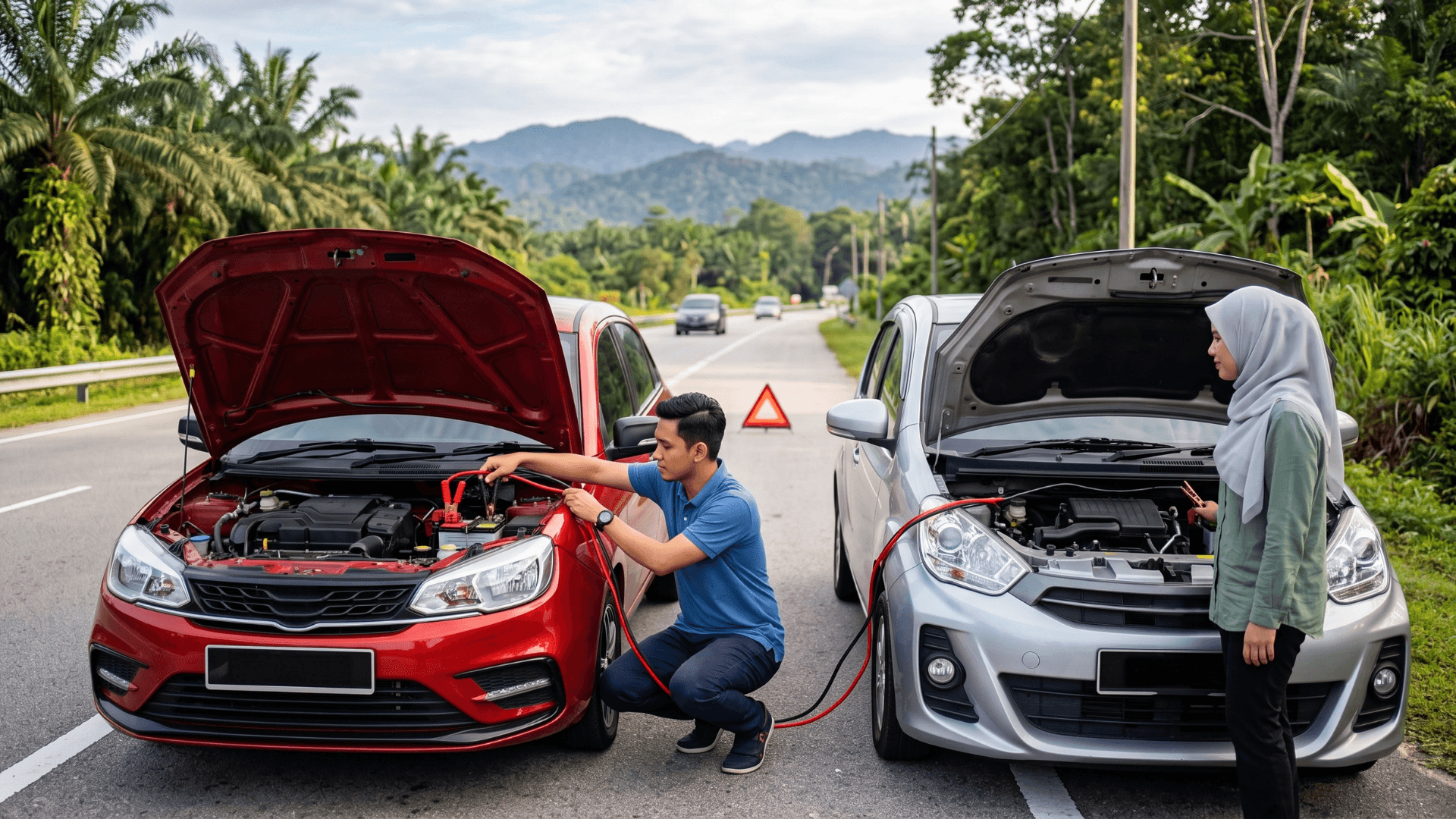
Your car won't start, the dashboard lights are dim, and you're already late a flat battery is one of the most common breakdowns Malaysian drivers face, especially given the country's hot, humid climate that shortens battery lifespan.
To jump-start a car safely, connect the red (positive) jumper cable to both batteries' positive terminals first, then the black (negative) cable to the working battery's negative terminal and a bare metal surface on the dead car never its negative terminal before starting the working car's engine and waiting a few minutes.
Get this sequence wrong and you risk sparks, battery damage, or even an explosion. Below is the full step-by-step process, plus what to do when jumper cables or a helpful stranger aren't available.
Key takeaways
- Correct cable order matters: Red-to-positive first, black-to-negative last, and always attach the final black clamp to bare metal, not the dead battery.
- Wait time is critical: Let the working car run for 2–5 minutes before attempting to start the dead one.
- Malaysia's heat accelerates battery wear: Car batteries in Malaysia typically last around 2–3 years, compared to roughly 4–5 years in temperate climates.
- Not everyone carries jumper cables: The Motorist App gives you quick access to roadside assistance, plus reminders for road tax and insurance renewal, in one place.
- A jump-start isn't a fix: If your battery keeps dying, it likely needs testing or replacement, not repeated jump-starts.
Step-by-step guide
Before you start: Safety checks
Park both cars close but not touching, ideally nose-to-nose or side-by-side, with enough cable slack to reach both batteries comfortably. Turn off both engines and all electrical accessories (aircon, radio, headlights) before touching any cables.
Inspect the dead battery for damage. If you see cracks, leaking fluid, or a rotten-egg smell, do not attempt a jump-start call for professional roadside help instead, as a damaged battery can be dangerous.
The 6-step jump-start sequence
- Identify the terminals. Positive is marked "+" (often red, sometimes with a cover); negative is marked "-" (usually black).
- Connect red clamp to dead battery's positive terminal.
- Connect the other red clamp to the working battery's positive terminal.
- Connect black clamp to the working battery's negative terminal.
- Connect the final black clamp to an unpainted metal surface on the dead car (like a bolt on the engine block), away from the battery and fuel lines. This grounds the circuit and reduces spark risk near battery gases.
- Start the working car, let it idle 2–5 minutes, then try starting the dead car. If it starts, let both cars run for 15–20 minutes before disconnecting cables in reverse order.
If the car still won't start
Don't keep cranking the engine. Repeated attempts can drain the working battery too or damage the starter motor. If the dead car doesn't start after two tries, the issue may be the alternator, starter, or a battery too far gone to accept a charge this calls for towing or a mobile mechanic.
Jump-start dos and don'ts
| ✅ Do |
❌ Don't |
|---|---|
| Check both batteries are 12V and compatible before connecting cables | Connect the final black clamp directly to the dead battery's negative terminal this is the most common cause of sparks near battery gas |
| Connect red-to-positive first on both cars, black-to-negative last | Attempt a jump-start if the battery is cracked, leaking, or smells of rotten eggs |
| Attach the final black clamp to bare, unpainted metal not the dead battery | Let the two cars touch each other during the process |
| Let the working car idle 2–5 minutes before attempting to start the dead one | Keep cranking the engine repeatedly if it fails to start after two tries this can damage the starter motor |
| Turn off all electrical accessories (aircon, radio, headlights) on both cars first | Drive off immediately after a successful jump run the engine 15–20 minutes first to let it recharge |
| Keep a roadside assistance option in mind as a backup if you don't have cables, a second car, or aren't confident doing it yourself | Assume a jump-start "fixes" the problem if it keeps recurring get the battery tested instead of repeating the process |
Expert tip
Test your battery's health every time you send your car for service, not just when it fails. A multimeter reading below roughly 12.4V at rest signals a battery that's getting low in Malaysia's heat, batteries degrade faster than the "it still starts fine" feeling suggests, so a proactive check beats an unexpected flat at the Jalan Tun Razak toll plaza.
Common mistake to avoid
Connecting the final black (negative) clamp directly to the dead battery's negative terminal. This is the single most common jump-start error it creates a spark right next to the battery, where hydrogen gas can accumulate, raising the risk of an explosion. Always ground the last clamp to bare metal elsewhere on the dead car's engine bay instead.
Conclusion
A safe jump-start comes down to one thing: cable order, with the last connection always going to bare metal, never the dead battery itself. When cables, a second car, or the confidence to do it yourself aren't available, the Motorist App gives you quick access to roadside assistance without needing to flag down a stranger.
FAQs
Q: Can I jump-start a car by myself without another car?
A: No a standard jump-start requires a second vehicle with a working battery, though a portable jump-starter power pack can work as a self-contained alternative.
Q: How long should I let the car run after a jump-start?
A: Drive or idle for at least 15–20 minutes afterward to let the alternator recharge the battery sufficiently.
Q: Why does my car battery keep dying in Malaysia?
A: Heat and humidity accelerate battery fluid evaporation and internal corrosion, which is why car batteries in Malaysia typically last around 2–3 years compared to roughly 4–5 years in cooler climates.
Q: Is it safe to jump-start a car in the rain?
A: It's best avoided if possible; if unavoidable, keep connections dry, avoid standing in water, and consider calling roadside assistance instead.
Q: What if my car still won't start after jump-starting?
A: The problem is likely the alternator, starter motor, or a battery too degraded to hold a charge this needs professional diagnosis rather than repeated jump-start attempts.
Q: Can jump-starting damage my car's electronics?
A: Incorrect cable connections or reversed polarity can damage the vehicle's electronic control units, which is why following the correct red-then-black sequence matters.
Q: How do I know if it's the battery or the alternator?
A: If the car starts after a jump but dies again shortly after, or the battery warning light stays on while driving, the alternator is the likely culprit, not the battery.
Stuck with a dead battery and no jumper cables in sight? Download the Motorist App for quick access to roadside assistance, plus reminders for road tax, insurance renewal, and traffic fines all in one place.
Read More: JPJ 'H' series plates hit record RM91.2M in 5 days
I want to find the highest selling price for my car within 24 hours!
Download the Motorist App now. Designed by drivers for drivers, this all-in-one app lets you receive the latest traffic updates, gives you access to live traffic cameras, and helps you manage vehicle related matters.