Can you hold a newborn in the front seat in Malaysia?
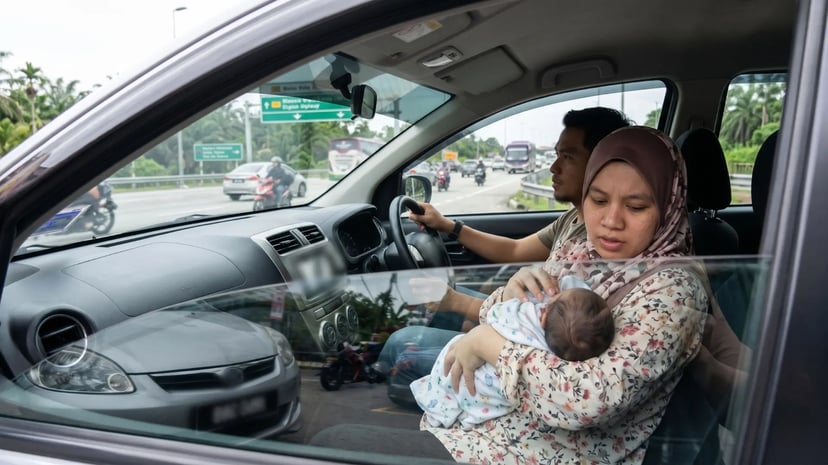
No, you should never hold a newborn baby in your arms while sitting in the front passenger seat of a moving car. Even on a short journey, sudden braking or a collision can cause serious injuries to your baby. In Malaysia, the safest way to transport a newborn is in a properly installed, rear-facing child restraint system (CRS) in the back seat.
Some parents believe holding their newborn tightly provides enough protection, especially when travelling slowly or making a quick trip to a nearby clinic. Unfortunately, even the strongest grip cannot protect a baby against the forces generated during a road accident.
Table of Contents
- Why holding a newborn in the front seat is dangerous
- What happens during sudden braking or a collision?
- Are airbags dangerous for newborn babies?
- Malaysia's child car seat rules
- Where should a newborn sit in a car?
- How to choose and install a newborn car seat
- Common newborn travel mistakes to avoid
- Frequently Asked Questions
- Conclusion
Key takeaways
- Never carry a newborn on your lap or in your arms while travelling in a moving car.
- A properly installed rear-facing car seat provides essential protection for a newborn's head, neck and spine.
- Front passenger airbags can cause severe injuries to babies, particularly those in rear-facing car seats.
- Malaysia introduced child restraint requirements for private cars in January 2020.
- Choose a child car seat that meets applicable safety standards and fits both your baby and your vehicle.
Why holding a newborn in the front seat is dangerous
Newborn babies are particularly vulnerable during road accidents because their neck muscles are still developing, their heads are proportionally large, and their bodies cannot withstand the same forces as adults.
When an adult holds a newborn in the front passenger seat, the baby has no independent restraint to keep them securely positioned during sudden vehicle movements.
Three major risks make this especially dangerous.
1. Your arms cannot replace a car seat
During a collision, the baby's body continues moving forward due to inertia. Even if the adult is wearing a seat belt, the baby can be thrown from their arms or crushed against the dashboard, seat or other interior surfaces.
2. The adult's seat belt does not protect the baby
Adult seat belts are designed to restrain one occupant of an appropriate size. Placing a baby between an adult and the seat belt, or wrapping the same belt around both people, can cause serious injuries.
3. Front seats expose babies to additional hazards
The dashboard, windscreen and passenger airbag create additional injury risks during a frontal collision. Newborns should travel in a suitable rear-facing restraint in the rear seating area whenever possible.
What happens during sudden braking or a collision?
Imagine travelling at 50 km/h when the driver suddenly brakes to avoid another vehicle.
The car slows down, but an unsecured newborn continues moving forward until another force stops their movement. This could be the adult's arms, the dashboard or another part of the vehicle.
In a collision, the forces can be far greater than those experienced during ordinary braking.
Why newborns face greater injury risks
- Their developing neck muscles provide limited support for their relatively heavy heads.
- Their delicate bones and tissues are more vulnerable to impact forces.
- They cannot brace themselves or maintain a safe position during sudden movements.
- Without a proper restraint, their bodies can move unpredictably inside the vehicle.
A rear-facing child car seat helps distribute collision forces across the baby's back, head and shoulders while reducing dangerous head and neck movement.
Are airbags dangerous for newborn babies?
Yes. Front passenger airbags can pose a serious danger to newborns, particularly when a rear-facing child car seat is positioned in front of an active airbag.
Airbags are designed to inflate rapidly during certain collisions to protect appropriately seated and restrained occupants. However, their deployment can severely injure a baby positioned too close to the airbag.
Never install a rear-facing child car seat in front of an active passenger airbag.
Even when the passenger airbag can be switched off, the rear seat remains the preferred location for newborns. Always follow both the vehicle manufacturer's instructions and the child car seat manufacturer's installation guidance.
For further guidance, refer to the US National Highway Traffic Safety Administration (NHTSA) child passenger safety recommendations.
Malaysia's child car seat rules
Malaysia introduced child restraint system requirements for private vehicles on 1 January 2020 under the Road Transport Act 1987 framework.
The policy is intended to improve child passenger safety by encouraging the use of appropriate child restraint systems rather than allowing young children to travel without suitable protection.
Who needs a child restraint system in Malaysia?
Malaysia's child restraint policy identifies children below 12 years old, weighing less than 36 kg and measuring less than 136 cm as the target group for CRS use. Parents should check the latest official JPJ guidance for the precise application of these criteria, exemptions and enforcement arrangements.
For newborn babies, a suitable rear-facing child car seat is the appropriate safety choice regardless of the journey's distance.
Can parents be fined for holding a newborn in the front seat?
Failure to comply with applicable child restraint requirements may raise enforcement issues. However, specific penalties and current enforcement practices should be verified with JPJ rather than assuming a fixed fine applies in every situation.
Official references:
Where should a newborn sit in a car?
The safest recommended position for a newborn is in a properly installed rear-facing child car seat in the back seat of the vehicle.
Rear-facing car seats support the baby's head, neck and spine during a collision and help reduce the risk of severe injuries.
Is the middle rear seat the safest position?
The middle rear seat can be an excellent choice when it allows the child restraint to be installed correctly and securely. However, not every vehicle has suitable seat belt arrangements or approved ISOFIX anchor points in the middle position.
A correctly installed child car seat in an appropriate rear outboard position is preferable to an incorrectly installed seat in the middle.
Expert tip: Before leaving the hospital with your newborn, install the child car seat and check that it fits securely. At the correct belt path, the installed seat should not move more than approximately 2.5 cm from side to side or front to back. Follow the manufacturer's instructions and consider getting help from a trained child passenger safety technician.
How to choose and install a newborn car seat
Not every child car seat is suitable for a newborn. Parents should select a restraint specifically approved for their baby's size and developmental stage.
Step 1: Choose a newborn-compatible rear-facing seat
Look for a rear-facing infant carrier or convertible child car seat approved for use from birth. Check the manufacturer's minimum and maximum height and weight limits.
Step 2: Check the applicable safety standard
Choose a child restraint that meets recognised standards accepted under Malaysia's CRS framework, including applicable UN regulations such as UN R44 or UN R129. Check current Malaysian approval and labelling requirements before purchasing.
Step 3: Confirm compatibility with your vehicle
Some child car seats use ISOFIX anchorage systems, while others are secured using a vehicle seat belt. Follow the instructions for the specific restraint and vehicle. Do not assume every ISOFIX seat fits every ISOFIX-equipped vehicle.
Step 4: Adjust the harness correctly
For a rear-facing newborn, position the harness straps at or below the baby's shoulders, following the manufacturer's guidance. The harness should fit snugly without slack or twists.
Step 5: Check the recline angle
Newborns need the correct recline angle to help maintain an open airway. Use the car seat's recline indicator and instructions rather than estimating the angle yourself.
Step 6: Keep your baby rear-facing
Keep your child in a rear-facing seat until they reach the maximum height or weight permitted by the restraint manufacturer. Do not turn the seat forward simply because the baby has reached their first birthday.
Common newborn travel mistakes to avoid
Holding the baby during a short drive
A trip lasting only a few minutes can still involve sudden braking or a collision. Every journey requires a suitable restraint.
Sharing a seat belt with the baby
One seat belt should never restrain both an adult and a newborn. The baby needs a separate, properly fitted child restraint.
Using a baby carrier instead of a car seat
Wearable baby carriers and slings are not substitutes for approved child car seats. They are not designed to protect babies during vehicle collisions.
Leaving thick clothing under the harness
Bulky clothing can prevent the harness from fitting securely. Dress the baby in suitable thin layers and place a blanket over the fastened harness if necessary.
Removing the baby from the seat while the car is moving
If your newborn cries or needs feeding, stop at a safe location before taking them out of the child restraint.
Common mistake: Some parents remove a crying newborn from the car seat and hold them until they settle down. This leaves the baby unprotected if the driver suddenly brakes. Instead, ask the driver to stop safely, attend to the baby, and secure them back into the car seat before continuing the journey.
Frequently Asked Questions
1. Can you hold a newborn in the front passenger seat in Malaysia?
No. Holding a newborn in the front passenger seat is unsafe because the baby is not independently restrained. Use a properly installed rear-facing child car seat in the back seat.
2. Can I hold my newborn in the back seat instead?
No. Holding a newborn in the back seat is also dangerous. The baby needs an appropriate child restraint for every journey.
3. Can a newborn sit in the front seat with a car seat?
The rear seat is the recommended position. A rear-facing child car seat must never be placed in front of an active passenger airbag. Follow all applicable vehicle, restraint and local safety requirements.
4. Is a car seat compulsory for newborns in Malaysia?
Malaysia introduced child restraint requirements for private vehicles in January 2020. Newborns fall within the age group targeted by the policy, and parents should use a suitable approved child restraint.
5. Can I use a baby carrier instead of a car seat?
No. A wearable baby carrier or sling is not designed to restrain a baby during a vehicle collision and cannot replace an approved child car seat.
6. What is the safest car seat for a newborn?
A properly installed, newborn-compatible rear-facing child car seat that meets applicable safety standards and fits your vehicle is the recommended choice.
7. Can I breastfeed my baby while the car is moving?
You should not remove your newborn from their car seat to breastfeed while the vehicle is moving. Stop at a safe location before feeding and secure the baby again before driving.
8. Is it safe to hold a newborn during a five-minute drive?
No. Short journeys can still involve sudden braking and serious collisions. Your newborn should remain properly secured in a suitable child restraint throughout the drive.
9. When can a baby switch to a forward-facing car seat?
Children should remain rear-facing until they reach the maximum rear-facing height or weight limit specified by their car seat manufacturer. Avoid switching earlier than necessary.
10. What should I do if my newborn keeps crying in the car seat?
Stop the vehicle somewhere safe and check whether your baby needs feeding, changing or comforting. Never unbuckle or carry the baby while the vehicle is moving.
Conclusion: Your newborn's safety comes first
Holding a newborn in the front passenger seat may feel comforting, but it offers no reliable protection during sudden braking or a collision. Even the shortest journey can become dangerous when a baby is not properly restrained.
Before every drive, secure your newborn in a suitable rear-facing child car seat installed correctly in the back seat. A few minutes spent checking the restraint can make an important difference to your baby's safety.
Keeping your family safe also means ensuring your vehicle is in good condition. If you're considering upgrading to a more family-friendly car, Motorist Malaysia can help you explore your car-selling options and request a valuation before making your next move.
Read More: JPJ eBid: VSE and QF Number Plates Open for Bidding
I want to find the highest selling price for my car within 24 hours!
Download the Motorist App for a more convenient car ownership experience.


