Malaysia Has 6,416 Public EV Chargers, Targets 30,000 by 2030
 Malaysia Has 6,416 Public EV Chargers, Targets 30,000 by 2030
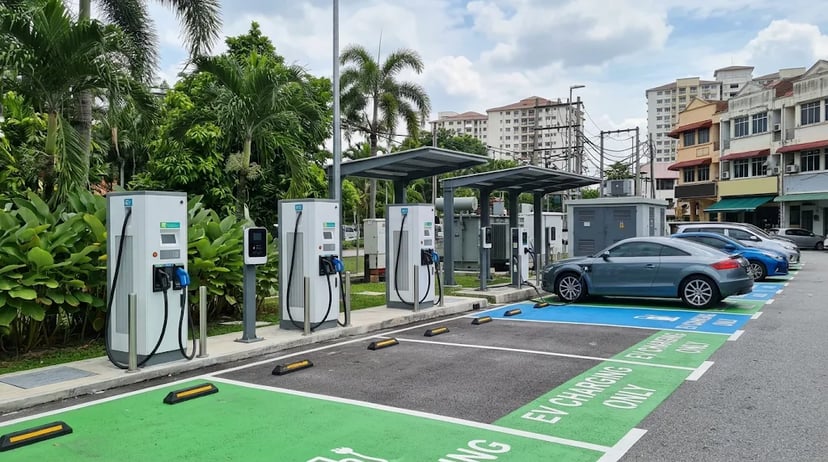
Malaysia had 6,416 public electric vehicle (EV) chargers installed nationwide as of May 31, 2026, comprising 2,143 DC fast chargers and 4,273 AC chargers, according to the Ministry of Investment, Trade and Industry (MITI).
The government is now targeting 30,000 public EV charging facilities by 2030 as part of its efforts to strengthen the country's electric mobility ecosystem and support the growing adoption of electric vehicles.
However, Malaysia remains behind its previous target of 10,000 public EV chargers by the end of 2025, highlighting the challenges involved in expanding the country's charging infrastructure.
Here's what Malaysian motorists should know about the latest EV charging figures and the government's plans.
Table of Contents
- Malaysia Has 6,416 Public EV Chargers
- AC vs DC EV Chargers: What's the Difference?
- Malaysia Missed Its 2025 EV Charger Target
- Government Targets 30,000 EV Chargers by 2030
- EV Charging Approvals Could Take As Little As 14 Working Days
- What Does This Mean for Malaysian EV Owners?
- Conclusion
- Frequently Asked Questions
Key Takeaways
- Malaysia had 6,416 public EV chargers as of May 31, 2026.
- The network consisted of 2,143 DC fast chargers and 4,273 AC chargers.
- Malaysia missed its previous target of 10,000 public chargers by the end of 2025, recording 5,624 instead.
- The government has set a new target of 30,000 public EV chargers by 2030.
- New EV Charging Bay Planning Guidelines have shortened certain approval processes to as little as 14 working days.
1. Malaysia Has 6,416 Public EV Chargers
According to MITI, Malaysia had installed a total of 6,416 public EV chargers nationwide as of May 31, 2026.
The figures were reported by Bernama following a written parliamentary reply from the ministry.
Of the total installed chargers, 2,143 units are DC fast chargers, while the remaining 4,273 units are AC chargers.
Here's a breakdown of Malaysia's public EV charging infrastructure:
| Charger Type | Number Installed | Percentage |
|---|---|---|
| DC Fast Chargers | 2,143 | 33.4% |
| AC Chargers | 4,273 | 66.6% |
| Total | 6,416 | 100% |
The figures show that AC chargers account for approximately two-thirds of Malaysia's public charging infrastructure, while DC fast chargers make up the remaining third.
2. AC vs DC EV Chargers: What's the Difference?
Not all EV chargers deliver electricity at the same speed. AC and DC chargers serve different purposes, depending on how quickly drivers need to recharge their vehicles.
AC Chargers
AC chargers supply alternating current, which is converted into direct current by the vehicle's onboard charging system.
They are generally suitable for longer parking periods, such as when drivers leave their vehicles at shopping malls, offices or residential buildings.
DC Fast Chargers
DC fast chargers supply direct current directly to the vehicle's battery system, allowing compatible EVs to recharge significantly faster.
They are particularly useful for highway journeys and motorists who need to recharge their vehicles during shorter stops.
Actual charging speeds depend on the charger's power output, the vehicle's charging capability, battery temperature and battery condition.
3. Malaysia Missed Its 2025 EV Charger Target
Although Malaysia's public charging network has continued to expand, the country did not achieve its original target of 10,000 public EV chargers by December 31, 2025.
According to MITI, Malaysia recorded 5,624 public EV chargers by the end of 2025, considerably below the original target.
Of these, 1,923 units, representing approximately 34%, were DC chargers.
The figures highlight the difficulties involved in expanding charging infrastructure quickly enough to support the country's growing EV market.
Building charging facilities requires coordination between various stakeholders, including charging point operators, electricity providers, local authorities and relevant government agencies.
4. Government Targets 30,000 EV Chargers by 2030
Malaysia has since established a more ambitious target of 30,000 public EV charging facilities by 2030.
MITI Deputy Minister Sim Tze Tzin announced the target during a parliamentary session, acknowledging that the country still faces a shortage of EV charging facilities.
To support the expansion, the government is working with industry stakeholders, particularly Tenaga Nasional Berhad (TNB), to strengthen the electricity infrastructure needed to operate additional charging facilities.
This includes developing more substations to ensure sufficient electricity supply for EV charging installations, particularly those requiring higher DC charging capacity.
Reaching the 30,000-unit target will require sustained investment and cooperation between public and private sector organisations.
5. EV Charging Approvals Could Take As Little As 14 Working Days
One of the measures introduced to accelerate the expansion of Malaysia's EV charging network involves improving the approval process for charging bay installations.
MITI stated that the government is strengthening its whole-of-government approach through the implementation of the EV Charging Bay Planning Guidelines by PLANMalaysia.
Under the guidelines, certain approval processes can be shortened to as little as 14 working days.
The government is also continuing discussions with several important stakeholders, including:
- Local authorities
- Energy Commission (Suruhanjaya Tenaga)
- Tenaga Nasional Berhad (TNB)
- Charging Point Operators (CPOs)
- EV Charging Industry Association
- Malaysia Zero Emission Vehicle Association
These collaborations are intended to address administrative and infrastructure challenges that could slow down the deployment of new charging facilities.
Expert Tip: Check charger compatibility before travelling
Before heading to a public charging station, check its connector type, charging speed and live availability through the relevant charging operator's platform. This can help you avoid unnecessary detours and delays, especially during long-distance journeys.
6. What Does This Mean for Malaysian EV Owners?
The expansion of public EV charging infrastructure is important for making electric vehicle ownership more practical in Malaysia.
For drivers who cannot install home charging facilities, public chargers provide an important alternative for daily vehicle charging.
A larger charging network could also make interstate travel more convenient by providing additional charging options along highways and at popular destinations.
However, the total number of charging points is not the only factor that matters. Their locations, reliability, charging speeds and accessibility are equally important.
For example, a large concentration of chargers in major urban areas may not sufficiently address the needs of motorists travelling through less-developed regions.
Therefore, Malaysia's next challenge is not simply to install more chargers, but also to ensure that the infrastructure is distributed effectively across the country.
Common Mistake: Assuming every public charger is a fast charger
AC and DC chargers offer different charging speeds. Always check the charging output and your vehicle's maximum charging capability before choosing a station, as a higher advertised charger output does not guarantee the same charging speed for every EV.
Conclusion: Can Malaysia Reach 30,000 EV Chargers by 2030?
Malaysia's public EV charging network is expanding, with 6,416 chargers installed as of May 31, 2026. However, the country still has considerable ground to cover before reaching its target of 30,000 charging facilities by 2030.
Improving approval processes, strengthening electricity infrastructure and encouraging cooperation between government agencies and private charging operators will be important to achieving this goal.
For Malaysian motorists considering an electric vehicle, continued improvements in charging accessibility and reliability could make EV ownership increasingly practical in the years ahead.
Looking to manage your vehicle-related matters more conveniently? Explore the Motorist App for useful motoring updates and services.
Frequently Asked Questions
1. How many public EV chargers does Malaysia have in 2026?
Malaysia had 6,416 public EV chargers installed nationwide as of May 31, 2026, according to MITI.
2. How many DC fast chargers are there in Malaysia?
There were 2,143 public DC fast chargers in Malaysia as of May 31, 2026, accounting for approximately 33.4% of the total charging network.
3. How many AC EV chargers are there in Malaysia?
Malaysia had 4,273 public AC chargers as of May 31, 2026, representing approximately 66.6% of the country's public EV charging infrastructure.
4. What is Malaysia's EV charger target for 2030?
The Malaysian government aims to establish 30,000 public EV charging facilities nationwide by 2030.
5. Did Malaysia achieve its 10,000 EV charger target in 2025?
No. Malaysia recorded 5,624 public EV chargers by December 31, 2025, falling short of the original 10,000-unit target.
6. What is the difference between AC and DC EV chargers?
AC chargers supply alternating current that is converted by the vehicle's onboard charging system, while DC fast chargers supply direct current to the battery system for faster charging.
7. How long does it take to approve a new EV charging bay in Malaysia?
MITI stated that the EV Charging Bay Planning Guidelines introduced by PLANMalaysia have shortened certain approval processes to as little as 14 working days.
8. Which government agencies are involved in expanding EV charging infrastructure?
MITI works with organisations including PLANMalaysia, local authorities, the Energy Commission and TNB, alongside charging operators and EV industry associations.
9. Why does Malaysia need more public EV chargers?
More public chargers can improve charging accessibility, reduce charging concerns among EV owners and support the increasing adoption of electric vehicles, particularly for drivers without home charging facilities.
10. Will Malaysia have enough EV chargers by 2030?
Malaysia is targeting 30,000 public EV charging facilities by 2030. Whether this target will be achieved depends on continued investment, infrastructure development and coordination between relevant stakeholders.
Read More: KL to Penang in an EV: Where to Charge, Rest and Grab Coffee in 2026
I want to find the highest selling price for my car within 24 hours!
Download the Motorist App now. Designed by drivers for drivers, this all-in-one app lets you receive the latest traffic updates, access live traffic cameras, and manage vehicle-related matters.


