Malaysia petrol price: Calculate fuel cost per km
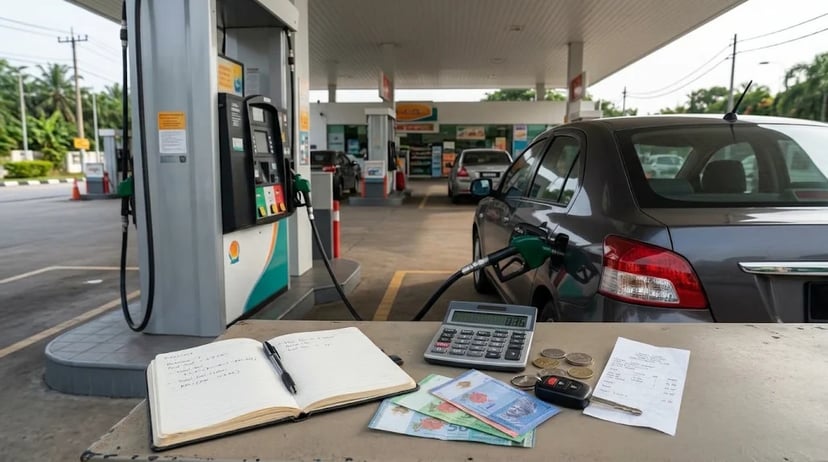
How to Calculate Fuel Consumption in Malaysia: km/L, L/100km and Cost per Kilometre
To calculate fuel consumption in Malaysia, divide the distance travelled by the litres of fuel used to get km/L, divide litres used by distance and multiply by 100 to get L/100km, or divide the total fuel cost by kilometres travelled to calculate cost per kilometre. These calculations help Malaysian drivers understand their vehicle's fuel efficiency, estimate monthly petrol expenses and plan their driving budget more accurately.
Whether you drive a Perodua Myvi, Proton Saga, Honda City, Toyota Vios or an SUV, understanding your vehicle's actual fuel consumption can help you manage rising motoring expenses. By recording your mileage and fuel purchases, you can also identify changes in fuel efficiency and compare your running costs over time.
This guide explains how to calculate fuel consumption using three common measurements: kilometres per litre (km/L), litres per 100 kilometres (L/100km) and fuel cost per kilometre (RM/km).
Table of Contents
- What is fuel consumption?
- How to measure your car's fuel consumption
- How to calculate fuel consumption in km/L
- How to calculate fuel consumption in L/100km
- How to calculate fuel cost per kilometre
- Malaysia petrol prices and fuel cost examples
- What affects fuel consumption in Malaysia?
- How to improve your car's fuel efficiency
- Conclusion
- Frequently Asked Questions
Key Takeaways
- km/L: Divide the kilometres travelled by the litres of fuel consumed. A higher figure means better fuel efficiency.
- L/100km: Divide litres consumed by kilometres travelled and multiply by 100. A lower figure means better fuel efficiency.
- Cost per kilometre: Divide the total amount spent on fuel by the distance travelled.
- Accurate measurement: Use the full-tank-to-full-tank method and record your mileage and litres refilled.
- Fuel prices: Malaysia's petrol and diesel prices can change, so use the actual price you paid when calculating your running costs.
1. What Is Fuel Consumption?
Fuel consumption refers to the amount of petrol or diesel a vehicle uses to travel a particular distance. It is one of the main factors that determines how much a driver spends on fuel.
In Malaysia, drivers commonly use kilometres per litre (km/L) to measure fuel efficiency. However, some vehicle manufacturers and international automotive publications use litres per 100 kilometres (L/100km).
Both measurements describe the same thing but present the information differently.
| Measurement | Meaning | Better result |
|---|---|---|
| km/L | Distance travelled using one litre of fuel. | Higher is better. |
| L/100km | Litres of fuel needed to travel 100 kilometres. | Lower is better. |
| RM/km | Amount of money spent on fuel for every kilometre travelled. | Lower is cheaper. |
For example, a vehicle that achieves 15 km/L travels 15 kilometres using one litre of fuel. The same fuel consumption can be expressed as approximately 6.67 L/100km.
Understanding these measurements makes it easier to compare vehicles, estimate fuel expenses and determine whether your car is consuming more fuel than usual.
2. How to Measure Your Car's Fuel Consumption
One of the simplest ways to calculate your actual fuel consumption is through the full-tank-to-full-tank method. This approach uses the distance travelled and the amount of fuel required to refill your tank.
Follow these steps to measure your vehicle's fuel consumption accurately.
Step 1: Fill up your fuel tank
Visit a petrol station and fill your tank until the fuel nozzle automatically stops. Record your vehicle's current odometer reading or reset your trip meter to zero.
For more consistent results, use the same filling method each time.
Step 2: Drive your vehicle normally
Continue driving as you normally would. You can include your daily commute, highway journeys, school runs and other regular trips.
Record the distance travelled before your next refuelling. A longer measurement period can help reduce variations caused by small differences in how much fuel enters the tank.
Step 3: Refill your tank
Return to a petrol station and refill your tank using the same fuel grade and filling method. Record the number of litres required to fill the tank again.
The litres added during this refill are used as an estimate of the fuel consumed since your previous full-tank refill.
Step 4: Record your distance and fuel used
For example, suppose your vehicle travelled 600 kilometres before requiring another refill, and you needed 40 litres to fill the tank.
- Total distance travelled: 600 km
- Fuel consumed: 40 litres
- Fuel price: RM1.99 per litre (illustrative BUDI95 example)
You can now use these figures to calculate your fuel consumption and cost per kilometre.
Expert Tip
Repeat the full-tank measurement over at least three refuelling cycles. Calculate your overall average using the total distance travelled divided by the total litres refilled. This gives you a more useful picture of your actual fuel consumption than relying on one reading.
3. How to Calculate Fuel Consumption in km/L
Kilometres per litre (km/L) measures how far your vehicle can travel using one litre of petrol or diesel. It is a common measurement used by Malaysian drivers to understand fuel efficiency.
Formula:
km/L = Total distance travelled (km) ÷ Fuel consumed (litres)
Example:
Your car travels 600 kilometres after consuming 40 litres of petrol.
600 km ÷ 40 litres = 15 km/L
This means your vehicle travels approximately 15 kilometres for every litre of petrol consumed.
A higher km/L result generally indicates better fuel efficiency, provided the vehicles are compared under similar driving conditions.
For instance:
| Distance | Fuel used | Fuel efficiency |
|---|---|---|
| 600 km | 40 litres | 15 km/L |
| 600 km | 50 litres | 12 km/L |
| 600 km | 30 litres | 20 km/L |
Based on these examples, the vehicle achieving 20 km/L uses less fuel to travel the same distance than the vehicles achieving 12 km/L or 15 km/L.
4. How to Calculate Fuel Consumption in L/100km
Litres per 100 kilometres (L/100km) measures how much fuel your vehicle needs to travel 100 kilometres. It is commonly used in international vehicle specifications and fuel economy comparisons.
Formula:
L/100km = (Fuel consumed in litres ÷ Distance travelled in km) × 100
Example:
Your vehicle consumes 40 litres of petrol to travel 600 kilometres.
(40 ÷ 600) × 100 = 6.67 L/100km
This means your car consumes approximately 6.67 litres of fuel to travel 100 kilometres.
Unlike km/L, a lower L/100km figure represents better fuel efficiency because the vehicle needs less fuel to cover the same distance.
How to convert km/L into L/100km
You can convert between the two measurements using the following formulas:
- L/100km = 100 ÷ km/L
- km/L = 100 ÷ L/100km
For example, if your vehicle achieves 15 km/L:
100 ÷ 15 = 6.67 L/100km
Both measurements describe the same fuel consumption, so you can use whichever format is easier to understand.
5. How to Calculate Fuel Cost per Kilometre
Knowing your vehicle's fuel consumption is useful, but understanding how much you spend for every kilometre driven can make budgeting easier.
Fuel cost per kilometre tells you how much money you spend on petrol or diesel for every kilometre travelled.
Formula:
Fuel cost per km = Total fuel cost (RM) ÷ Distance travelled (km)
You can also calculate it using your fuel efficiency:
Fuel cost per km = Fuel price per litre (RM) ÷ Fuel efficiency (km/L)
Example:
Assume your vehicle travels 600 kilometres using 40 litres of RON95 petrol priced at RM1.99 per litre.
- Fuel consumed: 40 litres
- Fuel price: RM1.99 per litre
- Total fuel cost: 40 × RM1.99 = RM79.60
- Distance travelled: 600 km
Calculation:
RM79.60 ÷ 600 km = RM0.1327 per km
Your estimated fuel cost is approximately 13.27 sen per kilometre.
This calculation can also help you estimate your monthly fuel budget.
For example, if you travel 1,500 kilometres per month:
1,500 km × RM0.1327 = approximately RM199.00 per month.
This is an estimate based on the assumed fuel price and consumption. Your actual monthly spending may change depending on driving conditions and fuel prices.
Common Mistake
Do not calculate fuel consumption using only the number of fuel gauge bars or the amount of money spent at the petrol station. Fuel prices can change, and fuel gauge indicators are not precise measurements of litres consumed. Always record the actual litres refilled and the distance travelled for a more reliable calculation.
6. Malaysia Petrol Prices and Fuel Cost Examples
Fuel prices in Malaysia can affect how much motorists spend on their daily journeys. Even when your vehicle's fuel efficiency remains unchanged, a higher price per litre increases your overall fuel cost per kilometre.
For the period from 19 to 25 November 2026, the Ministry of Finance announced the following retail fuel prices:
| Fuel type | Price per litre |
|---|---|
| RON95 under BUDI95 (eligible recipients) | RM1.99 |
| RON95 without subsidy | RM3.72 |
| RON97 | RM4.00 |
| Diesel under BUDI Diesel (eligible recipients) | RM2.10 |
| Diesel without subsidy | RM4.72 |
Source: Ministry of Finance Malaysia, 18 November 2026. Prices are applicable from 19 to 25 November 2026 and are subject to subsequent announcements and applicable subsidy arrangements.
Example: How different petrol prices affect your fuel expenses
Assume two drivers use vehicles with identical fuel consumption of 15 km/L and each travels 600 kilometres using 40 litres of RON95.
| Calculation | BUDI95 | Unsubsidised RON95 |
|---|---|---|
| Fuel price | RM1.99/L | RM3.72/L |
| Fuel used | 40 litres | 40 litres |
| Total fuel cost | RM79.60 | RM148.80 |
| Distance travelled | 600 km | 600 km |
| Cost per kilometre | 13.27 sen | 24.80 sen |
Although both vehicles have the same fuel efficiency, their running costs differ because the drivers pay different prices for petrol.
This example demonstrates why Malaysian motorists should consider both fuel consumption and the actual petrol price when calculating their vehicle expenses.
For updated fuel prices, motorists can also refer to the official Malaysian government fuel price dataset.
7. What Affects Fuel Consumption in Malaysia?
Your vehicle's fuel consumption does not depend entirely on its engine. Driving habits, road conditions, vehicle maintenance and environmental factors can all influence how much petrol or diesel your car uses.
Here are some common factors that can increase fuel consumption in Malaysia.
1. Heavy traffic and frequent stop-start driving
Traffic congestion in Kuala Lumpur, Petaling Jaya, Shah Alam and other busy areas often requires motorists to accelerate, brake and idle repeatedly. These driving conditions can increase fuel consumption compared with maintaining a steady speed on an open highway.
2. Aggressive acceleration and braking
Rapid acceleration and unnecessary hard braking can increase fuel usage. Driving smoothly and maintaining a consistent speed where conditions permit can help improve fuel efficiency.
3. Incorrect tyre pressure
Underinflated tyres can increase rolling resistance, requiring the engine to use more energy to move the vehicle. Check your tyre pressure regularly and follow the manufacturer's recommended pressure.
4. Excessive vehicle weight
Carrying unnecessary luggage, equipment or heavy items increases the load on your vehicle. Removing items that you do not need can help reduce unnecessary fuel consumption.
5. Air-conditioning usage
Air-conditioning places an additional load on a vehicle's engine. In Malaysia's hot and humid climate, frequent air-conditioning use can contribute to higher fuel consumption, particularly during slow-moving traffic.
6. Poor vehicle maintenance
Neglected servicing, incorrect engine oil, worn components and other mechanical problems can affect fuel efficiency. Following your vehicle manufacturer's maintenance schedule helps keep the vehicle operating as intended.
8. How to Improve Your Car's Fuel Efficiency
While you cannot control every factor affecting petrol prices or road conditions, you can adopt better driving habits to manage your fuel expenses.
Consider these practical tips:
- Maintain correct tyre pressure: Check your tyres regularly and follow the recommended pressure in your owner's manual or vehicle tyre-pressure label.
- Drive smoothly: Avoid unnecessary acceleration and sudden braking whenever road conditions allow.
- Reduce unnecessary idling: Switch off the engine when appropriate during prolonged stops, following your vehicle manufacturer's guidance.
- Remove unnecessary weight: Avoid carrying heavy items that you do not need.
- Service your vehicle regularly: Follow the manufacturer's recommended servicing intervals and use the correct engine oil.
- Plan your journeys: Combine errands and choose practical routes to reduce unnecessary travelling.
- Monitor your fuel consumption: Record your mileage and refuelling amounts to identify unusual changes in fuel efficiency.
These habits can help you understand your vehicle's running costs and avoid unnecessary fuel expenditure over time.
Conclusion
Knowing how to calculate fuel consumption in Malaysia can help motorists make better decisions about their vehicle expenses. Whether you use km/L, L/100km or cost per kilometre, each measurement provides a different way to understand how efficiently your car uses petrol or diesel.
The simplest approach is to record your mileage, refill your tank and calculate the amount of fuel consumed over the distance travelled. By repeating this process and monitoring changes in fuel prices, you can estimate your monthly petrol expenses more accurately.
Ultimately, understanding your vehicle's fuel efficiency is not just about saving money at the petrol station. It also helps you manage your motoring budget and make more informed decisions when maintaining, comparing or purchasing a vehicle.
Frequently Asked Questions
1. How do I calculate fuel consumption in Malaysia?
Divide the total distance travelled by the litres of fuel consumed to calculate km/L. Alternatively, divide litres consumed by kilometres travelled and multiply by 100 to get L/100km.
2. What is a good fuel consumption rate for a car in Malaysia?
There is no single fuel consumption figure that is suitable for every vehicle. Fuel efficiency depends on engine size, vehicle weight, transmission, driving conditions and vehicle design. Compare vehicles in a similar category for a more meaningful assessment.
3. Is higher km/L better for fuel efficiency?
Yes. A higher km/L figure means your vehicle can travel further using the same amount of fuel, which generally indicates better fuel efficiency.
4. Is lower L/100km better?
Yes. A lower L/100km figure means your vehicle uses fewer litres of fuel to travel 100 kilometres, indicating better fuel efficiency.
5. How do I convert km/L to L/100km?
Divide 100 by your km/L figure. For example, a vehicle achieving 15 km/L has a fuel consumption rate of approximately 6.67 L/100km.
6. How do I calculate fuel cost per kilometre?
Multiply the litres consumed by the price per litre, then divide the total fuel cost by the kilometres travelled. You can also divide the price per litre by your km/L figure.
7. How much does it cost to drive 100 kilometres in Malaysia?
The cost depends on your vehicle's fuel consumption and the price you pay per litre. For example, a car consuming 6.67 L/100km using RON95 priced at RM1.99 per litre would cost approximately RM13.27 to travel 100 kilometres.
8. Why is my car consuming more fuel than usual?
Higher fuel consumption may result from heavy traffic, aggressive driving, incorrect tyre pressure, excessive vehicle weight, poor maintenance or mechanical problems. Compare your actual fuel consumption over several refuelling cycles.
9. How often should I calculate my car's fuel consumption?
You can calculate your fuel consumption every time you refill your tank. Tracking several refuelling cycles provides a more reliable average and makes it easier to identify unusual changes.
10. Does a change in petrol price affect km/L?
No. A change in petrol price does not directly change your vehicle's physical fuel efficiency. However, it changes your cost per kilometre because you pay a different amount for each litre of fuel.
11. Can I use the same fuel consumption formula for diesel cars?
Yes. The km/L, L/100km and cost-per-kilometre formulas work for both petrol and diesel vehicles. Simply use the actual litres consumed and the price paid for your fuel.
12. Can I calculate monthly petrol expenses using fuel consumption?
Yes. Multiply your estimated monthly driving distance by your fuel cost per kilometre. For example, if your fuel cost is RM0.1327 per kilometre and you travel 1,500 kilometres monthly, your estimated fuel expense is approximately RM199.
Read More: Malaysia fuel prices November 19–25, 2026: All prices down
I want to find the highest selling price for my car within 24 hours!
Download the Motorist App now. Designed by drivers for drivers, this all-in-one app lets you receive the latest traffic updates, access live traffic cameras, and manage vehicle-related matters.