How one JPJ blacklist record can increase your 2027 insurance by 20%
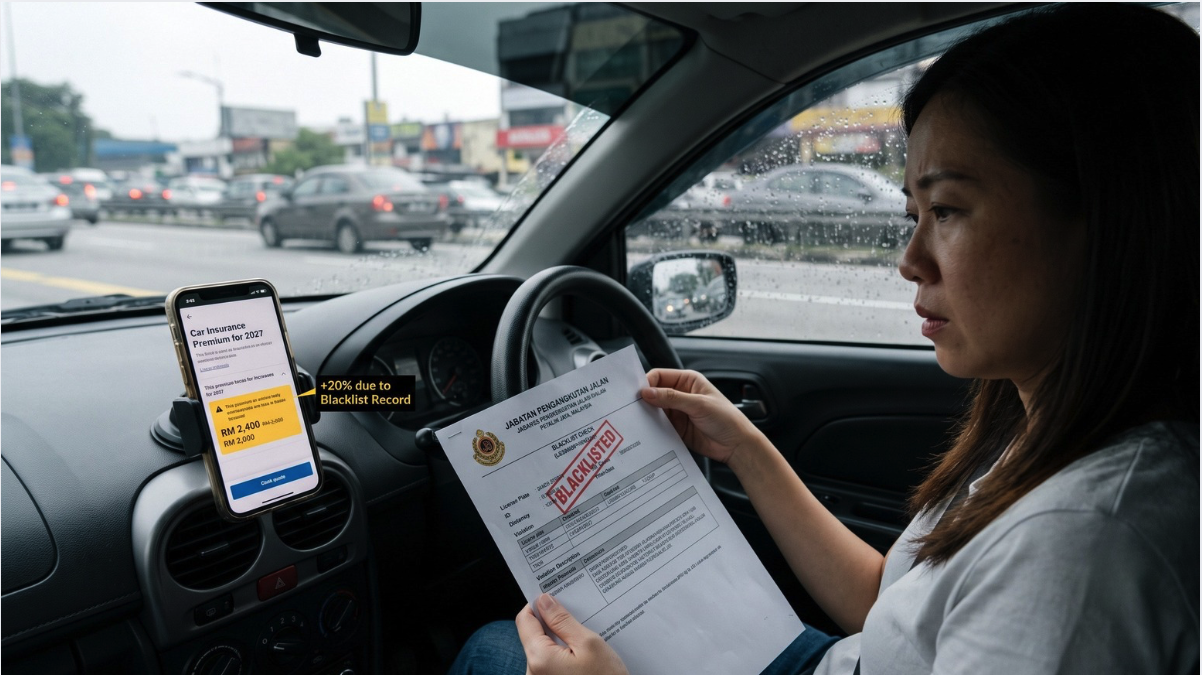
Imagine this: You were caught speeding on the North-South Expressway in early 2026. You received the summons, felt the sting of the RM300 fine, and eventually paid it off. You thought the matter was settled. You "cleared" your record with the Road Transport Department (JPJ) and moved on with your life.
Fast forward to January 2027. You log into the Motorist App to renew your car insurance, expecting the usual premium. Instead, you are greeted by a quote that is 20 percent higher than last year, despite having an extra year of No Claim Discount (NCD).
What happened? You have just encountered "Risk Loading," the hidden financial hangover of a JPJ blacklist record.
In the fully liberalized insurance market of 2026 and 2027, paying your fine is only the first half of the penalty. The second half is a long-term surcharge determined by "Behavioral Pricing." Today, we take a deep dive into why your driving record is now your most valuable financial asset and how one mistake can haunt your wallet for years.
The 2026 Shift: From Tariff to Behavioral Pricing
For decades, motor insurance in Malaysia was "Tariff-based." This meant that if two people drove the same Perodua Myvi in the same city, they paid almost identical premiums, regardless of whether one was a safe driver and the other was a serial speeder.
As of mid-2026, the Phased Liberalisation of Motor Insurance has reached its final stage. Insurance companies no longer follow a fixed price book. Instead, they use complex algorithms and AI-driven data from the PDRM-JPJ Database Fusion to calculate your specific risk profile.
What is Behavioral Pricing?Behavioral pricing means that insurance companies now look at how you drive. They access your digital footprint, which includes:
Your history of JPJ blacklists.
Your accumulated KEJARA demerit points.
The frequency of your traffic summonses.
Your involvement in "At-Fault" accidents.
If your record shows even a single "Blacklist" status within a 12-month period, you are no longer classified as a "Standard Risk." You are moved into the "High-Risk Loading" category.
What is "Car Insurance Loading" in Malaysia?
"Loading" is an additional percentage charged on top of your basic insurance premium. In the past, loading was usually applied to older cars (over 10 years) or drivers under the age of 21.
In 2026 and 2027, a new type of loading has emerged: Regulatory Risk Loading.
When an insurer sees a JPJ blacklist record on your profile, they view it as a statistically significant indicator that you are likely to be involved in a future accident. To mitigate this risk, they add a surcharge, typically ranging from 15 percent to 35 percent, to your premium.
The Math of a Blacklist PenaltyLet us look at a typical scenario for a Honda City owner in 2027:
Base Premium: RM2,000
NCD (55 percent): -RM1,100
Standard Payable: RM900
20 percent Risk Loading (due to JPJ Blacklist): +RM400
Total New Premium: RM1,300
Even though you have a 55 percent NCD, the loading is calculated on the gross premium before the NCD is applied. In this case, that one speeding ticket effectively wiped out the benefit of several years of safe driving.
Why a JPJ Blacklist Specifically Triggers the Spike
Not every parking ticket will increase your insurance. The trigger for the 20 percent spike is specifically linked to the JPJ Blacklist (Senarai Hitam).
In the 2026 system, a blacklist occurs when an offense is deemed serious enough to "freeze" your vehicle's digital record. This happens for:
Unsettled Saman Bukan Kompaun: Offenses that require a court appearance.
AWAS/AES Violations: High-speed offenses or red-light jumping caught by AI cameras.
PG1 Notices: Failure to rectify illegal tinting or dangerous vehicle modifications.
Repeat Offenses: Accumulating more than three standard compounds within six months.
When an insurance company queries the JPJ API during your insurance renewal, the system returns a flag. For the insurer, a "Blacklist" is proof of defiant driving behavior. This is the data point that triggers the 20 percent loading for your 2027 renewal.
The KEJARA Factor: Demerit Points and Insurance
The KEJARA (Kesalahan Jalan Raya) demerit points system was fully integrated into the insurance ecosystem in early 2026. Every time you are blacklisted, you likely earn demerit points.
In 2027, insurers use these points as a tiered penalty system:
0 to 5 Points: Standard Premium.
6 to 12 Points: 10 percent Risk Loading.
13 to 20 Points: 20 percent Risk Loading plus loss of certain add-on benefits such as windscreen coverage or special perils.
20+ Points: Many insurers may refuse to provide comprehensive coverage, forcing you into a "Third Party Only" policy at a highly inflated price.
This is why paying the fine is no longer enough. The demerit points insurance link ensures that the financial consequences follow you long after the police officer has left the scene.
The 5 Offenses That Will Tank Your 2027 Budget
If you want to keep your 2027 insurance costs low, you must avoid these five high-loading offenses during the July 2026 enforcement phase:
1. Speeding Over 40km/hIn 2026, any speed violation exceeding the limit by 40km/h is an automatic non-compoundable offense. It leads to a blacklist and a court date. Insurers view extreme speeding as the primary predictor of total-loss claims. Expect a minimum 25 percent loading.
2. Emergency Lane MisuseWith the PDRM-JPJ Database Fusion, emergency lane violations are now high-priority. Because this offense often causes accidents that block emergency responders, insurers apply a social irresponsibility loading.
3. Mobile Phone Usage (Caught by AI)As discussed in our Mid-Year Enforcement Guide, AI cameras now catch you holding your phone. Insurance data shows that distracted driving is now the leading cause of rear-end collisions in Kuala Lumpur.
4. Illegal Tinting (PG1 Notice)If you are blacklisted for tinting, the insurer views it as a visibility risk. If you have an accident at night with illegal tint, your insurer might even use your PG1 record to deny your claim, citing that the vehicle was not in a roadworthy condition.
5. Drunk or Impaired DrivingThis is the "Insurance Killer." A single conviction for driving under the influence (DUI) in 2026 will result in a 100 percent to 200 percent loading, if you can find a company willing to insure you at all.
How Long Does the Insurance Hangover Last?
A common question we get at Motorist is: "How long will this blacklist affect my premium?"
In the 2027 market, insurance companies look at a 3-year rolling window:
Year 1: Maximum Loading (e.g., 20 percent).
Year 2: Reduced Loading (e.g., 10 percent), provided no new offenses occur.
Year 3: Loading removed, but you remain in a monitored tier.
This means a single JPJ blacklist in July 2026 could cost you an extra RM1,000 to RM3,000 in total premiums over the next three years.
The Commercial Trap: Impact on Lorry and Van Fleets
For business owners, the insurance loading penalty is even more severe. Logistics companies operating fleets of lorries or vans face "Fleet Loading."
If even 10 percent of a company’s drivers are blacklisted during a mid-year enforcement op, the entire fleet’s insurance premium is recalculated. For a company with 50 lorries, a 20 percent loading could mean an extra RM50,000 in annual operating costs. This is why Bukit Aman’s recent drug tests for truck drivers have sent shockwaves through the industry: it is not just a safety issue, it is an insurance survival issue.
How to Protect Your Budget for 2027
You cannot delete a blacklist once it is in the system, but you can mitigate the damage. Here is the Motorist 2026 Strategy for safe insurance renewals:
1. Early Clearing (The 48-Hour Rule)If you are blacklisted, settle it immediately. The longer a blacklist stays "Active" in the JPJ database, the more likely it is to be captured by the insurance industry’s monthly data-scraping algorithms.
2. Use the Motorist App to Monitor DemeritsDo not wait for your renewal date to find out you have 15 KEJARA points. Use our Saman and Demerit Tracker to stay in the "Green Zone."
3. Take a Defensive Driving CourseIn 2027, some Malaysian insurers have started offering loading rebates. If you have a blacklist record, completing a JPJ-approved defensive driving course can reduce your loading by 5 to 10 percent. It proves to the insurer that you are taking steps to rehabilitate your driving behavior.
4. The Fresh Start Option (Selling the Car) If your car is tainted with a history of PG1 notices and blacklists, its insurance profile is permanently damaged. Some owners choose to sell their car and purchase a new one. While your MyKad record follows you, a new vehicle allows you to start a new policy without the "Vehicle Condition Loading" that often accompanies blacklisted cars.
Your Driving is Your Currency
In 2026, the Road Transport Department and the insurance industry have become one single ecosystem. The fine you pay at the JPJ kiosk is only the tip of the iceberg. The real cost of a blacklist is the insurance loading that drains your bank account for years to come.
As we move into the July 2026 enforcement period, remember: every time you pick up your phone while driving or push your speed past 120km/h, you are not just risking a saman; you are signing a contract to pay more for your insurance in 2027.
Stay Safe. Stay Clean. Save Your NCD.
[Check Your Saman and Blacklist Status Now]
FAQ: JPJ Blacklists and Insurance
1. If I pay my saman immediately, will I still get an insurance loading?
If the offense resulted in a "Blacklist" status, yes. The insurer sees the occurrence of the blacklist, not just the payment status. However, paying immediately prevents further late-payment penalties.
2. Can I switch insurance companies to avoid the 20 percent loading?
No. In 2027, all Malaysian insurers use the Centralized Insurance Data (CID) and the JPJ Fusion Database. Every company will see the same blacklist flag. In fact, switching frequently is now seen as a minor risk factor itself.
3. Does a blacklist on my motorcycle affect my car insurance?
Yes. Since 2026, risk profiles are linked to your MyKad (NRIC). A serious offense on your bike proves high-risk behavior, which insurers will apply to all vehicles registered under your name.
4. How do I know if I have loading on my quote?
When using the Motorist Insurance Comparison Tool, look at the breakdown. If you see a line item labeled "Risk Loading" or "Underwriting Surcharge," that is the penalty for your driving record.
Read More: JPJ mid-year enforcement 2026: 5 things that will get your road tax blacklisted this July
I want to find the highest selling price for my car within 24 hours!
Download the Motorist App now. Designed by drivers for drivers, this all-in-one app lets you receive the latest traffic updates, gives you access to live traffic cameras, and helps you manage vehicle related matters.