Driving in the haze: 8 safety tips for Malaysian roads
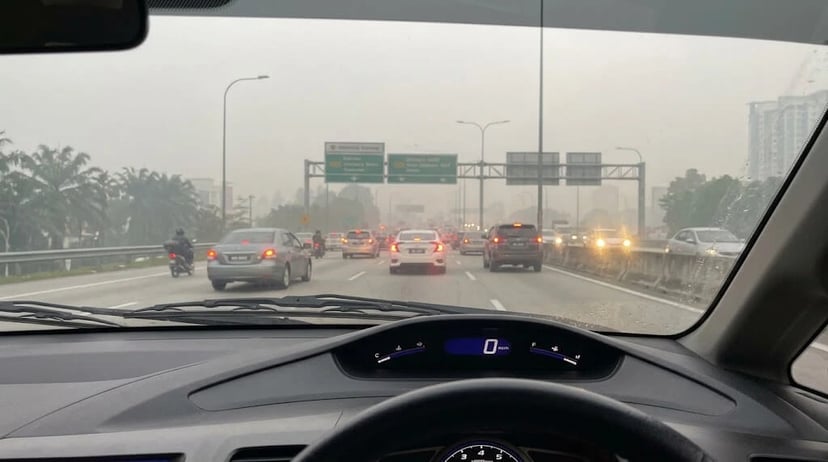
To drive safely in haze in Malaysia, switch on your low-beam headlights (not high beams), keep at least a 4-second following distance, slow down below the posted limit, and check live traffic conditions on the North–South Expressway before you set off. The haze is back. On 20 September 2026, 21 areas across Malaysia recorded unhealthy Air Pollutant Index (API) readings, with Serian, Sarawak, peaking at 182. Visibility on stretches of the PLUS highway can drop below 200 metres in a matter of minutes.
Key takeaways
- Use low beams, not high beams. High beams bounce off haze particles and make glare worse. Front fog lights only help when visibility is below about 100 m.
- Double your gap. Go from the normal 2-second rule to at least 4 seconds, and to 6 seconds when visibility is under 100 m.
- Slow down early. The PLUS limit is usually 110 km/h, but in heavy haze 60–80 km/h is safer.
- Hazard lights are for stopping, not driving. Flashing hazards while moving hides your turn signals.
- Check before you go. The Motorist App's live traffic cams and real-time updates show haze and congestion on the North–South Expressway before you leave.
How bad is haze for drivers in Malaysia?
API levels tell you how risky a drive will be. Malaysia's Department of Environment uses the following API bands, published through the Malaysian Air Pollutant Index Management System (APIMS):
| API reading |
Category |
What it means for drivers |
|---|---|---|
| 0–50 | Good | Normal driving |
| 51–100 | Moderate | Light haze, visibility mostly fine |
| 101–200 | Unhealthy | Visibility drops, use low beams all day |
| 201–300 | Very unhealthy | Postpone non-essential long drives |
| 301+ | Hazardous | Avoid expressway travel if you can |
Haze season usually runs from June to October and peaks during the southwest monsoon, when smoke from regional land fires drifts into Peninsular Malaysia and Sarawak
8 safety tips for driving in haze
1. Use low-beam headlights, not high beams
Low beams light the road without causing glare. Haze is made of tiny smoke particles that scatter light. High beams point upwards, hit those particles and reflect straight back into your eyes as a white wall. Low beams aim down at the road surface, where you need the light.
Turn them on even in daytime. Their main job in haze is to help other drivers see you, not to help you see.
2. Know when fog lights actually help
Front fog lights are for very low visibility only. They sit low and spread a wide, flat beam under the haze layer. That is useful when visibility falls below about 100 m, but it adds little in moderate haze.
Rear fog lights can dazzle the driver behind you. They are as bright as brake lights, so switch them off once visibility goes above 100 m or when a car is close behind you.
| Light |
Best used when |
Avoid when |
|---|---|---|
| Low beam | Any haze, day or night | Never. Keep them on |
| High beam | Clear nights only | Any haze (glare bounces back) |
| Front fog light | Visibility under ~100 m | Light or moderate haze |
| Rear fog light | Visibility under ~100 m, no car close behind | A car is following closely |
| Hazard lights | Stopped on the hard shoulder | Driving while moving |
3. Keep at least a 4-second following distance
The normal 2-second rule isn't enough in haze. At 90 km/h a car covers 25 metres every second, so a 4-second gap gives you about 100 m to react and brake.
Here's how to measure it. When the car ahead passes a fixed point such as a PLUS kilometre post, count "one-thousand-one…" slowly. If you reach the post before you count to four, drop back. When visibility is below 100 m, stretch the gap to 6 seconds.
4. Slow down before visibility drops, not after
Don't drive faster than you can stop within the distance you can see. Most PLUS stretches have a 110 km/h limit, but that limit assumes clear conditions. If you can only see 150 m ahead, 60–80 km/h is a more realistic speed.
Brake gently and early. Sudden braking in low visibility is how pile-ups start on long, straight expressway stretches.
5. Plan around the worst haze stretches on the North–South Expressway
Haze tends to settle in low-lying and open areas. On the PLUS North–South Expressway, look out for stretches near agricultural land and peat areas, valleys, and early-morning river crossings, where haze and mist can combine.
Check conditions before you leave. The Motorist App shows live traffic camera feeds and real-time traffic updates along the PLUS highway, so you can see the haze on your route instead of guessing. Save the PLUSLine number, 1-800-88-0000 (24/7), and remember that PLUS emergency phones are placed every 2 km along the highway.
6. Switch your air-con to recirculation mode
Keep haze out of the cabin. Set your air-con to recirculate so it stops drawing in outside air, and keep the windows up. An old cabin filter lets fine PM2.5 particles in.
Replace a clogged cabin filter. Most workshops in Malaysia charge roughly RM40–RM120 for the part and fitting, depending on the model. Ask for a PM2.5-rated or activated-carbon filter.
7. Keep your windscreen and wipers in top condition
Haze ash builds up on glass and makes glare worse. Top up your washer fluid, and replace wipers that streak. Clean the inside of the windscreen too, because film on the glass scatters oncoming headlights.
Use the demister. Cooler air-con and humid haze can fog up the glass quickly, so keep it ready.
8. Use hazard lights only when stopped
Never drive with hazard lights on. They stop drivers behind you from seeing which way you're turning or changing lanes, and they make your speed hard to judge.
If you need to pull over, get fully onto the hard shoulder or into an R&R. Turn your hazards on once you have stopped, place your warning triangle, and wait behind the guardrail. In an emergency, call 999 or PLUSLine on 1-800-88-0000.
Expert tip: Before a long drive on the North–South Expressway in haze season, check two things at the same time: the APIMS reading for your destination and the Motorist App's live PLUS traffic cams for the stretch you're worried about. If the API is above 200 and the cams show visibility under about 200 m, leave 2–3 hours later. Haze often thins by late morning, once the sun breaks up the overnight inversion layer.
Common mistake to avoid : Using automatic headlights as a "set and forget" setting. Many auto-headlight sensors read brightness, not visibility, so on a bright, hazy afternoon they may leave your low beams off. Your tail lights then stay dark and cars behind you can't see you. Switch your headlights to ON manually in haze.
Conclusion
In haze, you see less and react later, so the basics matter most: low beams on, hazards off, a gap of at least 4 seconds and a speed that suits what you can see. Check conditions on the North–South Expressway before you leave, and let the Motorist App keep track of your car's paperwork while you focus on the road.
Frequently asked questions
1. Should I use fog lights or headlights in haze?
Use low-beam headlights in all haze conditions. Turn on front fog lights only when visibility drops below about 100 m.
2. Why are high beams bad in haze?
High beams reflect off haze particles and create glare that cuts your visibility. Low beams light the road surface without bouncing back.
3. Can I drive with hazard lights on in haze in Malaysia?
No. Use hazard lights only when your car has stopped, because flashing hazards while moving hide your turn signals from other drivers.
4. What is a safe following distance in haze?
Keep at least a 4-second gap, and 6 seconds when visibility is below 100 m. At 90 km/h, 4 seconds is about 100 metres.
5. What API level is unsafe for driving?
An API of 101–200 is unhealthy and calls for extra caution. Above 200 is very unhealthy, and drivers should postpone non-essential long-distance trips.
6. What speed should I drive on PLUS during haze?
Drive at a speed that lets you stop within the distance you can see, often 60–80 km/h in heavy haze. That is well below the usual 110 km/h limit.
7. What is the PLUS highway emergency number?
PLUSLine is 1-800-88-0000 and runs 24/7, and emergency phones are placed every 2 km along the expressway. In a life-threatening emergency, call 999.
8. How can I check haze and traffic on the North–South Expressway?
The Motorist App shows live traffic camera feeds and real-time traffic updates along the PLUS highway. You can check APIMS for API readings at the same time.
9. Should I use air-con recirculation mode in haze?
Yes. Recirculation mode stops outside air from coming in, and a good PM2.5 cabin filter reduces the haze particles that get into the cabin.
10. Does haze affect my car's paperwork deadlines?
No. Road tax and insurance deadlines don't change during haze season, so set reminders in the Motorist App to avoid lapsed cover.
Download the Motorist App to check live PLUS traffic cams before you drive and get automatic road tax, insurance and fine reminders, all in one free app.
Read More: Petrol Price Malaysia: RON95, RON97 & Subsidies
I want to find the highest selling price for my car within 24 hours!
Download the Motorist App now. Designed by drivers for drivers, this all-in-one app lets you receive the latest traffic updates, gives you access to live traffic cameras, and helps you manage vehicle related matters.