Calculate road tax malaysia: 2026 rates & EV
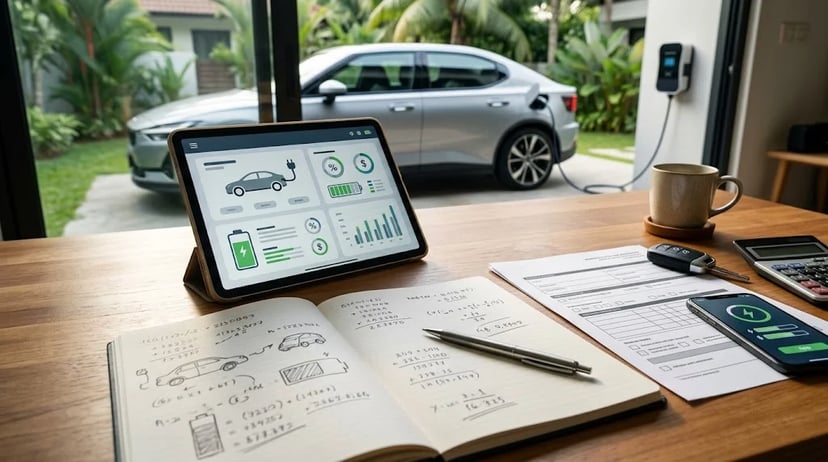
To calculate road tax in Malaysia in 2026, use your car's engine capacity in cc for petrol, diesel and hybrid vehicles, while fully electric vehicles use motor output in kW under the new EV rates effective 1 January 2026.
Wondering how much your car's road tax will cost this year? The answer depends mainly on your vehicle type, engine size, motor power, registration region and whether the vehicle is classified as a saloon or non-saloon.
The good news is that once you know the relevant figure from your vehicle registration details, you can calculate your annual road tax without guessing. The Motorist App can also help you keep track of your road tax expiry date and other vehicle ownership tasks.
Key takeaways
- Petrol, diesel and hybrid cars: Road tax is generally calculated using engine capacity in cc.
- Fully electric vehicles: From 1 January 2026, road tax is calculated using the EV's total rated motor output in kW.
- EV road tax starts at RM20: EVs with motor output of up to 50 kW pay RM20 a year under the new structure.
- Your location matters for conventional cars: Peninsular Malaysia, Sabah and Sarawak have different LKM rates, with special rates also applying in certain territories.
- PHEVs are different from BEVs: A plug-in hybrid uses its internal-combustion engine capacity for road tax rather than the 2026 fully electric kW schedule.
How to calculate road tax malaysia in 2026
First, identify your vehicle type. If you own a petrol, diesel or hybrid vehicle, check the engine capacity shown in your vehicle registration information. This is measured in cubic centimetres, or cc.
For a fully electric vehicle, there is no conventional engine capacity to use. Instead, Malaysia's 2026 EV structure uses the rated power output of the electric motor or motors, measured in kilowatts, or kW.
Next, identify where the vehicle is registered. Conventional LKM rates differ between Peninsular Malaysia and Sabah and Sarawak, so the same engine size can produce a different road tax amount depending on the registration region.
Finally, check the vehicle classification. Private saloon cars such as sedans, hatchbacks, coupés and wagons generally follow a different rate schedule from SUVs, MPVs, pick-ups and other private vehicles.
How petrol and diesel road tax is calculated
For conventional vehicles, engine capacity is the key number. In Peninsular Malaysia, a private saloon with an engine capacity of 1,000cc or below has a basic annual LKM rate of RM20. The rate then increases as engine capacity rises.
| Engine capacity |
Annual road tax |
|---|---|
| 1,000cc and below | RM20 |
| 1,001cc to 1,200cc | RM55 |
| 1,201cc to 1,400cc | RM70 |
| 1,401cc to 1,600cc | RM90 |
| 1,601cc to 1,800cc | RM90 + progressive amount |
| 1,801cc to 2,000cc | RM180 + progressive amount |
| Above 2,000cc | Higher progressive rates apply |
The exact calculation becomes progressive at higher engine capacities. For example, the JPJ schedule uses a base rate plus an additional amount for each cc above the threshold in higher engine-capacity bands.
This means you should not simply multiply engine capacity by a fixed rate. The JPJ schedule determines the applicable base and progressive amount.
How to calculate road tax for an EV in Malaysia
EV road tax changed on 1 January 2026. Malaysia's previous EV road tax exemption ended on 31 December 2025, meaning fully electric vehicles registered for road use now have to pay LKM.
Unlike petrol and diesel cars, EV road tax is based on motor power in kW.
The 2026 structure is divided into power bands. Within each band, the amount increases in blocks based on the vehicle's rated motor output.
2026 EV road tax rates
| Motor output |
Road tax calculation |
Maximum within band |
|---|---|---|
| 1 to 50 kW | Flat RM20 | RM20 |
| 50.001 to 100 kW | +RM10 per 9.999 kW block | RM70 |
| 100.001 to 210 kW | +RM20 per 9.999 kW block | RM280 |
| 210.001 to 310 kW | +RM30 per 9.999 kW block | RM575 |
| 310.001 to 410 kW | +RM50 per 9.999 kW block | RM1,065 |
| 410.001 to 510 kW | +RM100 per 9.999 kW block | RM2,040 |
| 510.001 to 610 kW | +RM150 per 9.999 kW block | RM3,515 |
| 610.001 to 710 kW | +RM200 per 9.999 kW block | RM5,490 |
| 710.001 to 810 kW | +RM250 per 9.999 kW block | RM7,965 |
| 810.001 to 910 kW | +RM300 per 9.999 kW block | RM10,940 |
| 910.001 to 1,010 kW | +RM350 per 9.999 kW block | RM14,415 |
| Above 1,010 kW | Flat RM20,000 | RM20,000 |
The new structure makes EV road tax considerably simpler than the previous progressive system. The rate is based on the vehicle's rated electric motor output rather than battery capacity.
EV road tax calculation example: 150 kW
Suppose your EV has a rated output of 150 kW. Under the 2026 structure, it falls into the band above 100 kW and up to 210 kW.
A 150 kW EV has a road tax of RM160 per year under the current schedule.
Another example is the BMW i4 eDrive35 M Sport, which has a 210 kW output and carries a reported annual road tax of RM280 under the 2026 structure.
What about a 50 kW EV?
A 50 kW EV pays RM20 a year. This is the minimum annual road tax under the 2026 EV structure and is comparable to the lowest conventional-car LKM rate.
For example, an EV producing 70 kW falls into the next power steps and pays RM40 per year.
What about hybrid and PHEV cars?
Do not automatically use the EV kW table for a hybrid. A conventional hybrid or plug-in hybrid is not treated the same way as a fully electric vehicle for this road tax calculation.
For example, Motorist reported that the Proton e.MAS 7 PHEV, which uses a 1.5-litre petrol engine, is calculated using engine capacity and works out to approximately RM90 a year in Peninsular Malaysia.
The important distinction is:
| Vehicle type |
Main road tax basis |
|---|---|
| Petrol | Engine capacity, cc |
| Diesel | Engine capacity, cc |
| Hybrid | Engine capacity, cc |
| PHEV | Engine capacity, cc |
| Fully electric EV | Motor output, kW |
Always check the vehicle's actual registration details rather than assuming the calculation based on a model's marketing specifications.
Does Sabah and Sarawak road tax cost the same?
No. Conventional vehicle LKM rates can differ between Peninsular Malaysia, Sabah and Sarawak. JPJ publishes separate calculation guidelines covering these regions.
This is particularly important if you are comparing vehicles or moving a car between regions. A road tax figure quoted for Kuala Lumpur, Selangor or another Peninsular Malaysian location should not automatically be used for a vehicle registered in Sabah or Sarawak.
Expert tip: If you own an EV, do not use battery capacity such as 60 kWh or 80 kWh to calculate road tax. Check the vehicle's rated motor output in kW, because that is the figure used in Malaysia's 2026 EV LKM structure.
Common mistake: Do not use a pre-2026 EV road tax calculator or assume your EV is still exempt.
The nationwide EV road tax exemption ended on 31 December 2025. From 1 January 2026, EV owners have to pay LKM based on the new kW-based structure.
When should you renew road tax?
Renew before your current LKM expires. Motorist reports that road tax can be renewed up to two months before expiry for six or 12 months, provided the required insurance remains valid.
The Motorist App can help by sending reminders for road tax and insurance expiry dates, reducing the chance of overlooking your renewal deadline.
Conclusion
Calculating road tax in Malaysia in 2026 depends on the vehicle: petrol, diesel and hybrid cars use engine capacity, while fully electric vehicles use motor output in kW. With EV road tax now active from 1 January 2026, checking the correct vehicle specification and LKM category is essential before renewal.
Frequently asked questions
1. How do I calculate road tax malaysia in 2026?
Use your vehicle's engine capacity in cc for petrol, diesel and hybrid vehicles, while fully electric vehicles use motor output in kW. Your registration region and vehicle classification can also affect the applicable rate.
2. How much is the cheapest car road tax in Malaysia?
The basic road tax rate for a private car with an engine capacity of 1,000cc or below in Peninsular Malaysia is RM20 per year. EVs with motor output of up to 50 kW also start at RM20 per year.
3. How is EV road tax calculated in Malaysia in 2026?
EV road tax is calculated according to the vehicle's rated electric motor output in kW. The new structure took effect on 1 January 2026.
4. Is EV road tax still free in Malaysia in 2026?
No. The EV road tax exemption ended on 31 December 2025, and EV owners have been required to pay LKM from 1 January 2026.
5. How much is road tax for a 150 kW EV?
A 150 kW EV has an annual road tax of RM160 under the 2026 EV structure.
6. Do PHEVs use the EV road tax rate?
No. A plug-in hybrid is not calculated using the fully electric kW schedule. Its road tax is based on its applicable engine capacity.
7. Does road tax cost more in Peninsular Malaysia than Sabah and Sarawak?
The LKM schedules for conventional vehicles differ between Peninsular Malaysia, Sabah and Sarawak, so the same engine capacity can have a different rate depending on the registration region.
8. Does EV battery capacity affect road tax?
No. Malaysia's 2026 EV road tax structure uses rated motor output in kW, rather than battery capacity in kWh.
9. What is the maximum EV road tax in Malaysia?
The 2026 structure has a flat maximum rate of RM20,000 for EVs with motor output above 1,010 kW.
10. Can I get a reminder when my road tax expires?
Yes. The Motorist App provides reminders for road tax expiry and other vehicle-related deadlines. Its AutoConcierge feature also provides personalised assistance through in-app chat.
Never lose track of your road tax expiry date. Download the Motorist App to receive road tax reminders, manage your vehicle details and get personalised motoring assistance through AutoConcierge.
Read More: Driving in the haze: 8 safety tips for Malaysian roads
I want to find the highest selling price for my car within 24 hours!
Download the Motorist App now. Designed by drivers for drivers, this all-in-one app lets you receive the latest traffic updates, gives you access to live traffic cameras, and helps you manage vehicle related matters.