Malaysia’s Road Transport Act 2026: 42 Changes Drivers Must Know
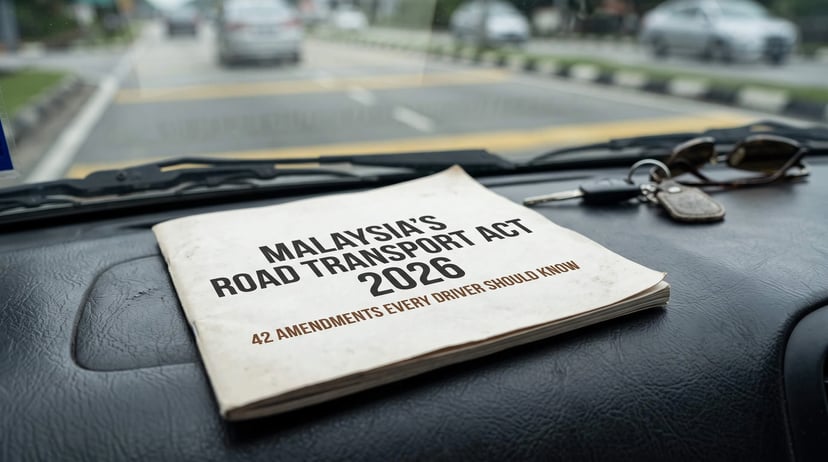
Malaysia’s Road Transport Act 2026: 42 changes every driver should know
Malaysia’s Road Transport (Amendment) Act 2026 became effective on 16 October 2026. This act introduced 42 amendment clauses. The purpose of these clauses is to make roads safer. The changes also focus on improving how laws are enforced. Another goal is to improve services. The changes include penalties for illegal street racing. There are also penalties for people who try to stop enforcement officers. Registered vehicle owners must now take responsibility. The maximum fine for violations has gone up. The new maximum fine is RM500. This change starts on 1 January 2029.
For drivers in Malaysia these changes can affect how traffic violations are handled. The way official notices are sent can also change. The way vehicle ownership is managed can be different too. Knowing about these changes now can help drivers avoid errors. It can also help drivers get ready, for the rules that are coming.
Key takeaways
Effective date: The Road Transport (Amendment) Act 2026 came into force on 16 October 2026.
Illegal street racing: First-time offenders face a fine of RM2,000 to RM10,000, imprisonment of up to two years, or both.
Repeat street racing offences: A second or subsequent conviction carries a fine of RM5,000 to RM20,000, imprisonment of up to five years, or both.
Maximum compound limit: The limit for compoundable offences will increase from RM300 to RM500 on 1 January 2029, but not every offence will automatically attract a RM500 compound.
Digital enforcement: The amendments strengthen the legal framework for electronic documents and notices and clarify registered vehicle owners’ accountability for offences detected by enforcement cameras.
What is Malaysia’s Road Transport Act 2026?
The Road Transport (Amendment) Act 2026 changes Malaysia’s Road Transport Act 1987 which is also called Act 333. It adds 42 clauses in several areas of road transport rules including how the digital services of the Road Transport Department (JPJ) are used.
The new rules aim to make roads safer gaps in enforcement and bring a modern feel to how transport services are handled.
The changes cover street racing ways that people try to stop enforcement, electronic notices how vehicles can be altered, electric vehicles and rules for small electric movers.
The Road Transport (Amendment) Act 2026 began on 16 October 2026. Some parts, like the higher maximum compound limit will start later.
1. Illegal street racing is now a specific offence
One of the important changes is the creation of Section 42A which makes racing or speed testing with two or more motor vehicles on a road a crime. Before it was difficult to bring a case for racing because authorities had to prove dangerous driving or show that an incident caused damage. The new rule allows enforcement, against the racing activity itself without waiting for an accident, injury or death to occur.
What are the penalties for illegal racing?
The penalties under Section 42A depend on whether the offender has a previous conviction.
| Offence | Fine | Imprisonment |
|---|---|---|
| First conviction | RM2,000-RM10,000 | Up to 2 years |
| Second or subsequent conviction | RM5,000-RM20,000 | Up to 5 years |
A court may impose a fine, imprisonment or both, as provided under the law.
What this means for drivers: Illegal racing is not limited to motorcycles. The provision also covers cars and other motor vehicles involved in racing or speed-testing on public roads.
Drivers should avoid organised street races, competitive speed-testing and other activities that could fall within the offence.
2. Tonto activities face heavier penalties
The amendments add Section 110B to deal with actions by called tonto groups that disrupt road enforcement operations.
In this case tonto refers to people who watch enforcement activities and share information to help others avoid law enforcement. This can include following enforcement vehicles getting in the way of operations and spreading details, about enforcement efforts.
What happens if someone interferes with enforcement?
| Detail | Penalty or provision |
|---|---|
| Relevant provision | Section 110B |
| Fine | RM10,000-RM50,000 |
| Imprisonment | 1-5 years |
| Other consequence | Classified as an arrestable offence |
A person convicted under this provision may face a fine, imprisonment or both.
What this means for drivers: Helping another motorist evade enforcement is not necessarily harmless assistance. Individuals who deliberately obstruct officers or disclose operational information to facilitate evasion could face serious legal consequences.
3. Maximum compound limits will rise to RM500 in 2029
The changes mean that the highest amount that can be paid as a fine for offences that can be settled by paying a fine will go up from RM300 to RM500.
This increase will not start right away. It will begin on 1 January 2029 even though the law was already passed and started to work.
The goal of raising the fine is to make people think twice before breaking the rules. This is especially for some traffic offences. These include problems with driving licences, speeding rules, about vehicles and breaking traffic light rules.
Does every traffic summons automatically cost RM500?
No. The RM500 figure is the revised maximum compound limit for applicable compoundable offences, not a fixed amount payable for every traffic offence.
The actual compound offered depends on the offence and the applicable rules and procedures. Some offences may also carry penalties that are determined separately under the law.
| Detail | Previous limit | Revised limit |
|---|---|---|
| MAximum compound limit | RM300 | RM500 |
| Increase | -- | RM200 |
| Percentage increase | -- | Approximately 66.7% |
| Implementation date | Existing limit | 1 January 2029 |
What this means for drivers: Motorists should not assume that every summons will immediately increase to RM500. Instead, they should understand the offence, check the applicable compound amount and settle outstanding matters through the appropriate official channels.
4. Registered vehicle owners face stronger accountability
The amendments strengthen the framework that governs the responsibility of registered vehicle owners for offences detected by enforcement cameras, including automated enforcement systems. These changes make sure that responsibility stays clear for registered vehicle owners when offences are caught by cameras or automated enforcement systems.
Section 53B is one of the provisions that ties into this responsibility accountability. The changes aim to cover situations where responsibility for an offence committed with a vehicle could otherwise be avoided.
This is especially relevant when a vehicle is used by someone, than its registered owner.
What this means for drivers: If you lend your car to a family member, friend or another driver you must know who is using it and make sure that driver follows traffic laws.
If an enforcement notice is issued do not ignore it just because someone else was driving. Check the notice identify the circumstances and follow the applicable procedures to establish or dispute responsibility.
5. Electronic licences, documents and notices receive stronger legal support
The changes make it clearer that electronic licenses, documents, records and notices can be used in road transport administration.
They also allow for accident reporting as long as the rules set by the correct authorities are followed.
These updates help to make JPJ services more digital. Could mean less use of paper-based ways of doing things.
How could digital notices affect motorists?
Electronic delivery can speed up communications and make them easier to handle. Yet motorists must remember that ignoring a notice simply because no paper copy arrived is not a safe choice.
The new rules allow electronic service to flow through designated information-processing systems and the legal effects are set out by the rules.
What this means for drivers is that drivers should keep contact details and registration information current. Drivers should look at JPJ channels, for notices and instructions and drivers must double‑check any message before paying or giving out personal information.
6. Electric vehicles and modified vehicles receive greater regulatory attention
The amendments also strengthen parts of the rules that govern vehicles, modified vehicles and vehicle parts.
These changes are part of a push to make sure all vehicles on Malaysian roads follow the required safety and regulatory standards.
Modifying a vehicle can impact how well it drives, how it handles, how it brakes and whether it meets rules. Electric vehicles come with parts and safety needs that are different, from regular petrol-powered cars.
What this means for drivers: Before making any changes, to your vehicle check if the modifications need approval or an inspection. Don’t assume a change is legal just because it is sold commercially.
Electric vehicle owners should also make sure their vehicles and any parts they add meet the required standards.
7. Micromobility regulation is being strengthened
The amendments also cover micromobility vehicles, including rules about how they're regulated how they can be detained and how they are disposed of.
Micromobility refers to transport devices, like electric scooters and electric bicycles.. The exact way these vehicles are regulated depends on their category and the rules that apply to them.
The changes aim to improve oversight of these vehicles and make enforcement powers clearer.
What this means for drivers and for road users: Do not think that every electric scooter or electric bicycle is allowed on every public road. Check the rules that apply to each scooter or electric bicycle and, to each location before riding.
Motorists should also stay alert to road users and follow traffic rules that are made to keep all drivers and all other road users safe.
8. Penalties for false information and interference with officers are being strengthened
The wider amendments make the enforcement powers stronger. Include new rules, about false information or fake documents given to authorities.
They also add measures to deal with people who block or interfere with enforcement teams during their work.
Depending on the type of offence and the rule that applies the penalties can be quite serious. So drivers and vehicle owners should make sure that any information they provide for licensing, registration or other official processes is correct and truthful.
What this means for drivers: Always make sure to not give papers change details about your car on purpose or try to trick a police officer. If you don't know what papers you need or what to say check with JPJ before you send anything in. Always make sure to not give papers change details, about your car on purpose or try to trick a police officer. If you don't know what papers you need or what to say check with JPJ before you send anything in.
9. What should Malaysian drivers do now?
Although not every amendment changes the everyday driving experience immediately, motorists should take practical steps to stay compliant.
Check your vehicle documents
Ensure that your driving licence, motor vehicle licence (road tax) and other relevant documents are valid. Check expiry dates and follow the applicable renewal procedures.
Review traffic summonses
Check outstanding summonses through official channels and verify the amount payable, payment deadline and available resolution procedures.
Do not rely on the future RM500 maximum compound limit to estimate the amount of a current summons.
Avoid illegal racing and unsafe modifications
Do not participate in street racing or speed-testing on public roads. Before making significant vehicle modifications, confirm the relevant approval and inspection requirements.
Keep vehicle ownership information accurate
Make sure your vehicle registration details and contact information are correct. If you sell your car, complete the required ownership-transfer procedures rather than leaving the vehicle registered under your name indefinitely.
Use Motorist App to understand your car's value
Motorist App can help vehicle owners check their car's estimated market value when considering a sale or reviewing their ownership plans.
An up-to-date valuation can also help you make informed decisions about whether to keep, sell or replace your vehicle. For legal requirements and official enforcement notices, however, refer to JPJ and the relevant authorities.
Old way vs. Motorist App: Understanding your car's value
Keeping track of your vehicle's market value does not need to be a complicated process. Motorist App provides a convenient way to obtain a valuation estimate and support your car ownership decisions.
| Feature | Traditional approach | Motorist app |
|---|---|---|
| Getting a car valuation | Contact dealers or request individual estimates | Check an estimated market value through the app |
| Number of estimates | Depends on the number of dealers contacted | Start with an-app valuation estimate |
| Cost of checking an estimate | Depends on the provider | Check the app's current valuation terms |
| Time required | Depends on dealer availability and response times | Convenient digital access |
| Legal summons information | Contact or check the relevant authority | Use official JPJ channels for authoritative information |
Important: A vehicle valuation is an estimate, not a guaranteed selling price. The actual price depends on the cars condition, mileage, service history, variant, location and market demand. Motorist App does not replace JPJ channels for confirming legal requirements or traffic penalties.
Expert tip: Check the implementation date before acting
Do not confuse the Act's commencement date with the implementation date of every individual measure. The Road Transport (Amendment) Act 2026 came into force on 16 October 2026, but the revised maximum compound limit of RM500 is scheduled to take effect on 1 January 2029.
Before paying a summons or advising another driver about a penalty, verify the applicable offence, the current compound amount and the relevant effective date through official channels.
Common mistake: Assuming every traffic summons is now RM500
A common mistake is that the amendments instantly cause every traffic summons to cost RM500.
That is wrong. The RM500 figure is the revised compound limit, for applicable offences. That limit will take effect from 1 January 2029. The amount that a traffic summons can be paid depends on the provisions and procedures that apply to each offence.
Always check the summons instead of trusting headlines or social media posts.
Conclusion
Malaysia’s Road Transport (Amendment) Act 2026 strengthens road safety enforcement, introduces tougher penalties for illegal racing and tonto activities, and expands the legal framework for digital transport services. Drivers should understand the changes, pay attention to implementation dates and verify their obligations through official channels. Motorist App can also help owners make informed decisions by checking their vehicle's estimated market value.
FAQs
1. When did Malaysia’s Road Transport (Amendment) Act 2026 take effect?
The Act came into force on 16 October 2026. However, certain measures, including the revised maximum compound limit, have separate implementation dates.
2. How many amendments are included in the Road Transport Act 2026?
The Road Transport (Amendment) Act 2026 contains 42 amendment clauses covering enforcement, digitalisation, vehicle regulation and road safety.
3. What is the fine for illegal street racing in Malaysia?
For a first conviction under Section 42A, the fine is RM2,000 to RM10,000, or imprisonment of up to two years, or both.
4. What is the penalty for repeat illegal street racing?
A second or subsequent conviction carries a fine of RM5,000 to RM20,000, imprisonment of up to five years, or both.
5. What is the penalty for tonto activities under the amended Act?
A person convicted under Section 110B may face a fine of RM10,000 to RM50,000, imprisonment of one to five years, or both. The offence is also classified as an arrestable offence.
6. Will all Malaysian traffic summonses increase to RM500?
No. The RM500 figure is the revised maximum compound limit for applicable compoundable offences, not an automatic fixed amount for every summons.
7. When will the maximum compound limit increase to RM500?
The revised maximum compound limit is scheduled to take effect on 1 January 2029, increasing from RM300 to RM500.
8. Can a registered vehicle owner be held accountable for a camera-detected traffic offence?
The amendments strengthen registered owners' accountability for offences detected by enforcement cameras. The applicable responsibility and procedures depend on the circumstances and the relevant legal provisions.
9. Are electronic JPJ notices legally recognised under the amendments?
The amendments strengthen the legal basis for electronic notices, licences, documents and records. Motorists should check official channels and follow the procedures applicable to the notice they receive.
10. Do the amendments affect electric vehicles and modified cars?
Yes. The amendments strengthen aspects of the regulatory framework covering electric vehicles, modified vehicles, vehicle components and micromobility. Owners should check the specific requirements that apply to their vehicles.
11. Where can Malaysian drivers check official traffic summons information?
Drivers should use the relevant official JPJ or enforcement-authority channels to verify summons details, payment amounts and applicable deadlines.
12. Can Motorist App tell me whether my car complies with the new Act?
Motorist App can help owners check their vehicle's estimated market value, but it does not replace official legal guidance or JPJ verification. For compliance questions, consult the relevant authorities.
Check your car's value with Motorist App
Read More: Someone hit your parked car and drove away? What to do
I want to find the highest selling price for my car within 24 hours!
Download the Motorist App now. Designed by drivers for drivers, this all-in-one app lets you receive the latest traffic updates, gives you access to live traffic cameras, and


