Headlights left on overnight? Battery fix tips
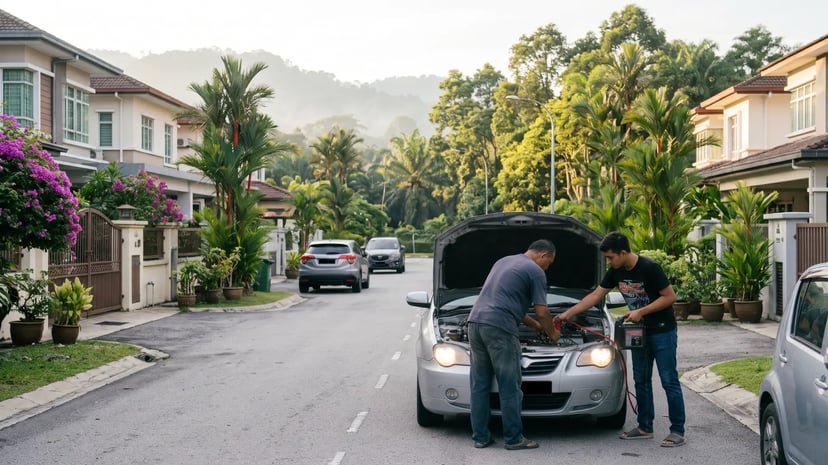
If you left your headlights on overnight, your car battery is very likely flat, but in most cases it is not dead for good: a jump-start and a 30-minute drive usually revive it, while repeated drain-downs can shorten its life by months.
It is 7am, you are already late, and your car clicks once and goes silent. Every Malaysian driver dreads this moment, and it takes only one forgotten switch to cause it. Here is what actually happens inside your battery, the dos and don'ts of getting moving again, and how to stop it happening twice.
Key takeaways
- Headlights can drain a typical car battery flat in roughly 4 to 8 hours, so a full night with the lights on almost always leaves you unable to start.
- A flat battery can usually be saved. A jump-start plus at least 30 minutes of driving restores enough charge to start the car again.
- Repeated deep drains cause permanent damage. Each one shortens battery life, and a battery drained more than once or twice often needs replacing.
- What you do in the first 10 minutes matters. Switching everything off and jump-starting correctly protects both the battery and your car's electronics.
- Get help fast. If you have no cables or donor car, the Motorist App, backed by AutoConcierge, is the quickest way to get help while stranded.
What actually happens to your battery when headlights stay on overnight
The drain is faster than most drivers expect. Your engine is off, so the alternator is not charging anything. The headlights run entirely off the battery, which is built to deliver a short burst of power to start the engine, not to power lights for hours.
The maths is simple. A pair of halogen headlight bulbs draws roughly 100 to 120 watts, or about 9 to 10 amps at 12 volts. A typical small-to-mid-size car battery holds around 40 to 60 amp-hours, so the lights can empty it in roughly 4 to 6 hours. Add dash lights, and a full night is more than enough. These are typical figures; your exact numbers depend on your bulbs and battery size.
Stage 1: The charge drops below starting strength (first 2 to 4 hours)
A healthy, fully charged battery rests at around 12.6 volts. As the lights draw it down, voltage falls toward 12.0 volts (about 50% charge). The car may still start at this point, but it is already struggling.
Stage 2: The starter motor can't turn the engine (4 to 8 hours)
Starting an engine needs a large surge of current. Once voltage sags too far, you hear slow cranking or rapid clicking, and the dashboard lights look dim. This is the classic flat-battery symptom.
Stage 3: Deep discharge damages the battery (voltage stays very low)
If a lead-acid battery sits deeply discharged, lead sulfate crystals harden on the plates (sulfation). Hardened crystals reduce the battery's capacity permanently. This is why one overnight drain may be harmless, but repeated drains quietly kill batteries.
Note on modern cars: Many newer cars switch the headlights off automatically when you lock the car or open the door, and LED lights draw far less power than halogen. If your car has these features, a single night is less likely to flatten it, but older cars and manual-light models remain at risk.
Will the battery recover? How to tell
Most batteries survive one overnight drain. Whether yours does depends on its age, type and how deeply it was discharged.
| Situation |
Likely outcome |
|---|---|
| Battery under 2 years old, drained once | Usually recovers after a jump-start and a long drive |
| Battery 2 to 3 years old, drained once | May recover, but get its health checked soon |
| Battery over 3 years old | Often fails to hold charge afterwards; plan to replace |
| Drained two or more times | Capacity is likely reduced; replacement is the safer choice |
| Car has start-stop (EFB/AGM battery) | Needs a proper charge or professional check, not just a quick jump |
Dos and don'ts when your battery is flat
Do the right things in the right order. Most lasting damage to a flat-battery car comes from rushed fixes, not from the headlights themselves. Use this table as a quick checklist.
| ✅ Do | ❌ Don't |
|---|---|
| Switch off the headlights, air-conditioning, radio and any plugged-in charger before you try anything | Keep trying to crank the engine repeatedly; it drains what little charge is left and can overheat the starter |
| Check your owner's manual for the jump-start points, especially on hybrids, EVs and start-stop cars | Jump-start a hybrid or EV the same way as a conventional car without checking the manual first |
| Connect cables in order: red to both positives, black to the donor's negative, last black clamp to bare metal on your engine | Clamp the last black cable to the dead battery's negative terminal; this can cause a spark near battery gas |
| Let the donor car run for about five minutes before you try to start yours | Let the cable clamps touch each other or rev the donor engine hard while connected |
| Drive for at least 30 minutes after it starts so the alternator can recharge the battery | Switch the engine off as soon as you arrive; a few minutes of charge will not restart it |
| Get the battery and alternator tested the same day or the next day | Assume it's fixed because the car started; a weak battery often fails again within days |
| Replace the battery if it is over 2 to 3 years old or has been drained more than once | Ignore warning signs such as slow cranking, dim lights or a battery warning light |
Expert tip
Insider tip from the Motorist team: After any flat-battery incident, check the date sticker or code on your battery. If it is more than about 2 to 3 years old, replace it rather than just jump-starting it. In Malaysia's heat, an ageing battery that has been drained once is the one that strands you again, usually at the worst possible moment. Replace it on your schedule, not the battery's.
Common mistake to avoid
Mistake: turning the engine off after a jump-start to "save fuel" or because you've arrived. A jump-start only gives the battery a trickle of charge. If you park after five minutes, the battery is still nearly flat and the car often will not restart. Drive for at least 30 minutes, ideally at steady speed, before switching off.
How to stop it happening again
Build a two-second habit. Before you step out, glance at the dashboard and turn the light switch to off. If your car has an "Auto" light setting, use it.
Use the reminder tools your car already has. Many cars chime when the door opens with lights on. Do not ignore the chime.
Test your battery every year. Many battery retailers and workshops offer battery health checks. Book one once the battery reaches about 18 months old.
Keep a jump-starter or cables in the boot. A portable jump-starter pack is a one-off purchase that gets you moving without needing another car.
Keep help one tap away. If you do get stranded, the Motorist App, supported by AutoConcierge, lets you request car help from your phone instead of calling around.
Conclusion
Leaving your headlights on overnight will almost always flatten your battery, but a correct jump-start and a long drive usually bring it back. If it happens more than once, or your battery is over two to three years old, replace it before it strands you. Keep help one tap away with the Motorist App.
FAQ
1. How long does it take for headlights to drain a car battery?
Halogen headlights typically drain a standard car battery in about 4 to 8 hours, depending on battery size, age and charge level. A full night will almost always leave it too flat to start.
2. Will my car battery recover after the headlights were left on all night?
Often yes. A jump-start followed by at least 30 minutes of driving usually restores enough charge, but an older battery, or one drained repeatedly, may not hold charge afterwards.
3. Can leaving headlights on overnight damage the battery permanently?
Yes, especially if it happens more than once. Deep discharge causes sulfation on the battery plates, which permanently reduces capacity and shortens lifespan.
4. How do I jump-start a car after leaving the headlights on?
Connect the red cable to both positive terminals, the black cable to the donor's negative, and the last black clamp to bare metal on your engine. Run the donor car for about five minutes, then start yours and keep it running.
5. How long should I drive after a jump-start?
Drive for at least 30 minutes. Short trips do not give the alternator enough time to recharge a flat battery.
6. Should I replace my battery after leaving the headlights on?
Replace it if the battery is more than 2 to 3 years old, struggles to start again, or has been drained more than once. A workshop can test it to confirm.
7. Do LED headlights drain the battery as quickly as halogen?
No. LED headlights draw considerably less power than halogen bulbs, so they take much longer to flatten a battery, but a full night can still be enough on an older or weak battery.
8. Do newer cars turn the headlights off automatically?
Many do, through an auto-off or "Auto" light setting, but not all cars have it. Check your owner's manual to see how your car behaves.
9. Can I jump-start a hybrid or electric car?
You can usually jump the 12V battery, but the method differs from a conventional car and mistakes can be costly. Check your owner's manual or call a professional.
Don't get stranded by a flat battery again. Download the Motorist App and get help in a few taps.
Read More: Best car insurance plans in Malaysia 2026: Compare top options
I want to find the highest selling price for my car within 24 hours!
Download the Motorist App now. Designed by drivers for drivers, this all-in-one app lets you receive the latest traffic updates, gives you access to live traffic cameras, and helps you manage vehicle related matters.


