MITI’s new CBU EV rules could reshape Malaysia’s EV market from July 2026
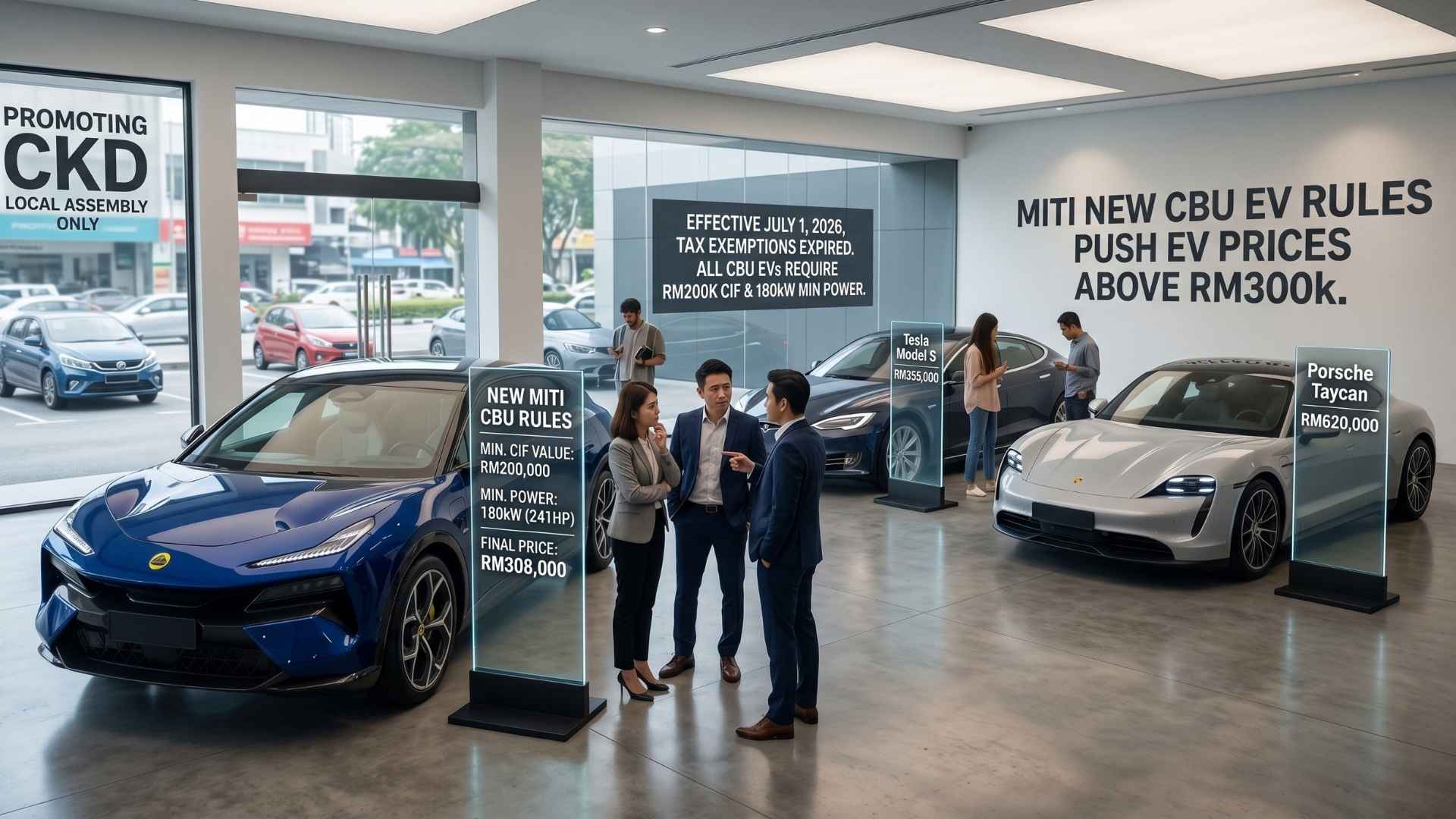
Malaysia’s electric vehicle market is heading into one of its biggest shakeups yet after the Ministry of Investment, Trade and Industry (MITI) confirmed new rules for fully imported EVs entering the country from July 1, 2026.
Under the new regulations, all completely built-up EVs, also known as CBU EVs, must meet two key requirements before they can be approved for import into Malaysia. The vehicle must have a minimum cost, insurance and freight value of RM200,000, and it must produce at least 180 kW or 245 PS of power.
While the policy may appear technical at first glance, its impact on the Malaysian automotive industry could be massive. Industry observers believe the move will significantly reduce the number of affordable imported EVs available locally while accelerating the push toward locally assembled EV production.
To understand why this matters, it is important to define what CIF value means. CIF refers to the declared value of the vehicle before local taxes, excise duties, dealer margins and distributor profits are added. In practical terms, a vehicle with a RM200,000 CIF value could easily end up costing more than RM300,000 on the road after taxes and operational costs are included.
This means many imported EVs currently sold between RM100,000 and RM200,000 may no longer qualify for sale in Malaysia unless manufacturers begin local assembly operations.
MITI says the move is intended to encourage more carmakers to invest in completely knocked down assembly programmes, commonly known as CKD operations. CKD refers to vehicles being assembled locally using imported parts instead of being brought in as complete units.
The policy direction aligns with Malaysia’s broader industrial strategy to develop local manufacturing capability, strengthen the EV supply chain and protect investments already made by domestic automotive players.
However, the announcement has also sparked debate across the automotive industry because the rules could dramatically reduce consumer choice in the short term.
Several popular EVs currently sold in Malaysia may fail to meet the new minimum power requirement. Models such as the BYD Atto 3, Nissan Leaf, Leapmotor B10 and iCaur 03 could potentially be affected under the new framework.
At the same time, higher-performance EVs such as the BYD Seal, Zeekr X, Xpeng G6 and smart EV range may technically survive the new regulations due to their stronger power outputs. However, many of these vehicles may see significant price increases if they remain fully imported.
This has led to growing speculation that the policy could indirectly benefit Proton’s eMas EV lineup, particularly the Proton eMas 5 and eMas 7, which already enjoy local assembly advantages and special regulatory considerations.
Industry analysts believe brands with existing CKD operations or confirmed assembly plans will gain a strong competitive advantage moving forward.
Some automakers are already preparing for this transition. MG has reportedly started local assembly activity for the MG S5 EV in Melaka, while Zeekr is expected to assemble vehicles in Tanjung Malim under Geely’s Automotive Hi-Tech Valley project.
Stellantis has also previously indicated that local assembly capability would allow the company to maintain pricing competitiveness even after tax incentives disappear.
The policy shift also reflects how Malaysia’s EV strategy has evolved since the government first introduced tax exemptions for imported EVs in 2022. Back then, the goal was clear. Malaysia wanted to accelerate EV adoption quickly by lowering entry barriers for consumers and attracting global EV brands into the market.
That earlier strategy helped increase EV awareness and gave Malaysians access to more affordable electric cars. EV registrations grew rapidly over the past two years as more consumers considered switching away from petrol vehicles.
Now, the government appears to be entering the next phase of its EV roadmap, focusing less on imports and more on domestic industrial growth.
Still, some experts worry the sudden tightening of regulations could slow EV adoption in Malaysia if consumers are left with fewer affordable options. The concern is especially relevant because mainstream EV buyers are highly price sensitive.
There are also questions about policy consistency. Over the past few months, MITI’s EV import conditions have reportedly changed several times, creating uncertainty for distributors, dealers and potential investors.
For consumers planning to buy an EV soon, the coming months could become crucial. Buyers interested in imported EVs may try to secure purchases before July 2026 to avoid potential price increases or limited availability.
Meanwhile, automotive brands without local assembly plans may need to rethink their long term strategy in Malaysia entirely.
What remains clear is that Malaysia’s EV market is entering a new chapter. The era of affordable fully imported EVs may soon be coming to an end, replaced by a market increasingly shaped by local assembly, industrial policy and strategic manufacturing investment.
FAQ
1. What are the new MITI rules for imported EVs?
Starting July 1, 2026, imported CBU EVs must have a minimum CIF value of RM200,000 and at least 180 kW or 245 PS of power to qualify for import approval in Malaysia.
2. What does CIF value mean?
CIF stands for Cost, Insurance and Freight. It refers to the vehicle’s value before local taxes, excise duties, dealer costs and profit margins are added.
3. Will EV prices increase in Malaysia?
Many analysts believe imported EV prices could rise above RM300,000 because of the new CIF requirement and taxes applied after importation.
4. Which EV brands may be affected?
Popular imported EV models from BYD, Nissan, Leapmotor and several Chinese EV brands could be affected if they do not meet the new minimum power and pricing requirements.
5. Why is MITI introducing these rules?
The policy aims to encourage more local EV assembly operations, strengthen Malaysia’s automotive ecosystem and support long term industrial development.
6. Thinking about buying an EV before prices potentially rise?
Compare new and used EV deals, check financing options and explore the latest automotive updates with Motorist Malaysia. Whether you are upgrading, selling or insuring your vehicle, Motorist Malaysia helps drivers make smarter automotive decisions with ease.