Buying a Car in 2026? Here’s What Changed on 1 June and Why It Matters for Every Malaysian Buyer
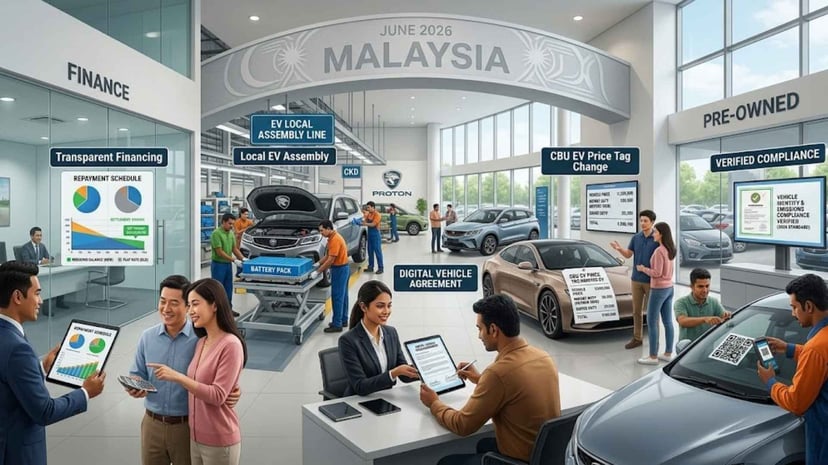
Starting 1 June 2026, several major reforms under the Hire-Purchase (Amendment) Act 2026 officially came into effect, introducing one of the biggest overhauls to Malaysia's vehicle financing landscape in decades. These changes are designed to improve transparency, strengthen consumer protection and make it easier for buyers to understand the true cost of vehicle ownership.
For many Malaysians, purchasing a vehicle is one of the largest financial commitments they will make. Yet for years, car loans were often criticised for being difficult to understand, particularly when it came to interest calculations, early settlement charges and loan comparisons.
The latest reforms aim to address these concerns. Whether you are shopping for your first car, upgrading your family vehicle or considering an electric vehicle, understanding these new rules could save you thousands of ringgit over the life of your loan.
Here are the five biggest changes every Malaysian car buyer should know.
what is the hire-purchase amendment act 2026?
the Hire-Purchase (Amendment) Act 2026 was introduced to modernise Malaysia's vehicle financing framework and improve fairness for consumers. The legislation officially took effect on 1 June 2026 and introduces several important changes to how banks and financing institutions structure and present vehicle loans.
The primary objective is simple. Consumers should be able to understand exactly how much they are paying, compare financing offers more easily and avoid hidden disadvantages that previously existed in traditional hire-purchase agreements.
The Rule of 78 Has Finally Been Abolished
One of the most significant changes is the removal of the Rule of 78.
Under the previous system, interest charges were heavily front-loaded into the early stages of a loan. This meant borrowers paid a larger proportion of interest during the first few years while reducing relatively little of the actual principal balance.
As a result, consumers who wanted to settle their loans early often discovered that they had saved less money than expected because much of the interest had already been paid upfront.
With the new amendments, the Rule of 78 is no longer permitted for new hire-purchase agreements. Instead, financing providers must move towards a reducing balance calculation method.
This creates a fairer system where interest is calculated based on the outstanding loan balance rather than the original borrowed amount throughout the entire loan tenure.
For consumers, this means greater transparency and potentially lower financing costs, especially for those planning to make early settlements or additional repayments.
Effective Interest Rate Becomes the New Standard
For decades, Malaysian car buyers have been familiar with flat interest rates.
A loan advertised at 2.5% or 3.0% may appear attractive on paper. However, many consumers were unaware that flat rates do not accurately reflect the true financing cost because interest is calculated on the original loan amount throughout the tenure.
The new framework places greater emphasis on the Effective Interest Rate, commonly known as EIR.
Unlike flat rates, EIR reflects the actual cost of borrowing by taking into account the reducing loan balance over time.
This change provides a more accurate comparison between different financing packages. Buyers can now evaluate loan offers more effectively and identify which bank is genuinely offering the best deal.
Financial experts have long advocated for the use of EIR because it aligns with international banking practices and provides consumers with clearer information when making borrowing decisions.
BLR Has Been Replaced With Reference Rate
Another change that may confuse some consumers is the disappearance of the term Base Lending Rate, commonly known as BLR.
From 1 June 2026 onwards, financial institutions will use the term Reference Rate instead.
For most car buyers, this change does not affect monthly repayments or financing structures directly. It is primarily a terminology update that aligns with modern banking frameworks and regulatory standards.
However, consumers reviewing financing documents should be aware of the new terminology to avoid confusion during the loan application process.
The underlying principles remain largely unchanged, but the language used by banks and financing institutions will now reflect the updated framework.
Digital Signatures Are Now Legally Accepted
Malaysia's vehicle financing process is also moving into the digital age.
Previously, purchasing a vehicle often involved lengthy paperwork, multiple signatures and repeated visits to dealerships or bank branches.
The amended legislation now allows consumers to electronically sign hire-purchase agreements using legally recognised digital signatures.
This creates a more convenient and efficient experience, especially for buyers who prefer online transactions.
Consumers can review agreements digitally, complete documentation remotely and receive electronic copies for future reference.
Financial institutions are still required to conduct identity verification and fraud prevention checks. Depending on the bank, additional security measures such as biometric verification or physical identity confirmation may still be required.
Nevertheless, the overall process is expected to become significantly faster and more user-friendly.
Not Every Bank Has Fully Transitioned Yet
Although the new law officially took effect on 1 June 2026, consumers should understand that implementation across the industry will not happen overnight.
The government has provided a transition period until 31 March 2027 for financing providers that require additional time to upgrade their systems and operational processes.
According to official announcements, several financial institutions were already prepared to implement the new framework from day one, while others will gradually transition over the coming months.
This means car buyers should actively ask dealerships and financing providers whether the loan package being offered complies with the new reducing balance and EIR framework.
Comparing multiple financing offers has never been more important.
What These Changes Mean for Malaysian Car Buyers
Collectively, these reforms represent a major shift towards greater transparency and consumer empowerment.
Buyers can now expect clearer loan disclosures, more accurate financing comparisons and fairer treatment when making early settlements.
While the changes may initially seem technical, they ultimately provide consumers with better information and greater control over one of their most significant financial commitments.
For first-time buyers especially, understanding EIR, reducing balance calculations and the new financing framework can help prevent costly mistakes and improve long-term financial planning.
As Malaysia's automotive industry continues to evolve alongside electrification, digitalisation and changing consumer expectations, these reforms provide a stronger foundation for responsible vehicle ownership.
FAQ
1. What is the biggest car loan change introduced on 1 June 2026?
The biggest change is the abolition of the Rule of 78 and the transition towards reducing balance interest calculations for new hire-purchase agreements. This creates a fairer financing structure for consumers.
2. What is Effective Interest Rate (EIR)?
EIR reflects the actual cost of borrowing by considering the reducing loan balance over time. It provides a more accurate comparison between different financing offers than traditional flat interest rates.
3. Can I still get a traditional flat-rate car loan?
New financing arrangements are moving towards the EIR and reducing balance framework under the amended legislation. Consumers should confirm the financing structure with their chosen bank or lender.
4. Can I sign my car loan documents online?
Yes. The amended legislation now recognises electronic and digital signatures for hire-purchase agreements, subject to verification requirements imposed by financial institutions.
5. Will all banks follow the new rules immediately?
Not necessarily. The government has provided a transition period until 31 March 2027 for providers still upgrading their systems. Buyers should verify whether their financing provider has already adopted the new framework.
Planning to buy a new car soon? Let Motorist Malaysia help you make a smarter decision. From comparing car financing options and insurance renewals to selling your current vehicle and managing ownership costs, Motorist Malaysia provides the tools and expertise you need throughout your car ownership journey. Download the Motorist Malaysia app today and discover a simpler, more transparent way to buy, own and manage your vehicle.
Read More: Malaysia traffic crisis as new car sales surge in 2026
I want to find the highest selling price for my car within 24 hours!
Download the Motorist App now. Designed by drivers for drivers, this all-in-one app lets you receive the latest traffic updates, gives you access to live traffic cameras, and helps you manage vehicle related matters.