Worn-out tyres: 7 signs Malaysian drivers should know
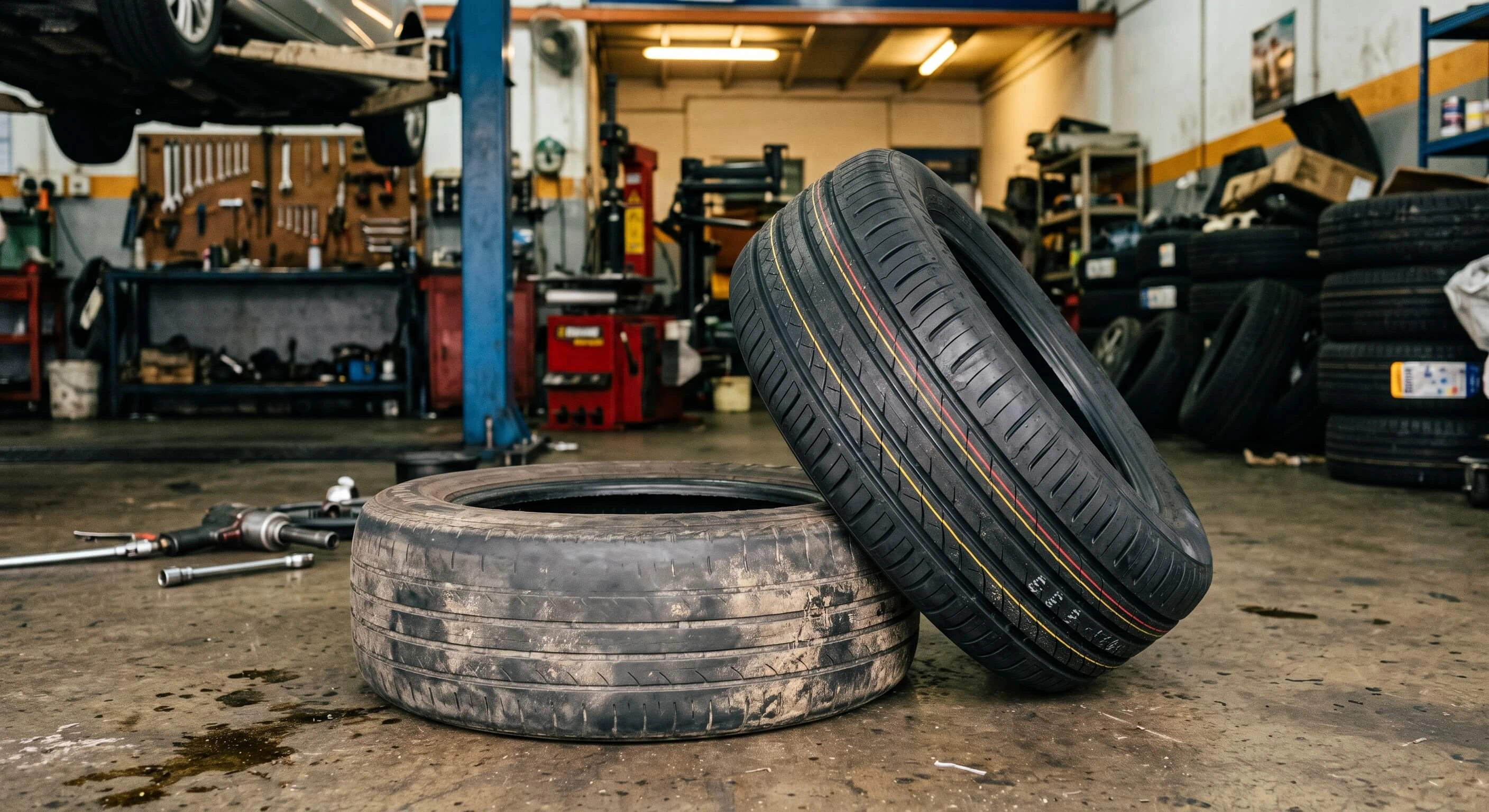
Worn-out tyres can become a safety problem before they look completely bald
Worn-out tyres can reduce wet-weather grip and increase the risk of punctures, blowouts and longer braking distances, so Malaysian drivers should check tread, damage, pressure and age regularly.
Your tyres are the only parts of your car constantly touching the road, yet they are easy to ignore until something goes wrong. Yokohama Malaysia identifies seven key warning signs, including low tread depth, uneven wear, sidewall cracks, unusual vibrations, tyre age, pressure fluctuations and sudden pressure loss.
For Malaysian drivers, this matters even more during heavy rain, when worn tread can reduce the tyre's ability to move water away from the contact patch.
Key takeaways
- 1.6 mm is the minimum tread-depth figure highlighted for worn tyres in Malaysia; commercial vehicles have faced a stricter whole-contact-surface inspection requirement since 1 June 2025.
- Around 3 mm is an earlier replacement point recommended by safety guidance cited by Yokohama, rather than waiting until the 1.6 mm legal threshold.
- Uneven wear can signal another problem, including incorrect tyre pressure, wheel misalignment or suspension faults.
- Cracks, bulges, vibrations and sudden pressure loss can indicate tyre damage even when plenty of tread remains.
- The Motorist App can help manage broader car ownership, including vehicle reminders and Personal AutoConcierge support, but it does not replace a physical tyre inspection.
1. Low tyre tread depth
Tread depth is one of the first things to check. The grooves in your tyres help channel water away from the contact patch. As tread wears down, wet-weather performance can deteriorate.
A tread depth of 1.6 mm is the minimum threshold used for tyre inspection in Malaysia. Drivers should not wait until their tyres are completely bald before checking them, as reduced tread can affect grip and water dispersion.
For commercial vehicles, inspection requirements introduced from 1 June 2025 require at least 1.6 mm across the entire tyre surface that contacts the road.
Should you wait until 1.6 mm to replace a tyre?
No. Treat 1.6 mm as a minimum threshold, not necessarily your replacement target. Replacing tyres at around 3 mm can provide additional tread depth before reaching the minimum.
This extra margin can be particularly useful for Malaysian drivers who regularly drive in heavy rain or on wet roads.
2. Uneven tyre wear
Uneven wear is often a warning that something else is wrong with the car. If one side of a tyre is wearing faster than the other, the cause could include incorrect tyre pressure, wheel alignment problems or suspension components.
For example, excessive wear on both shoulders can indicate under-inflation, while excessive centre wear can be associated with over-inflation. One-sided wear can point towards an alignment issue.
If the same pattern keeps appearing after replacing a tyre, simply fitting another tyre may not solve the underlying problem.
3. Cracks or bulges on the sidewall
Visible cracks, cuts or bulges should never be ignored. Sidewall cracking can develop as rubber ages, while a bulge can indicate damage to the tyre's internal structure.
A tyre with a significant bulge may have suffered an impact from a pothole or kerb. Because the sidewall contributes to the tyre's structural integrity, visible deformation should be professionally inspected.
If you spot serious cracking or a bulge, do not assume the tyre is safe simply because its tread still looks deep.
4. New vibrations or unusual noises
A new vibration or unusual tyre-related noise can be a warning sign. Possible causes include an unbalanced wheel, uneven tyre wear or internal tyre damage.
Pay particular attention if the vibration changes with vehicle speed or is accompanied by steering-wheel shaking. Alignment, balancing, suspension and tyre condition may all need to be checked.
Do not assume that a vibration is simply a normal characteristic of the car, especially if it has appeared suddenly.
5. Tyre age
Tyres can deteriorate with age even when the car is driven infrequently. Rubber gradually changes over time, which can increase the risk of cracking and other forms of deterioration.
A five-year-old tyre deserves particular attention even if it still appears to have sufficient tread. Actual tyre life can vary depending on storage, mileage, road conditions, climate and maintenance.
Check the tyre's manufacturing-date marking on the sidewall so you know how old the rubber actually is rather than relying only on how much tread remains.
6. Frequent tyre pressure changes
A tyre that repeatedly loses pressure deserves investigation. Pressure loss can be caused by punctures, leaks, valve problems or other issues, while normal air loss can also occur gradually over time.
Check your tyre pressure using the vehicle manufacturer's recommended pressure rather than the maximum pressure printed on the tyre sidewall.
Correct pressure also helps prevent premature and uneven tread wear.
7. Sudden pressure loss or a blowout
Sudden pressure loss is an emergency warning sign. A blowout or rapid deflation can result from excessive wear, impact damage, incorrect inflation or other tyre failures.
If a tyre suddenly loses pressure while driving, avoid making sudden steering or braking movements. Slow down safely, move to a safe location, switch on your hazard lights and arrange professional assistance if necessary.
It is also worth checking your spare tyre periodically. A spare that has been sitting unused for years is not automatically ready for an emergency.
How often should you check your tyres?
Make tyre inspection part of your regular car routine. A quick monthly check can help you spot tread wear, pressure problems, cracks and foreign objects before they become more serious.
A practical checklist is:
| What to check | Figure / timing | What to look for |
|---|---|---|
| Tread depth | 1.6 mm minimum | Excessively shallow tread |
| Earlier replacement point | Around 3 mm | Consider replacing before the minimum |
| Tyre age | 5 years | Age-related deterioration |
| Tyre rotation | Every 10,000 km or manufacturer's recommendation | Uneven wear |
| Tyre pressure | Monthly when cold | Under- or over-inflation |
| Commercial vehicle inspection | From 1 June 2025 | 1.6 mm across the entire road-contact surface |
The distinction is simple: use a physical tyre inspection for tyre safety, and use the Motorist App to simplify the wider administration of owning a car.
Motorist's Personal AutoConcierge can also provide personalised assistance through in-app chat for motoring-related questions.
Expert tip: Check all four tyres, not just the front pair
Turn the steering wheel and inspect the inner and outer edges of the front tyres. Drivers often look only at the easily visible outer shoulder, while alignment-related wear can develop on the inside edge.
Check all four tyres and compare the tread across the centre and both shoulders. If one tyre looks noticeably different from the others, get it inspected rather than assuming it will wear evenly later.
Common mistake: Using the tyre sidewall's maximum pressure
The maximum pressure printed on the tyre is not necessarily the pressure your car should use. Your vehicle manufacturer's recommended pressure is the figure to follow, usually displayed on the driver's-door placard or in the owner's manual.
Using the wrong pressure can contribute to uneven wear and affect handling. Check pressures when the tyres are cold for a more useful reading.
Conclusion
Worn-out tyres do not always announce themselves with a completely bald tread. Checking tread depth, wear patterns, sidewalls, pressure, vibrations and tyre age can help Malaysian drivers identify problems before they become more serious.
The Motorist App can simplify the wider business of car ownership, while tyre inspections and replacement should still be handled by qualified professionals when needed.
FAQs
1. What is the minimum tyre tread depth in Malaysia?
The minimum tread-depth threshold is 1.6 mm. For commercial vehicles, the inspection requirement applies across the entire tyre surface that contacts the road.
2. Should I replace my tyres at 1.6 mm?
Not necessarily. Around 3 mm can be considered an earlier replacement point, giving drivers additional tread before reaching the minimum threshold.
3. How can I check my tyre tread depth?
You can use a tread-depth gauge for a precise measurement or check the moulded tread-wear indicators. A visual inspection can identify obvious wear, but a gauge provides a more accurate reading.
4. What causes uneven tyre wear?
Common causes include incorrect tyre pressure, wheel misalignment, balancing problems and suspension faults. The wear pattern can help indicate which component needs inspection.
5. How often should I check my tyre pressure?
A practical routine is to check tyre pressure monthly, preferably when the tyres are cold. You should also check them before longer journeys or whenever you notice pressure dropping unusually quickly.
6. How long do car tyres last in Malaysia?
There is no single lifespan for every tyre. Usage, mileage, road conditions, pressure, storage and maintenance all affect tyre life. A tyre that is around five years old should receive particular attention for signs of deterioration.
7. Are cracked tyres safe to drive on?
Significant cracks can indicate rubber deterioration and may compromise tyre integrity. Cracked tyres should be professionally inspected, particularly when cracking is accompanied by bulges or other visible damage.
8. What does a tyre bulge mean?
A bulge can indicate internal structural damage, often following an impact with a pothole or kerb. It should be treated as a serious warning sign and inspected promptly.
9. Can low tyre pressure cause uneven wear?
Yes. Under-inflation can contribute to increased wear on the tyre shoulders and can also increase heat buildup and rolling resistance.
10. Does the Motorist App check tyre tread depth?
No. The Motorist App does not physically measure tyre tread. It helps with broader vehicle ownership through reminders, vehicle information, transactions and Personal AutoConcierge support.
Keep your car ownership organised with the Motorist App
Read More: BUDI Diesel: Now you can share it with anyone
I want to find the highest selling price for my car within 24 hours!
Download the Motorist App now. Designed by drivers for drivers, this all-in-one app lets you receive the latest traffic updates, gives you access to live traffic cameras, and helps you manage vehicle related matters.