Parking on pedestrian walkways in Malaysia: Fines and towing
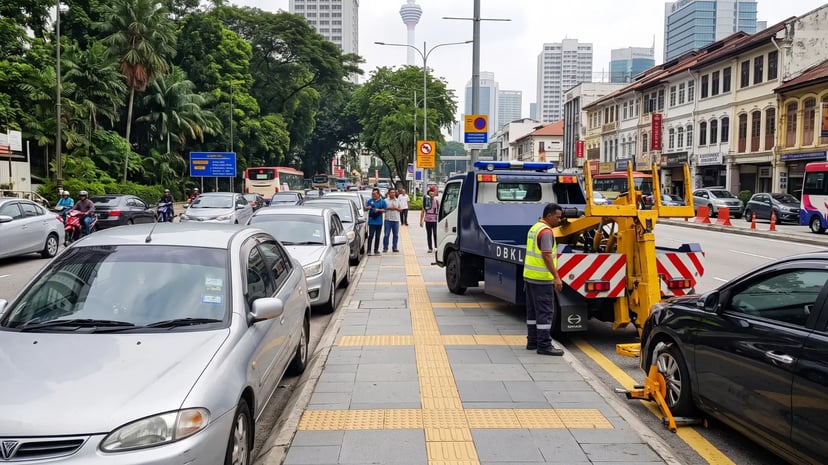
Parking on pedestrian walkways in Malaysia is illegal and can result in a saman, wheel clamping or vehicle towing. Under Rule 44 of the Road Traffic Rules 1959 and Section 48 of the Road Transport Act 1987, motorists who obstruct pedestrian access may face enforcement action. Depending on the offence, drivers may also be required to pay towing and vehicle storage fees.
Finding a parking space in busy areas such as Kuala Lumpur, Petaling Jaya and other major Malaysian cities can be frustrating. However, mounting the kerb and leaving your car on a pedestrian walkway is not a legal solution, even if you are only stopping for a few minutes.
Table of Contents
- Is parking on pedestrian walkways illegal in Malaysia?
- How much is the fine for parking on a pedestrian walkway?
- Can your car be towed for blocking a pedestrian walkway?
- How much does it cost to reclaim a towed car?
- What happens if your car is towed?
- Why parking on pedestrian walkways is dangerous
- How to report cars parked on pedestrian walkways
- How to avoid parking fines and towing
- Frequently Asked Questions
Key takeaways
- Parking on pedestrian walkways is prohibited in Malaysia.
- Under Section 48 of the Road Transport Act 1987, qualifying obstruction offences can carry a court-imposed fine of RM1,000 to RM5,000 upon conviction.
- Authorities can clamp or tow vehicles that obstruct road users.
- DBKL lists a towing fee of RM100 and a daily storage fee of RM100 for passenger cars, where applicable.
- Switching on your hazard lights or leaving your phone number on the dashboard does not make illegal parking permissible.
Is parking on pedestrian walkways illegal in Malaysia?
Yes. Pedestrian walkways, pavements and footpaths are intended for pedestrians, not motor vehicle parking.
Rule 44 of the Road Traffic Rules 1959 prohibits vehicles from using footpaths, subject to limited exceptions that do not permit ordinary car parking.
Additionally, Section 48 of the Road Transport Act 1987 makes it an offence to leave a motor vehicle on a road in circumstances likely to endanger or obstruct other road users or cause unreasonable inconvenience.
This means motorists should avoid parking in locations such as:
- Pedestrian walkways outside shops and restaurants.
- Pavements alongside public roads.
- Covered pedestrian pathways.
- Wheelchair access ramps.
- Pedestrian crossings.
- Walkways near schools, hospitals and public transport stations.
Even if there is no visible no-parking sign, a pedestrian walkway should not be treated as an additional parking space.
How much is the fine for parking on a pedestrian walkway?
The amount depends on the specific offence, the applicable legislation and the enforcement authority issuing the notice.
Under Section 48(1) of the Road Transport Act 1987, a driver convicted of the relevant vehicle obstruction offence may face a fine between RM1,000 and RM5,000, imprisonment or both.
However, this is a statutory penalty upon conviction, not a standard compound amount automatically issued to every driver who parks on a pavement.
Local councils may issue compound notices under applicable traffic and parking regulations. The amount payable should be checked directly with the issuing authority.
| Offence or enforcement action | Potential penalty or charge |
|---|---|
| Illegal parking on a pedestrian walkway | Compound amount depends on the applicable offence and authority |
| Vehicle obstruction under Section 48 | RM1,000 to RM5,000 fine upon conviction, possible imprisonment or both |
| Passenger car wheel clamping by DBKL | RM50 |
| Passenger car towing by DBKL | RM100 |
| Passenger car storage by DBKL | RM100 per day |
Sources: Road Transport Act 1987 and DBKL's official vehicle towing fee schedule. Charges may differ between local authorities and depend on the circumstances of the offence.
Can your car be towed for blocking a pedestrian walkway?
Yes. Under Section 48(2) of the Road Transport Act 1987, authorised enforcement officers can immobilise or remove vehicles that create an obstruction or danger on a road.
Depending on the location and applicable legal powers, enforcement action may be taken by:
- Dewan Bandaraya Kuala Lumpur (DBKL).
- Majlis Bandaraya Petaling Jaya (MBPJ).
- Other local authorities (PBT).
- Royal Malaysia Police (PDRM).
- Road Transport Department (JPJ).
Real enforcement cases in Malaysia
On 25 July 2025, DBKL conducted an enforcement operation in Brickfields targeting cars and motorcycles occupying pedestrian pathways. The operation resulted in 33 compound notices for various offences, the seizure of 10 motorcycles and the towing of four cars.
More recently, on 15 May 2026, DBKL, PDRM and JPJ conducted a joint enforcement operation along Jalan Sultan and Jalan Pudu in Bukit Bintang.
According to DBKL's official announcement, DBKL issued 55 compound notices and carried out 10 towing actions involving traffic obstruction offences, including vehicles parked in public pathways and unauthorised areas.
These operations demonstrate that illegal parking can result in more than just a parking saman.
How much does it cost to reclaim a towed car?
Getting your car back after it has been towed can be significantly more expensive than paying an ordinary parking compound.
According to DBKL's published vehicle towing fee schedule, the following charges apply to passenger cars where relevant:
- Wheel clamping fee: RM50.
- Vehicle towing fee: RM100.
- Vehicle storage fee: RM100 per day.
- Compound: RM100 or RM150, depending on the offence covered by the schedule.
For example, if a driver incurs a RM150 compound, RM100 towing fee and RM100 for one chargeable day of storage, the total would be RM350.
This is an illustrative calculation rather than a guaranteed release fee. The actual amount depends on the offence, enforcement action and storage period.
Expert tip: If your car has been towed, contact the enforcement authority and arrange to collect it as soon as possible. Ask for an itemised breakdown of the charges, as additional storage fees may accumulate while your vehicle remains at the depot.
What happens if your car is towed?
If you return to your parking spot and discover that your car is missing, it may have been removed by an enforcement authority.
Here is what you should do.
Step 1: Check for an official towing notice
Look for enforcement notices or contact information around the area where you parked. Nearby security personnel may also be able to confirm whether enforcement officers removed your vehicle.
Step 2: Contact the relevant enforcement authority
Contact the local council responsible for the area and provide your vehicle registration number. Confirm whether your car has been towed and where it is being held.
For DBKL towing enquiries, the official vehicle towing page lists the claims counter telephone number as 03-4024 4424.
If the authorities cannot locate your vehicle and you suspect theft, contact the police.
Step 3: Prepare the required documents
Ask the enforcement authority which documents are necessary to reclaim your car. You may need identification, vehicle ownership information and authorisation from the registered owner if you are collecting the vehicle on someone else's behalf.
Step 4: Settle the applicable charges
Confirm the compound, towing and storage fees before making payment through authorised channels. Always request an official receipt.
Step 5: Inspect your vehicle
Check your vehicle for visible damage before leaving the depot. Photograph any damage you notice and raise your concerns with the relevant authority immediately.
Why parking on pedestrian walkways is dangerous
Parking on pedestrian walkways is not simply an inconvenience. It can create serious safety and accessibility problems for vulnerable road users.
It forces pedestrians onto busy roads
When vehicles occupy a walkway, pedestrians may have no choice but to walk alongside moving traffic, increasing their exposure to accidents.
It restricts access for people with disabilities
Wheelchair users and people with mobility difficulties rely on continuous, unobstructed pathways. A single illegally parked car can make an entire section of pavement inaccessible.
It puts children and elderly pedestrians at risk
Children and senior citizens may have difficulty navigating around parked vehicles, particularly in busy commercial areas or near schools.
It can damage public infrastructure
Pedestrian pavements are not necessarily designed to support the weight of motor vehicles. Repeated parking can damage paving blocks, kerbs, drainage covers and accessibility features.
Common mistake: Assuming that parking with only two wheels on the pavement is acceptable because most of the car remains on the road. Even partial obstruction can prevent wheelchair users and pedestrians from passing safely and may result in enforcement action.
How to report cars parked on pedestrian walkways
If you encounter a vehicle blocking a pedestrian walkway, you can submit a complaint to the local authority responsible for that area.
When making a report, provide the following information where possible:
- The vehicle registration number.
- The exact location of the obstruction.
- The date and time of the incident.
- Photographs showing the vehicle and blocked pedestrian access.
- A brief description of the safety or accessibility issue.
For incidents in Kuala Lumpur, visit the DBKL Enforcement Department website for official contact information.
For incidents in Petaling Jaya, refer to the official MBPJ website for the appropriate complaint channels.
Avoid confronting the driver, damaging the vehicle or attempting to arrange an unauthorised tow yourself. Allow the relevant authorities to assess the complaint and determine the appropriate enforcement action.
How to avoid parking fines and towing in Malaysia
The easiest way to avoid unnecessary parking fines and towing charges is to develop responsible parking habits.
- Park only in designated or otherwise legally permitted parking areas.
- Check parking signs and restrictions before leaving your vehicle.
- Avoid mounting kerbs or occupying pedestrian pavements.
- Keep wheelchair ramps, pedestrian crossings and building entrances clear.
- Use designated pick-up and drop-off areas when waiting for passengers.
- Allow extra time to find parking in crowded commercial areas.
- Use paid parking facilities if legal roadside parking is unavailable.
Paying for a legitimate parking space is generally a better option than risking a compound, towing charges and the inconvenience of recovering your vehicle.
Frequently Asked Questions
1. Is it illegal to park on a pedestrian walkway in Malaysia?
Yes. Parking a car on a pedestrian walkway is prohibited and may result in a compound, clamping or towing under applicable traffic regulations.
2. How much is the saman for parking on a pavement in Malaysia?
The compound amount depends on the offence and issuing authority. A qualifying obstruction offence under Section 48 of the Road Transport Act 1987 can carry a court-imposed fine of RM1,000 to RM5,000 upon conviction.
3. Can DBKL tow my car for parking on a pedestrian walkway?
Yes. DBKL can remove illegally parked vehicles that create an obstruction where its enforcement powers apply.
4. Can I park on a pedestrian walkway for just five minutes?
No. A short parking duration does not automatically exempt you from traffic regulations or enforcement action.
5. Can I park on a pavement if there is no yellow line?
No. The absence of a yellow line or no-parking sign does not automatically permit vehicles to occupy pedestrian walkways.
6. Can I leave my hazard lights on while parking on a pedestrian walkway?
No. Hazard lights warn other road users of a potential hazard but do not grant permission to park in prohibited areas.
7. How much does DBKL charge for towing a passenger car?
DBKL's published fee schedule lists RM100 for passenger car towing and RM100 per day for storage. Applicable compounds and other charges may also be payable.
8. Is parking a motorcycle on a pedestrian walkway also illegal?
Yes. Motorcycles are not automatically exempt from footpath restrictions and may be subject to enforcement action when parked on pedestrian walkways.
9. Can someone report my car for blocking a pedestrian walkway?
Yes. Members of the public can submit complaints and supporting photographs to the relevant local authority for investigation.
10. Can I appeal a parking saman for obstructing a pedestrian walkway?
You can contact the issuing authority to check whether an appeal or review procedure is available for your specific offence. An appeal does not guarantee that the compound will be cancelled.
11. Can my car be towed while I am away without a prior warning?
Yes, where the relevant statutory powers permit immediate removal. Authorities must still comply with applicable notification and vehicle recovery procedures.
12. Is parking with two wheels on the pavement legal?
Partially parking on a pedestrian walkway does not make it permissible. It can still obstruct pedestrian access and expose the driver to enforcement action.
Conclusion
Parking on pedestrian walkways in Malaysia may seem convenient, but it can lead to fines, vehicle towing and additional storage fees. More importantly, it puts pedestrians and vulnerable road users at unnecessary risk.
Always park responsibly and keep pedestrian pathways clear. Spending a few extra minutes finding a legal parking space could save you hundreds of ringgit and help make Malaysian roads safer for everyone.
Thinking about selling your car? Explore Motorist Malaysia to get a free car valuation and discover your car-selling options.
Read More: Malaysia to Get 1,389 New Ambulances After Failed Supply Deal
I want to find the highest selling price for my car within 24 hours!
Download the Motorist App for a smarter and more convenient car ownership experience.