Malaysia EV registrations up 58.5% in 2026: is it time to switch to electric?
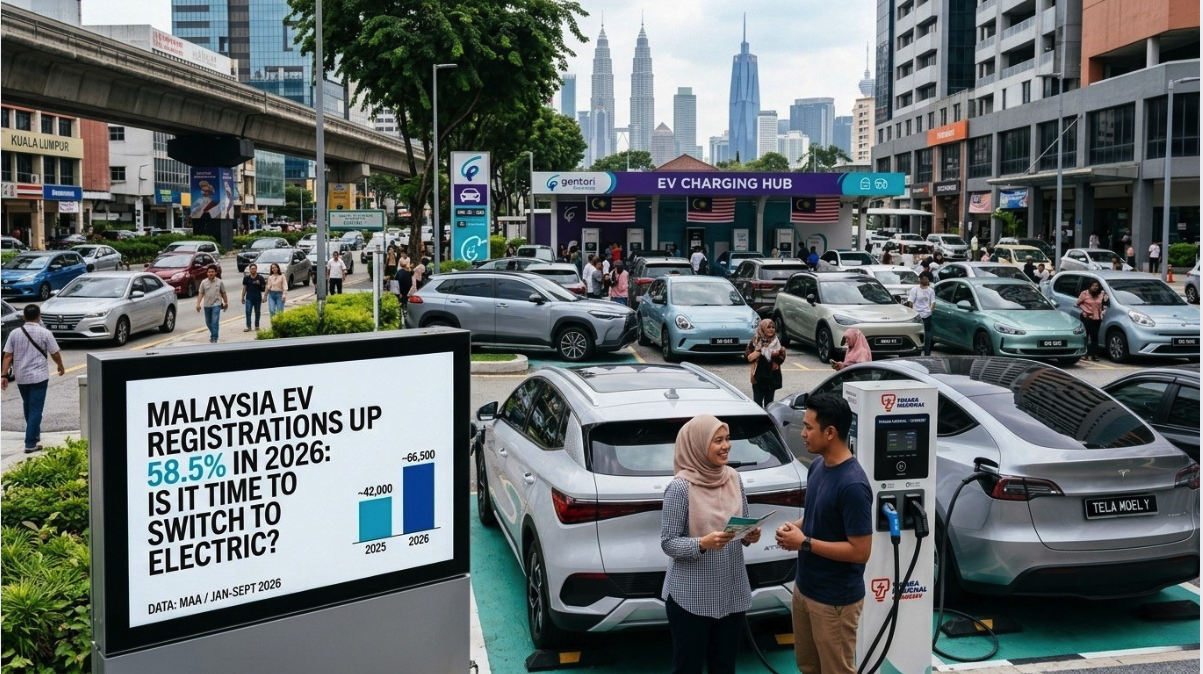
If you have been on the fence about going electric, the numbers coming out of JPJ this year make a pretty strong case for jumping in. In March 2026 alone, 4,717 EVs were registered in Malaysia, a 58.5% jump from the 2,976 units registered the same month last year. And this was not a one-off spike. Every single month in 2026 has told the same story: petrol sales softening, while EVs keep climbing.
So is this just hype, or is there something real behind the numbers that should actually influence your next car purchase? Let us walk through what is happening, why it is happening, and whether it makes sense for you specifically.
The Numbers Are Bigger Than You Might Think
Let us look at the full picture so far this year, month by month, because the trend tells a clearer story than any single snapshot.
| January | 6,239 | Nearly 4x | 9.18% |
| February | 3,635 | +68% | 6.4% (7.9% YTD) |
| March | 4,717 | +58.5% | 6.95% |
| April | ~5,396 | (20,485 YTD) | 110.8% growth YTD |
| May | 5,038 | +21.3% | 7.63% |
By the end of May 2026, Malaysia had recorded 25,523 EV registrations for the year, an 83.99% increase over the 13,871 units registered in the same period in 2025. To put that in context, the whole car market actually shrank during the same window. Total industry volume fell across several of these months while EVs kept growing. That is not a fluke. That is a structural shift in what Malaysians are choosing to drive.
For perspective on how far this has come, just three years ago in 2021, Malaysia sold barely a few thousand EVs the entire year. In 2025, that number hit 30,848 units, a 109% jump from 2024. If 2026 keeps its current pace, industry watchers expect the country could cross 80,000 EV registrations by year end.
Why Is This Happening Right Now?
A few things are converging at the same time, and together they explain why this growth is not slowing down.
Affordable mass-market EVs finally arrived
For years, EVs in Malaysia meant Tesla or premium European brands well above RM150,000. That changed the moment the Proton e.MAS 5 launched. It became the single best-selling EV in the country almost instantly, racking up 3,068 units in January 2026 alone, nearly half of all EVs registered that month. By the end of May, the e.MAS 5 had clocked 9,356 units year to date, making it not just the top EV but a genuine mainstream hit.
This matters because it shows EV adoption in Malaysia is no longer driven only by early adopters and tax breaks. It is being driven by ordinary buyers who simply find an EV cheaper and more practical than the petrol car they would have bought instead.
Petrol prices are biting harder
With Malaysia spending billions of ringgit a month on fuel subsidies, the BUDI95 quota cuts introduced in 2026 have pushed many drivers to actually calculate what they are spending at the pump. Unsubsidised RON95 now sits well above RM3.70 per litre. That gap between petrol cost and EV charging cost is becoming impossible to ignore for anyone clocking real mileage.
Chinese brands are flooding the market with options
It is not just Proton and Tesla anymore. BYD, Chery, Zeekr, MG, Leapmotor, XPeng and others have all entered Malaysia with multiple models across different price points. The iCaur V23 alone climbed into the top 5 best-selling EVs within months of launch, a sign that buyers now have real choice rather than one or two token options.
Road tax stayed manageable even after the exemption ended
The free road tax incentive that ran from 2022 expired on 31 December 2025. Many assumed this would slow things down. It has not. Under the new kW-based road tax structure introduced in 2026, most mainstream EVs still pay well under RM300 a year, far less than equivalent petrol cars. The fear of a financial shock did not materialise, and adoption kept climbing right through the transition.
But There Are Real Headwinds Too
It would not be honest to only show the good news. A few genuine concerns are shaping conversations in the industry right now.
The CBU EV tax holiday ended on 28 December 2025. Fully imported EVs now face a 30% import duty, 10% excise duty, and 10% sales tax, though the rate is lower for vehicles imported from countries with favourable trade agreements, including a reduced 5% duty for EVs from China. Distributors have mostly absorbed this so far using pre-2026 inventory, but once that stock runs out, some price increases are expected within the next few months.
There is also fresh uncertainty around new CBU EV import rules that raise the floor price for imported electric vehicles above RM300,000. If implemented as discussed, this would remove a large chunk of the BYD lineup and similar models from the affordable end of the market, since most of those are imported rather than locally assembled. Whether this directly affects locally assembled models like the Proton e.MAS range remains a separate question, but it shows that policy is still very much a moving target.
Reports have also surfaced that BYD is reconsidering its plans for a local assembly plant in Tanjung Malim due to a lack of long-term clarity on Malaysia's EV taxation framework. For the EV market to keep growing sustainably, the industry has been clear that it needs the government to commit to consistent rules rather than incentives that get adjusted every year.
Charging infrastructure is the other honest gap. While public chargers are expanding in major cities and along key highways, drivers without home charging access, particularly those in older condos or apartments without dedicated parking, still face real friction getting a charger installed.
So Is It the Right Time to Switch?
There is no single answer that fits everyone, but here is how to think about it based on your own situation.
It is a good time to switch if:
You drive mostly within the city or a regional hub like the Klang Valley, Penang or Johor Bahru, where charging access is already decent and public chargers are multiplying. Your daily mileage sits comfortably within the 200 to 400 km range most mainstream EVs now offer. You have access to home charging, whether through landed property or a condo that already supports EV points. You are looking at models in the RM60,000 to RM150,000 range, where most of the actual registration growth is happening, rather than premium imports facing future price uncertainty. You want to lock in current pricing before any CBU import rule changes potentially affect supply or cost for certain models later this year.
It might be worth waiting if:
You regularly drive long distances between states without reliable charging stops along your route, particularly in East Malaysia where infrastructure still lags behind the Peninsula. You are specifically eyeing an imported premium EV that could be affected by the proposed floor price changes, in which case watching how policy settles over the next few months could save you from buying right before a price shift. You do not have any charging access at home or work and would be entirely dependent on public infrastructure for daily use.
What Does the Total Cost Actually Look Like in 2026?
Even with the road tax exemption gone and import duties back in play for some models, the math for locally assembled and mass-market EVs still strongly favours going electric.
A Proton e.MAS 5 Premium owner pays around RM70 a year in the new EV road tax structure, compared to RM90 for an equivalent 1.5L Myvi. Charging costs for typical usage run a fraction of what the same distance would cost in petrol, especially with RON95 now above RM3.70 per litre unsubsidised. Servicing tends to be cheaper too, since EVs have far fewer moving parts that wear out.
Insurance premiums for EVs have adjusted upward slightly to reflect specialist parts and battery coverage, but most mainstream models remain competitively priced against similarly valued petrol cars once you compare total annual running costs rather than just the sticker price.
How to Compare EV Insurance and Get Ready to Switch
If the numbers have convinced you that this is your moment, the next practical step is sorting out insurance and getting your paperwork in order before you commit to a model.
Motorist Malaysia lets you compare EV insurance quotes from multiple insurers in one place, so you know your real running costs before you sign anything. EV-specific policies in 2026 typically cover battery damage from accidents, access to specialist EV workshops, 24-hour roadside assistance including flat battery recovery, and in some cases cross-border coverage if you plan to drive to Thailand or Singapore.
Once you have your new EV, road tax renewal is fully digital through the MyJPJ app, with no physical stickers required since February 2026. Motorist Malaysia connects your insurance and road tax renewal together so the whole process takes minutes instead of a trip to a counter.
With over 1.53 million motorists already using the platform and a 4.9 out of 5 star rating, it is a straightforward way to get the admin side of EV ownership sorted before you even drive off the lot.
Frequently Asked Questions
1. How many EVs were registered in Malaysia in 2026 so far?
By the end of May 2026, Malaysia had recorded 25,523 EV registrations year to date, an 83.99% increase compared to the same period in 2025.
2. Why are EV registrations growing while overall car sales are declining?
Malaysia's overall car market has softened in 2026 due to slower economic growth and rising costs, while EV adoption is being driven separately by more affordable mass-market models, rising petrol costs, and wider model availability from new entrants.
3. Is the Proton e.MAS 5 really the best-selling EV in Malaysia?
Yes. The Proton e.MAS 5 has consistently been the top-selling EV model through most of 2026, registering 9,356 units from January to May, well ahead of the BYD Atto 3 in second place.
4. Did EV road tax become expensive after the exemption ended?
No. The new kW-based road tax structure introduced in 2026 keeps most mainstream EVs under RM300 a year, which remains cheaper than many equivalent petrol cars.
5. Will EV prices go up because of new import rules?
Some imported premium EVs could see price changes if proposed floor price rules for CBU imports are implemented. Locally assembled models like the Proton e.MAS range are less directly affected since they fall outside the CBU import category.
5. Is charging infrastructure good enough to switch to an EV right now?
It depends on where you live and drive. Urban centres and major highways in Peninsular Malaysia have decent and growing coverage. Rural areas and East Malaysia still have more limited infrastructure.
Registration figures are based on official JPJ open data and industry reports current as of June 2026. Figures for April 2026 are estimated based on year-to-date totals reported. Always verify the latest figures via JPJ's official open data portal.
Read More: EV road tax 2026: how much will you pay now that the exemption has ended?
I want to find the highest selling price for my car within 24 hours!
Download the Motorist App now. Designed by drivers for drivers, this all-in-one app lets you receive the latest traffic updates, gives you access to live traffic cameras, and helps you manage vehicle related matters.