Report driving offences to JPJ: Can anyone do it?
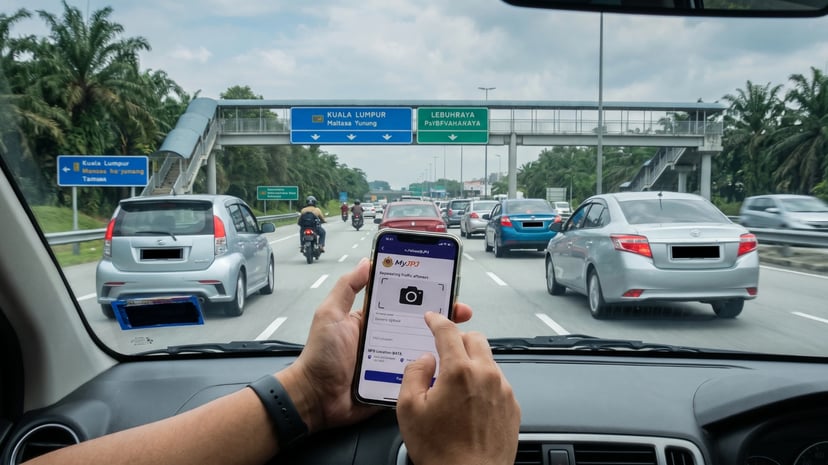
Yes, other road users can report your driving offences to the Road Transport Department (JPJ) in Malaysia. Through the e-Aduan@JPJ function in the MyJPJ application, members of the public can submit complaints about traffic offences supported by photographs, videos or dashcam recordings. However, receiving a report does not automatically mean you will be fined. JPJ must assess the information and supporting evidence before deciding whether further enforcement action is necessary.
Whether you accidentally cross a double white line, use your phone while driving or enter an emergency lane, another motorist may capture the incident on a dashcam and submit a report.
With public reporting channels becoming more accessible, Malaysian drivers should understand which driving offences can be reported, how the complaint process works and what happens after someone submits evidence to JPJ.
Table of Contents
- Key takeaways
- Can someone report your driving to JPJ?
- Which driving offences can be reported?
- How to report traffic offences using MyJPJ
- What evidence does JPJ require?
- What happens after someone reports you?
- Can dashcam and viral videos lead to a saman?
- Can someone report you anonymously?
- How to avoid reportable driving offences
- Frequently asked questions
- Conclusion
Key takeaways
- Members of the public can report traffic offences through the e-Aduan@JPJ function in MyJPJ.
- The Malaysian government lists 13 categories of traffic offences that can be reported through the service.
- Reports may include the vehicle registration number, photographs, videos, location, date and time of the incident.
- A public complaint does not automatically result in a saman because JPJ evaluates the evidence before taking further action.
- Complainants may be required to assist JPJ as witnesses if a case proceeds to court.
Can someone report your driving to JPJ in Malaysia?
Yes. Malaysian road users can report suspected traffic offences committed by other drivers through official JPJ reporting channels.
The e-Aduan@JPJ service was introduced on 1 April 2022 to provide a channel for the public to submit traffic offence complaints.
The service is available within the MyJPJ application, allowing members of the public to provide information and supporting evidence for JPJ's assessment.
This means a traffic offence does not necessarily have to be witnessed directly by a JPJ enforcement officer before it can be reported.
For example, another driver may record a vehicle running a red light, crossing a double white line or using the emergency lane. The recording can then be submitted for review.
However, there is an important distinction between being reported and being found responsible for an offence.
A complaint is not automatically proof that a traffic offence occurred. JPJ must assess the available evidence and determine whether further action is justified.
According to the Malaysian government's official MyJPJ reporting guidance, every complaint is evaluated based on the validity of the information and supporting evidence.
Which driving offences can someone report to JPJ?
Not every driving mistake automatically falls within the available e-Aduan@JPJ reporting categories.
According to the Malaysian government's reporting guidance updated on 31 July 2026, the MyJPJ reporting function covers 13 categories of traffic offences.
| Traffic offence | Example |
|---|---|
| Running a red light | Crossing the stop line after the traffic signal turns red. |
| Driving in the emergency lane | Using an emergency lane to bypass traffic without a permitted reason. |
| Improper overtaking or obstructing overtaking | Making an unsafe overtaking manoeuvre or preventing another vehicle from overtaking. |
| Overtaking on the left | Improperly overtaking another vehicle from the left. |
| Crossing double white lines | Crossing continuous double lines where prohibited. |
| Using a mobile phone while driving | Holding and using a mobile phone without a hands-free arrangement. |
| Non-compliant number plates | Using decorative or modified registration plates that do not meet specifications. |
| Non-compliant tinted windows | Using window tint that does not meet applicable requirements. |
| Not wearing a seat belt or helmet | Driving without a required seat belt or riding without an approved helmet. |
| Disobeying traffic signals | Failing to comply with applicable traffic signal instructions. |
| Prohibited U-turn | Making a U-turn where road signs prohibit the manoeuvre. |
| Vehicle technical offences | Using a vehicle with equipment or modifications that breach applicable requirements. |
| Commercial vehicles continuously using the far-right lane | A commercial vehicle remaining in the far-right lane contrary to applicable restrictions. |
These categories come from the official MyGovernment traffic offence reporting page.
Older JPJ guidance lists nine reportable categories. Drivers should therefore refer to the latest government information and the options available in MyJPJ rather than relying entirely on older instructions.
Other types of dangerous driving may need to be reported through alternative JPJ or police channels.
How to report traffic offences using the MyJPJ app
If you witness a reportable traffic offence, you can submit a complaint through the e-Aduan@JPJ function.
The official JPJ reporting instructions describe the following process.
Step 1: Download and open MyJPJ
Install the official MyJPJ application from a supported app store and open it on your phone.
Step 2: Register or log in
Sign in using your registered JPJ Public ID. If you do not have an account, follow the registration instructions provided through MyJPJ or the official JPJ portal.
Step 3: Open e-Aduan@JPJ
Find the traffic offence reporting function within the application. JPJ's instructions also advise users to enable their phone's GPS function.
Step 4: Choose the relevant offence
Select the category that most accurately describes the incident you witnessed.
Step 5: Provide the incident details
Enter the vehicle registration number, location, date, time and a factual description of what happened.
Step 6: Upload supporting evidence
Attach relevant photographs, videos or a video link showing the suspected offence.
Step 7: Submit your complaint
Review the information before submitting. JPJ's reporting process also requires the complainant to acknowledge their potential role as a witness.
You do not necessarily need to submit the complaint immediately after witnessing the incident.
According to JPJ's e-Aduan FAQ, reports can be submitted later, provided the complainant has the necessary incident details.
Expert tip: If your dashcam records a suspected traffic offence, save the original footage before it is automatically overwritten. Preserve the segment showing the vehicle, incident and surrounding road conditions. Submit the complaint only after you have safely completed your journey and parked your vehicle.
What evidence does JPJ require for a traffic offence report?
Clear and accurate evidence helps JPJ assess whether a reported incident requires further investigation or enforcement action.
The Malaysian government's official reporting guidance identifies the following information as relevant to a complaint:
- Vehicle registration number: The number plate of the vehicle involved.
- Photographs or videos: Supporting material showing the suspected offence.
- Incident location: Where the alleged traffic offence occurred.
- Date and time: When the incident happened.
- Brief explanation: A factual description of the alleged offence.
For example, if another driver records a vehicle crossing double white lines, the footage should ideally show the road markings, the vehicle's movement and its registration number.
A video showing only a number plate without the alleged offence may not provide enough context for JPJ to establish what happened.
Can you submit dashcam footage?
Yes. JPJ accepts photographs and videos as supporting evidence. Its official FAQ also confirms that relevant video links can be submitted.
Dashcam recordings may be particularly useful because they can show the sequence of events before and during an incident.
However, recording quality, visibility, the completeness of the footage and the accuracy of the accompanying information can affect how the evidence is assessed.
Do not edit footage in a way that misrepresents the incident. Providing accurate information is more important than making a recording appear dramatic.
What happens after someone reports your driving to JPJ?
If someone submits a traffic offence complaint involving your vehicle, JPJ may assess the report and supporting evidence before deciding whether further action is required.
The process is not necessarily immediate, and submitting a complaint does not guarantee that a saman will be issued.
1. JPJ receives the complaint
The submitted report contains the alleged offence, supporting evidence and relevant incident details.
2. The complaint is assessed
JPJ evaluates the information and supporting material to determine whether the incident warrants further action.
3. Further enforcement action may follow
Depending on the findings, the matter may result in further investigation or enforcement action under the applicable road traffic laws.
4. The complainant may be contacted
JPJ's FAQ explains that enforcement officers update complaint acknowledgement information and that complainants may receive mobile notifications.
The complainant may also be required to assist as a witness if the case proceeds to court.
Does every reported driver receive a saman?
No. JPJ's official guidance states that further action depends on the validity of the submitted information and evidence.
A complaint alone should not be interpreted as confirmation that the reported driver has committed an offence.
If you receive an official JPJ notice, verify its details through official channels and follow the instructions provided.
Can dashcam footage or viral videos lead to a JPJ saman?
Yes, dashcam footage and other video recordings can provide information that supports a traffic offence complaint.
For instance, footage showing a driver using an emergency lane to bypass congestion may be submitted through the appropriate reporting channel.
Similarly, a recording of a vehicle crossing a double white line or running a red traffic light may be relevant to JPJ's assessment.
However, posting a video online is different from submitting a formal complaint to JPJ.
A viral video may attract public attention, but this does not automatically establish that an offence occurred or that the driver will receive a saman.
JPJ must still evaluate the available information and determine whether enforcement action is appropriate.
Can someone report you using footage recorded days earlier?
Yes. JPJ's FAQ states that complaints do not have to be submitted at the location or time of the incident.
The complainant must still provide the relevant details, including the offence category, vehicle registration number, date and time.
This means a driver should not assume an incident cannot be reported simply because it happened several days earlier.
Can someone report your driving to JPJ anonymously?
Drivers may wonder whether someone can report their vehicle without revealing their identity.
For complaints made through e-Aduan@JPJ, the official process requires the complainant to register or sign in and acknowledge their potential responsibility as a JPJ witness.
According to JPJ's official e-Aduan FAQ, a complainant cannot refuse to become a witness solely because they are concerned about their information being disclosed if their testimony is legally required in court.
This means the reporting process should not be treated as an anonymous complaint system that guarantees the complainant will never be identified.
However, that does not mean every reported driver will automatically receive the complainant's personal details.
Questions about access to complainant information or disclosure during legal proceedings should be directed to JPJ or the relevant authorities.
It is also important to distinguish between submitting a genuine report and deliberately providing misleading information.
Members of the public should submit accurate complaints supported by authentic evidence rather than making accusations based on personal disputes or incomplete assumptions.
How to avoid driving mistakes that could be reported to JPJ
The best way to reduce the risk of receiving a traffic summons is to practise safe driving and follow Malaysian road traffic regulations consistently.
Follow traffic lights and road markings
Stop at red traffic lights and obey double white lines, turning restrictions and lane-direction arrows.
Avoid using your phone while driving
Set your navigation before starting your journey and use appropriate hands-free arrangements. Do not pick up your phone while stopped at traffic lights or in congestion.
Never misuse emergency lanes
Emergency lanes are intended for emergency situations and authorised uses. Do not enter one simply to avoid a traffic jam.
Use the correct lane
Plan lane changes early and avoid sudden overtaking, cutting into queues or blocking other road users unnecessarily.
Keep your vehicle compliant
Ensure your number plates, window tint, lighting and other vehicle components meet applicable JPJ requirements.
Wear the required safety equipment
Use seat belts and approved motorcycle helmets as required by Malaysian road traffic rules.
These habits help improve road safety while reducing the likelihood of committing offences that could lead to enforcement action.
Common mistake: Assuming that driving offences only matter when a police officer or JPJ enforcement officer is nearby. Other motorists may capture reportable offences using dashcams and submit evidence through official channels. Follow traffic rules consistently, regardless of whether an enforcement officer is visible.
Frequently Asked Questions
1. Can another driver report me to JPJ in Malaysia?
Yes. Members of the public can report suspected traffic offences through the e-Aduan@JPJ function in MyJPJ or other official reporting channels.
2. Can someone report my car using dashcam footage?
Yes. Dashcam footage can be submitted as supporting evidence for a traffic offence report. JPJ evaluates the information before deciding whether further action is necessary.
3. What driving offences can be reported through MyJPJ?
The government's July 2026 guidance lists 13 reportable categories, including running red lights, using a mobile phone while driving, crossing double white lines, emergency lane misuse and non-compliant number plates.
4. Will I automatically receive a saman if someone reports me?
No. A complaint does not automatically result in a summons. JPJ assesses the submitted information and evidence before determining whether enforcement action is appropriate.
5. Can someone report a traffic offence several days after it happened?
Yes. JPJ allows complaints to be submitted after the incident, provided the complainant has the necessary offence details, vehicle registration number, date and time.
6. Can someone report me anonymously through MyJPJ?
The e-Aduan@JPJ process requires a registered user and acknowledgement of potential witness responsibilities. Complainants may be required to participate in court proceedings, so anonymity is not guaranteed.
7. Can someone report me for using my phone at a red light?
Yes. Using a handheld mobile phone while driving is one of the reportable offence categories. The restriction also applies when a vehicle is temporarily stopped at a red traffic light.
8. Can someone report me for crossing a double white line?
Yes. Crossing double white lines is among the traffic offences that members of the public can report through e-Aduan@JPJ.
9. Can I check whether someone has reported my vehicle?
JPJ provides official services for checking summons and related driving records. However, a general public-facing facility for checking every complaint submitted about a particular vehicle is not confirmed by the cited guidance.
10. What should I do if I receive a JPJ saman after being reported?
Verify the notice using an official JPJ channel, review the alleged offence and follow the instructions provided. If you believe there has been a mistake, contact JPJ to clarify the appropriate procedure.
11. Can I report dangerous driving without using MyJPJ?
Yes. JPJ has identified other official reporting channels, including [email protected]. For immediate emergencies involving injury or danger, contact the emergency services instead of relying on a routine complaint.
12. Is there a fee for reporting traffic offences to JPJ?
The Malaysian government's digital service listing, updated on 20 October 2026, describes the online traffic offence complaint service as free of charge.
13. Can I send a video link instead of uploading dashcam footage?
Yes. JPJ's official e-Aduan guidance states that a relevant video link may be submitted as supporting evidence for a complaint.
14. Can the person making a report be called to court?
Yes. JPJ states that complainants may be required to act as witnesses if their testimony is necessary during court proceedings.
Conclusion: Your driving can be reported even when JPJ is not around
Yes, someone else can report your driving offences to JPJ in Malaysia. Through e-Aduan@JPJ, members of the public can submit information and supporting evidence about suspected traffic violations.
However, being reported does not automatically mean you are guilty or will receive a saman. JPJ must assess the evidence and determine whether further action is justified.
With dashcams and public reporting channels becoming part of everyday motoring, the safest approach is to follow traffic regulations consistently, respect other road users and avoid unnecessary risks.
For a more convenient car ownership experience, download the Motorist App to explore useful motoring information and car ownership services in Malaysia.
Read More: How to report dangerous driving via eAduan@JPJ
I want to find the highest selling price for my car within 24 hours!
Download the Motorist App for a more convenient car ownership experience.


